


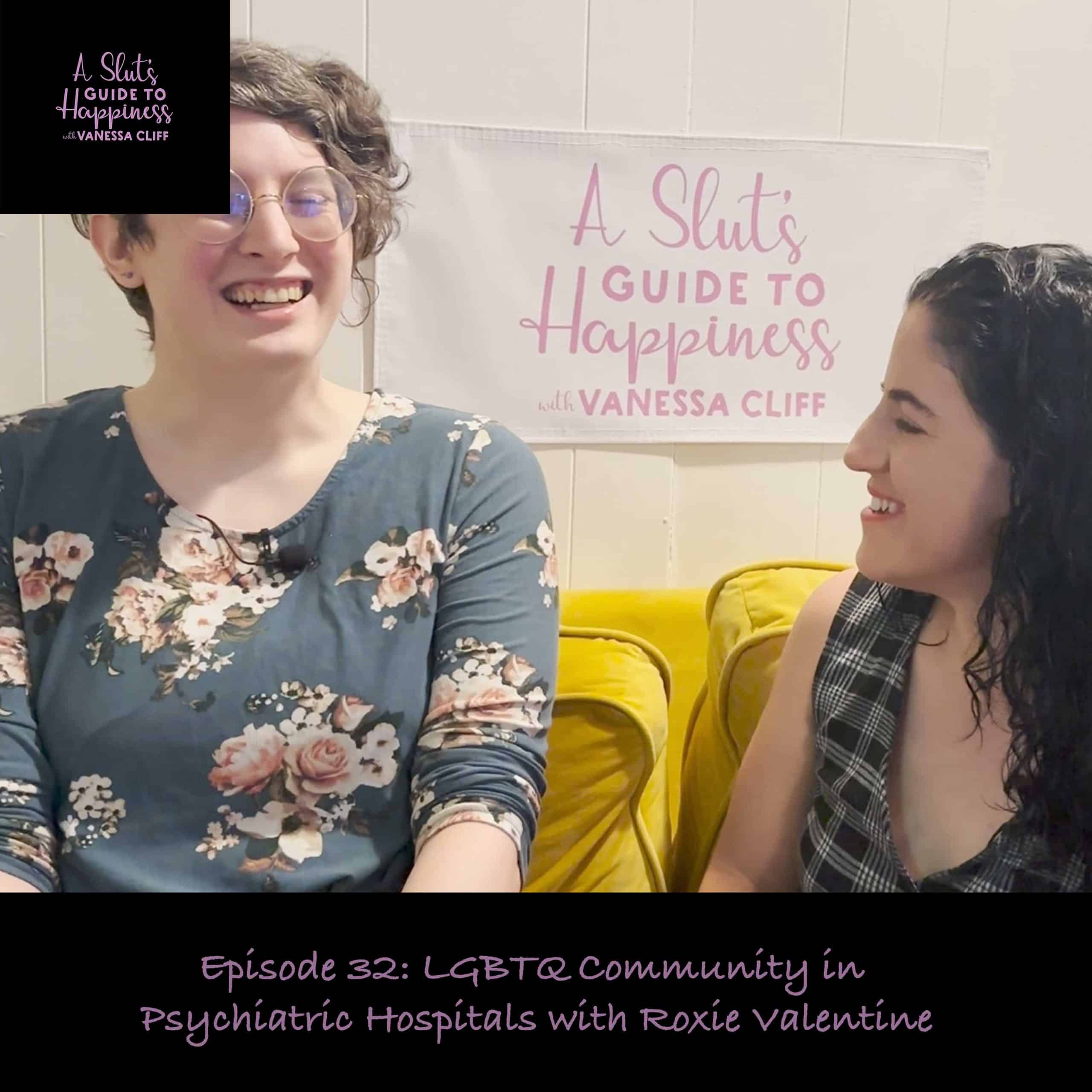
For LGBTQ people, the stressors of homophobia and transphobia, financial hardship caused by rejection from family or employers, trauma, shame and fear all contribute to high rates of depression and mental health crises. Inclusive mental healthcare can be a critical lifeline. Yet, many LGBTQ people report discrimination in accessing care, including denial of care, harsh language, or treating their sexual orientation or gender identity as the cause of their illness.
Based on her recent personal experience in a psychiatric hospital, Roxie, a trans woman, describes connections made among LGBTQ patients and the role these connections played in creating a healing environment. Especially in areas with less access to LGBTQ-affriming mental health care, Roxie’s experience demonstrates why it’s important for ally providers to allow LGBTQ patients to talk with each other, including about subjects that may be relevant to their sexuality or identity.
Welcome back to A Slut’s Guide to Happiness, where your body is perfectly imperfect and it’s safe to be as sexual, kinky, queer, or slutty as you want.
Today we’re going to be talking with Roxie Valentine, who is the chaos queen of Cliff Media, our queer and female-led porn production company rooted in community organizing.
Roxie is a wealth of beautiful energy that stirs up some excellent chaos. She is also a proud trans woman and leader, and has previously talked with us about her experience in a gangbang scene that we did together, which was super hot and beautiful.
Today, she is going to be talking with us about another really powerful subject that’s maybe a little bit more serious. I can’t wait for you all to dive in with this beautiful woman.
I’m going to give a little bit more background before I get started. Today we’re talking about mental health, especially in the LGBTQ community and how that is approached in mental health care settings.
We have been exploring the leadership of people with disabilities increasingly in this media and for some people, that’s very visible. Right. And the experiences of discrimination may be a lot more. For example, there is one person that is an incredible leader with Cliff Media, who has paraplegia and uses a wheelchair as a tool of increased independence in his life. He recently created a scene, where he was talking a lot about his experiences, both of discrimination and how he reclaims his independence. That was just incredible.
In a situation like that, it’s a very visible disability. There are also many invisible disabilities. That includes cognitive disabilities and mental health. One of the things that’s really critical, I think, in our organizing work and in general in the world, is understanding that intersection of LGBT identity and mental health.
Especially in communities where there’s more homophobia and transphobia, this idea that being queer, LGBTQ, is the cause of mental illness, that it’s an illness itself or a disorder. Of course, if you’re listening to this podcast, you probably already share the same sentiment that that’s not the case. It’s a thing that I would love for people to more widely understand.
And at the same time that it is not inherently a mental illness at all, being LGBTQ is also correlated with increased levels of mental health challenges.
Homophobia and transphobia can bring up discrimination, family rejection and rejection from peers. The increased difficulty and discrimination can lead to lower income and economic stress in communities.
We see that especially in young people. Although we know coming out can be incredibly powerful and good for mental health, because then you can be yourself and don’t have to hide anymore, but it can also lead to increased discrimination.
LGBTQ young people experience six times the rate of suicidal ideation or considering taking your life compared to the rest of the teen population. Six times the rate. That is incredible to think about. That is a mental health crisis in our community, and that doesn’t necessarily go away as people get older.
There’s that phrase, “It gets better.” And sure, yes, you find people, you figure out how to live your life outside of the situations in your early adult life or teen life where you may have been rejected. But there is such continued discrimination and other aspects of challenge that relate to higher rates of mental health concerns.
For example, survey research finds that about half of trans adults have thought about taking their life, and 67% of LGBTQ people reported needing a mental health service over the last two years, compared to just 39% of non-LGBTQ people. Those statistics do not reflect the number of people who seek out or use the mental health care services.
The reason for that is there’s lots of discrimination of course, also because it’s part of society in the health care professions, people have much higher risks of experiences of harsh communication, discrimination, of the perception that mental healthcare services are not needed or that the sexual orientation or identity itself is the cause of the illness and somehow needs to be treated itself.
So there’s a lot of fear of accessing mental health care services in our community. This is part of why I think Roxie’s perspective that she has been sharing with me in her recent encounters with mental health care are so critical. When people need mental health care resources, especially people who have faced rejection from their family or friends, community or from the workplace, need support to fall back on and need support that is going to meaningfully heal rather than re-traumatizing.
One of the things that’s really powerful about Roxie’s experience that is important to me, and that is it does not mean that it’s not universal, is that it happened here in a bluer city. It’s important to note that, of course, there is still homophobia and transphobia here because this is the society we live in. It’s not a it’s not a utopia.
But there is more consideration and at least awareness and desire to do better for LGBTQ community here compared to, for example, some more conservative areas in rural areas, areas in the American South, places where there’s less intentionality around acceptance of trans, queer, and LGBTQ lives.
So with that in mind, I’m really excited to learn from some of the experiences that Roxie has, and also noting that one of the reasons that I think that she had this experience is part of Roxie is, personality and previous experience and community that allowed her to seek out and facilitate these, healing opportunities within the hospital.
Before we get into your experience of really valuable connections that you facilitated while you were in the hospital, I actually want to start in a kind of unexpected place because it was it was funny to me while you’re explaining it.
You were actually connecting in that environment with a couple of people that you normally would make assumptions about as people that are not necessarily part of your safe community. Can you describe some of that?
Roxie:
Yeah, absolutely. There were actually two people who ended up being very, very strong supports for me when I was in the hospital. I didn’t expect them to be. They were both white, cis males. Very blue collar types. We love blue collar workers around here. But I have personally faced difficulties with said type. I feel trepidation when engaging with them.
When you have enough circumstances and experiences, you start to watch out for certain types of people. It could be any type of people that you’ve had negative experiences with.
So I went in and I had certain prejudices about these two. We’ll call him bear. He was a very large guy. Bear had a very thick drawl and was a very masculine guy. They both were.
What opened my mind was that Bear at one point shared just what his favorite season was with the rest of the group. But his words were so evocative and powerful that everyone was taken away for a moment to this crisp fall day. It was poetry. And I told him that. He was like, I don’t know if it was poetry. But I said, no, that was poetry.
And Bear turned out to be an excellent companion when I was feeling really down about some things. He was the heart and soul of many people’s experiences there. He encouraged everyone. I like there was one slip up, and he immediately begged for forgiveness. He was like, I am so sorry. And I told him you know, we are not looking for perfection.
I understand that the society that he runs in has certain terms for things that aren’t always politically correct [pc]. But I forgave him on the spot multiple times because I’m like I realize that this is a societal influence on you and it isn’t an indicator of who you are.
I think we were able to have, we were able to build this connection because being in psychiatric hospital, you can recognize that everyone else around you is also feeling very soft and fragile at the moment.
Vanessa:
Yeah. And you, you want to give other people grace that you would, that you might not normally. You recognize that you’re in similar places. So you already have a very powerful common denominator.
Roxie:
Yeah. And, you know, I went in with certain prejudices and I came out more evolved.
Vanessa:
I think one of the things that I hear that’s really beautiful about that is, even though that those people were maybe necessarily the core of your experience there and the the connections that you made, that, that, that being in the hospital allows people to share what is also true for all of us that we have.
We have this iceberg, tip of the iceberg that other people see. And beneath that, like all of us have our stuff. Maybe it’s sometimes coming up more than others, but there’s sadness, there’s anger, there’s trauma. There’s all those things that we’re dealing with and it’s beautiful that like in that moment of your experience in the mental hospital, people are able to be more vulnerable and honest about that and that it allows for you to cross identity.
I’m also hearing that even outside the context of queer connections that we’ll get into, the fact that you were able to assert yourself but in a loving, forgiving way allowed you to cross identity for this connection.
When I take a little step back into the extent you feel comfortable, if you could share some of the life experiences and triggers that led to that beautiful, brave choice to go into the hospital to take care of yourself.
Roxie:
There were multiple stressors that happened all at once, which is often the case. Life comes at you fast sometimes. There was one acute trigger, and there were a couple of more persistent triggers. Which would you like me to lead with?
Vanessa:
You’ve shared some things with me that I think are common for queer folks. Do you want to talk about those in particular?
Roxie:
So one big issue for me is, I don’t have much of a support network. There’s you, of course. And to put it bluntly, family is a four letter word for me. I have a lot of difficulties with my family. They have said that they are very supportive of me, but sometimes their actions have not shown that. I don’t feel understood by my family. And I don’t feel like they make a lot of effort to understand me.
And that has led to a lot of difficulties. I have been subjected to a lot of abuse by my family. For the purposes of this, I don’t think I’ll get into. You’d have to add a lot more trigger warnings. But you know, family’s very difficult. I love them, and I want to have a good relationship with them. So that just makes it more difficult when I get hurt by them.
Vanessa:
As you struggle with family, when there are triggers that come up at work, housing and financial support isn’t as available to you as it might be to some people.
Roxie:
Right. I basically feel like I can only count on myself, when things are unstable. And financial instability has been a big stressor for me.
The classic tale of you makes just enough to scrape by, but not enough to really live and too much for government assistance. That has been my experience. Then in the middle that a lot of people live, that just is hard and a constant pressure on you that is hard to sustain.
Vanessa:
Absolutely. Yeah. You had described that, very early on in your experience, I think it was maybe the first day that you were in the psychiatric hospital that you had connected with a trans woman. I think you said you two connected during that time as you were just beginning to get comfortable in the hospital. Can you talk about how you bridged that connection, how you all talked about having a similar experience or initially connected and why that was important or healing to you?
Vanessa:
So I’ll start with this. First of all, your first day in any hospital, but especially a psychiatric hospital is going to be the hardest. They’re going to ask you a ton of questions about why you’re there. You might have to explain that multiple times. And you’re in a new environment. You don’t know anyone there. You’re very fragile when you come in. It is absolutely the hardest day.
I have developed a trick where I will find the person who I immediately have some kind of obvious connection with. And I kind of glue myself to that person just for the first day. Mind you, you may not want to be social that first day. I spent a lot of time in my room, but when I was out, I thought this person felt safe. This person, I feel like I can be safe around and be as close to myself as I’m willing to be at this moment.
Vanessa:
I think that’s a really powerful thing to dig into a little bit more. I feel like sometimes there’s, especially for people who are not marginalized communities, there’s some lack of understanding of why that’s important for your feelings of emotional safety. Can you share a little bit more about why you felt that being with someone who was also a trans woman?
Roxie:
I latched onto a fellow trans woman, at least temporarily, because we have a shared sense of community. I feel, as trans people, we have gone through similar circumstances. Many of us, not all, but many of us struggle with dysphoria.
Vanessa:
For viewers, can you help understand what that means, dysphoria.
Roxie:
Gender dysphoria is where, your body, your appearance, who you are on the outside doesn’t match who you are on the inside specifically relating to your gender. Gender dysphoria is insidious. It works its way into your head and it’s very hard to spot sometimes, but when it releases, you realize, wow, that’s been with me this whole time.
Vanessa: :
So that was one of the things that the two of you connected over?
Roxie:
Right. Yeah. Right. And being both queer people, that’s an additional sense of community.
It doesn’t have to be a fellow queer person. My first trip to a psychiatric hospital ever, my main support person was a cis straight woman. But she had this overflowing positivity. She greeted me first. She made me feel welcome.
I try to do that myself whenever I’m in that space. Because someone had helped me in the past, and I want to be a help to other people.
But especially on your first day, it’s not expected. You don’t have to put yourself out there until you’re ready.
Vanessa:
For sure. That feels like a really good love lesson to people who are struggling with how to be in the hospital in a kind way, while also still feeling really messed up inside?
Roxie:
One thing I wanted to touch on is that, I have experienced multiple trips to psychiatric hospitals, and there’s almost always another queer person there, but they may not feel comfortable expressing that. Being yourself comes in all sorts of different ways.
One trans person that I met there was stealth. For those who don’t know, stealth is when you’re trans, but you don’t disclose that you’re trans to anybody. “Passing.” They were passing. It was by pure coincidence that I figured it out.
I asked them about it and they asked me not to talk about it. I said, that’s totally fair. Being out is not a positive thing for everyone at that particular moment in their lives. For some people, being out is a constant question. You never stop coming out, but you don’t have to come out except for when you want to.
Vanessa:
Oh, that’s so powerful that it’s not like there’s this moment in life that now I’m in the closet. I’m not out of the closet for everybody. It’s like moment by moment, space by space. You make that choice when it feels safe.
Roxie:
Absolutely. You have to make that decision for yourself.
Vanessa:
This is not at all a judgment on people who don’t want to be out. But it does feel like the fact that you are so out and proud about who you are in a lot of spaces, helps to create safety for other people. Being able to disclose to you and build those connections.
I want to jump into this experience that you described. That was just when you were talking about it on the way home from the hospital, it was like, oh my God, this is amazing that you were talking about multiple queer people that you encountered and the connections and deep emotional sharing that you had there.
Can you describe some of what happened and also how you forged those connections there?
Roxie:
One thing I’ll say, if you’re in a psychiatric hospital, go to the groups. Most psychiatric hospitals will offer collective group therapies where they’ll, you know it might, it might be as simple as art therapy where you just color and listen to music.
It might be as difficult as a process group where people share the issues that have been plaguing them. Other people will relate and talk about their own lives. I think that right there, relating to other people knowing that you’re not alone, being able to share your own struggles to whatever extent you want to and having people understand because they’ve been in a similar place is so powerful.
So no matter what, if they offer groups, if there is a chance to socialize with other patients, I think people should take that opportunity. It can be scary at times, but to find community in a really dark place – not that psychiatric hospitals are dark places – I’m referring to the dark place of the mind, Is powerful. Community is powerful.
As queer folks, I think that’s one of our biggest strengths, is being able to forge that community.
Vanessa:
To the extent you feel comfortable sharing while respecting people’s privacy, I was just surprised by the number of people that you identified, like this was a trans woman, this is a lesbian, etc, can you describe in general terms what queer people you met while you were there?
Roxie:
Let’s see, I met that that stealth trans person, I met at least two open trans women. I met a lesbian. I met a non-binary person.
I met someone who was just coming to grips with being non-binary. Well, they had that revelation while we were there, while we were talking about surgeries and they mentioned wanting a breast reduction and they connected that with dysphoria. That had happened starting when they hit puberty, but they had never been out about it. Yeah. They had never really made those connections in their head.
Vanessa:
It sounds like you were openly talking, queer folks there together were openly talking about some of these experiences of gender dysphoria or other other identities that perhaps because it was safe was amongst you or in that environment to talk about that, that made it easier to help people process through these new things.
Was there any way in which the mental health professionals who were there responded to your identity specifically, or just like the fact that you all were talking about this, was there acceptance and allowance for that?
Roxie:
At one point, I expressed frustration to the staff that we did not introduce ourselves with our pronouns, which is something that I have experienced at other hospitals, and I asked them to start doing that.
Not everyone started with their pronouns. And we had a few people say, “What are pronouns?”
Vanessa:
I love that teaching moment.
Roxie:
But they agreed right away. They’re like, that’s an excellent idea.
I have been misgendered by staff before, on this occasion and once before, on a previous visit to a different hospital. But health care staff here are very on top of that. If they misgender you, they’re usually very apologetic.
If they’re not apologetic, you are well within your rights to bring that up, to take it higher because that is part of their job to acknowledge you using the correct pronouns, acknowledging someone’s identity.
It’s part of mental health and emotional health.
Vanessa:
I was just reading a study before we sat down from the Mental Health Association of America that was talking about the incidence of people who are correctly gendered is directly linked to the rate of mental health among trans folks.
I think one of the things that you’re describing that I hear that is so powerful is like, fortunately, you are in a place that happens to be located in a blue city, in a blue state where there was more conversation and awareness about it. But also you’re encouraging people and you can take that step to whatever extent you have the emotional capacity to do or experience, to go higher up and to say like, this is part of quality mental health care. You need to respect our pronouns and identity.
So another thing that I thought was beautiful is as you’re coming out of the hospital, you were talking about how you had this connection between like in the hospital. There’s this beautiful queer community around on the regular throughout the day and then coming out. You want to continue that experience.
Roxie:
Yeah.
Vanessa:
We have times in Cliff Media where we have queer community get together, but you wanted lots more spaces in life with queer community, like a queer choir that you want to join.
Roxie:
Yeah, there are multiple blue states that have queer choirs, whether it’s gay, lesbian, there’s even a northwest queer chorus here that I found. So it’s one thing I wanted to pursue.
One thing that I found very helpful to me in the hospital was music therapy. The music therapist would be playing a song either on guitar or through a speaker. They offered that we could sing along. I love singing, and I joined in with almost every song, every one that I knew at least. Many other people did, too. And I found that very healing.
And I want to link that with queer community by finding a, if not LGBT friendly, then an LGBT focused, choir in, in my local area. I found a website with a quick Google search that listed all the choirs in the area, and there were multiple, LGBTQ choirs and even though some of them were specified to be like gay choir, lesbian choir, I don’t think I found a trans choir, actually, but many of those choirs were open to all walks of life.
Vanessa:
One thing I’m hearing is that there are aspects of queer community and joy that are in and of themselves feeling that like we could get together and talk about depression and we can get together and sing and all of that is good and useful.
And the other really core thing that I have learned and heard from what you’re describing is listening to patients, to their needs, to their connections as healing and valuable. Because I think a lot of times the medical profession believes they have the answers, they have the medication, they have the diagnoses, they can tell you what to do.
And actually those connections that you were making with peers were really powerful and healing. I think that’s an important lesson for mental health professionals seeking to support LGBTQ people, is following the guidance of what your experience.
As we close out, I want to leave a love note to other LGBTQ folks. I think especially outside of areas where there’s more conversation about this, the importance of LGBTQ informed care, is how you survive, how you advocate for yourself and create those kinds of connections or that kind of access to mental health services that can be healing and productive.
Roxie:
You touched on something that I want to, kind of talk about is that self-advocacy can be so important, and especially in those spaces, often, you have to lead your own recovery. And that can be as small as going to those groups even when it’s very difficult. Or it can be as big as, you know, telling them exactly what you need from them.
I was very vocal as a patient about what I needed. And sometimes they do something and you have to accept that not every facility has all of the resources at hand. But ask. The worst they can do is say no. Go to groups, find that community. As difficult as it is, being brave is crucial.
Bravery is not the lack of fear. Bravery is doing things that are scary, even though they’re scary.
Vanessa:
Yes, I love it. Yeah. Thank you, actually, for sharing your experiences. And your bravery and being out there, even in a moment where you were feeling bad, you were still able to put yourself out as yourself. You advocated for yourself. But you were also creating space for other queer people in the hospital to have a more healing experience, which is beautiful.
Thanks for sharing your perspectives Roxie. And listeners, thanks for tuning in.
I hope if you’re a queer person going through a mental health struggle, which is so common, that you related to some of these things. If you are a mental health professional, I hope you gained a little bit of insight on how to support LGBTQ people who are going through mental health crisis.
This has been another edition of A Slut’s Guide to Happiness with your host, Vanessa Cliff, and our beautiful guest today, Roxie Valentine.
You can find us wherever you get your podcasts, including Apple and Spotify, as well as on Clif Media’s website. cliffmediaproductions.com.
Please help us out by liking and sharing this podcast. Stay tuned for more deep dives into beautiful, fun, messy waters.
If you’re over the age of 18, you can check out our video content on our website, including this Chaos Queen doing some amazing work, on cliffmediaproductions.com
And most of all, I invite you to join us in the pleasure of being awkwardly human, naked and without pretense.
Let’s get free.












Materials found in this section may be sexually explicit in nature. To view materials on the site, you must affirm all of the following:
I am at least 18 years of age (21 in some localities). Any sexually explicit material I am viewing is for my own personal use and I will not expose minors to the material under any circumstances. I do not find images of nude adults, adults engaged in sex, or other sexual material to be offensive or objectionable and I desire to receive and view sexually explicit material.
The viewing, reading and downloading of sexually explicit materials does not violate the standards of my community, town, city, state or country. I am solely responsible for any false disclosures or legal ramifications of viewing, reading or downloading any material on this site.
This website and its affiliates shall not be held responsible for any legal ramifications arising from fraudulent entry into or use of this website. This warning page constitutes a legal agreement between this website and you.
All models, actresses and actors whose images appear on this site are over the age of 18. Bookmarking to a page on this site whereby this warning page and/or terms and conditions are by-passed shall constitute an implicit acceptance of the terms and conditions herein.