


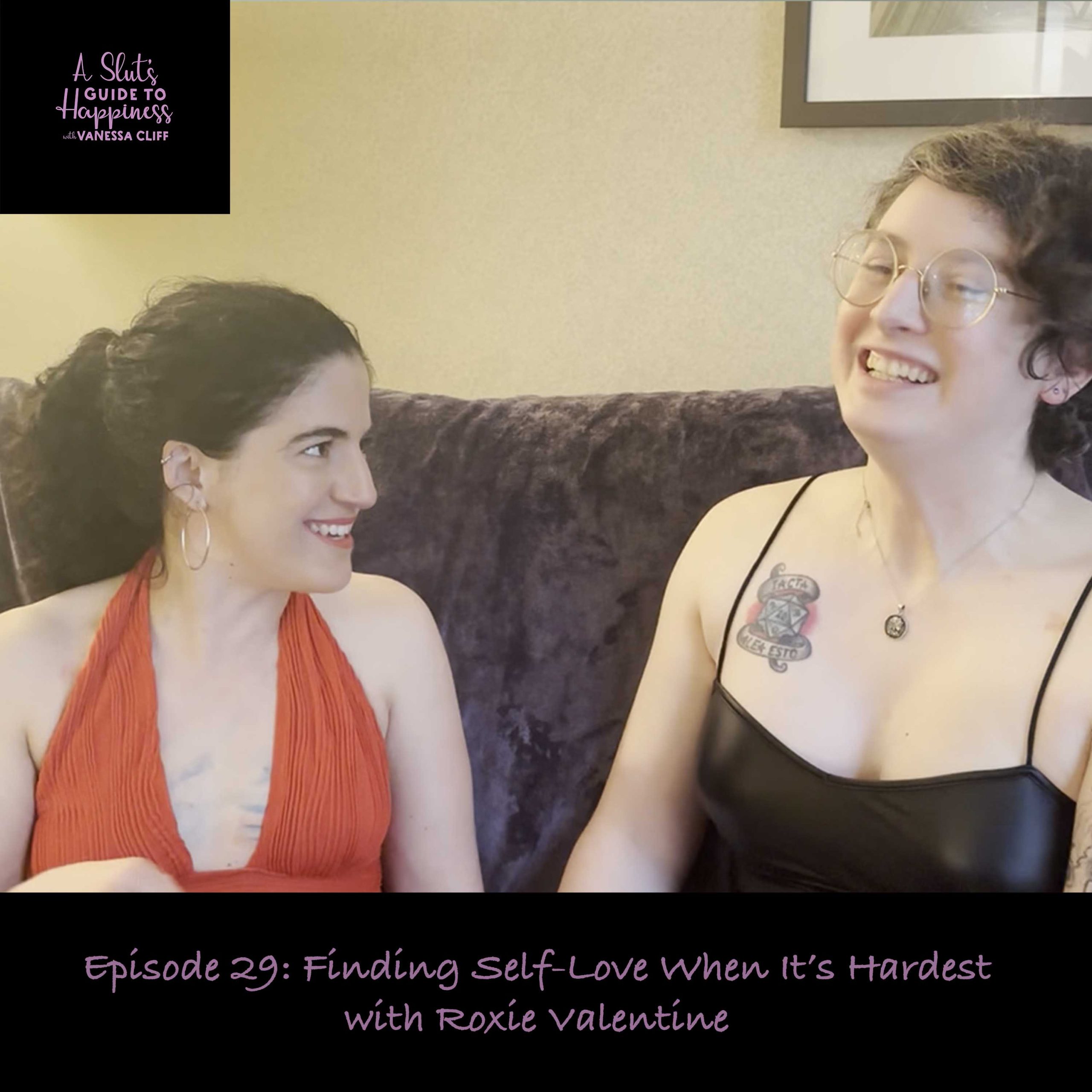
We all have moments in life that throw off our self-esteem, where it feels impossible to believe we’re loveable, smart, good, desirable, worthy. Those moments of self-doubt don’t go away, but we can breathe through them, lean into them, and find ways to get free on the other side.
In this episode, Roxie talks about her experience of deciding to come out as a trans woman, in spite of her ex-wife’s opinions about it. In order to regain footing in her life, especially at a time when she wasn’t surrounded by queer community and had minimal support for her decision, Roxie had to embark on a journey of learning radical self-acceptance.
From this experience, Roxie offers approaches to loving yourself in any tough moment of your life, including better self-talk, giving yourself grace, and practicing the golden rule inverse, that is treating yourself as you treat others.
Welcome back to A Slut’s Guide to Happiness, where your body is perfectly imperfect and it’s safe to be as sexual, kinky, queer, or slutty as you want.
I’m super excited to be joined today by Roxie Valentine, who is an incredible pornstar and director, and proudly a trans woman and amazing community member. We also are in the middle, smack dab in the middle of an incredible weekend, where a bunch of queer folks from three different states have come together to produce seven group scenes in a weekend of love and collective growth
We just did a scene – I intentionally didn’t change for you all – so you get to see some of the residue of our amazing scene celebrating our bodies in all the different ways they are by putting paint all over our favorite parts of our bodies.
Because I like lots of different parts of my body, I don’t know if you can see, but I have paint over my chest and my legs and everything else that’s currently covered by clothes in this SafeForWork podcast.
And then it turned into a big orgy, as our shoots do, because sexuality is one of the many beautiful ways that we express our connection to each other and who we are in the world, and how we experience joy.
Roxie is also part of the leadership team of Cliff Media. She helped to put together this weekend and many others, and identifies as our Chaos Queen.
As a company, we invite folks into joyful, sex-positive spaces where we film silly, loving porn scenes and work to undo junk stereotypes about which bodies are desirable, who is worthy of love and model more inclusive love.
While queer and trans people make up our leadership team, we invite all goodhearted people to join our shoots and lift up this collective exploration through wholesome smut, sharing online for the whole world to see. This takes huge bravery, and in many ways it’s about getting naked, not just physically, but also emotionally to share the truth of who you are.
On today’s podcast, Roxie is going to talk about some deeply personal experiences, sharing the truth of who she is, finding self-love when it’s hardest.
I know we all have moments in life that throw off our self-esteem. I’ve had a lot of them where it feels impossible to believe that I’m lovable, smart, good, desirable, worthy. Those moments of self-doubt don’t go away.
The mind will never be done returning to the narrative that we’re not good enough. We’re never going to reach a point in our life where we just are done with experiencing self-doubt. I wish. But we can learn strategies to breathe through those thoughts, lean into them, and find ways to get free on the other side.
Roxie, I’m so grateful that you’re joining us today.
Roxie:
Thank you.
Vanessa:
The way you take up space in a room, the way you own who you are is incredible. And I’m excited to be able to share that with people, and for people to learn from some of the journey that you took to get where you are today, in the self-love that you express and exude who you are from your spirit today.
You were recently telling me about one of the hardest moments in your life. I think we started this conversation while we were in a group of people naked in a hot tub, as it goes in our community.
Roxie:
Yep, yep.
Vanessa:
Can you share with our listeners what happened for you in that tough period of your life?
Roxie:
This happened when I was married. I found out that I was a trans woman after we had gotten married. And I came out to my wife at the time, and she was shocked and taken aback and hurt and not okay with it. So for reasons that I don’t want to discuss here on the podcast, I did end up delaying my transition for her, for multiple years, for about three years.
I had told her, we’ll take this at your pace and we’ll make sure that you’re comfortable. But it was exacting a huge toll on me to keep denying this very fundamental part of myself when I was so joyful about wanting to express it.
It all came to a head where, content warning, I tried to un-alive myself. The next morning, I checked into mental health inpatient. It took me a while to get back on my feet.
I discovered that I had two choices. I could either continue to live this supposedly ideal life with my wife and keep making the American dream happen, white picket fence and everything. Or I could embrace who I actually was.
It was a very easy decision after I finally had it laid out in front of me. I told the therapist that I was seeing that parts of my transition made me feel like I was flying. Like bursting with joy.
Vanessa:
So part of that decision was not necessarily some kind of intellectual contest. It was leaning into your gut. One option makes you feel like flying. That’s incredible. That’s how you chose what you wanted in your life. Listening to that gut feeling.
Roxie:
I’ve learned after that to go with my gut a lot of times. Before that, I was someone and I’m still recovering from this, but I was someone who would give up anything for my partner. I realized that there are some things that I can’t give up. My self-worth, my self-image is one of those things.
Vanessa:
So for three years, you were struggling with not being able to be out and transition, but also not feeling good about yourself, until it came to a head and you hit rock bottom. It sounds like that’s what you needed. What was going on in that moment, when it was the hardest?
I’ve been in a mental hospital too, and I’m really grateful for that period of time in my life, for hitting rock bottom and having some systems of support to catch me. And, I know that it’s like a really hard, messy space to be in. How did you go from being unsure about what’s going on to making such a huge, confident change in your life?
Roxie:
I think part of what did it was that I wasn’t socially out to friends at the time, but when I went into the hospital, I was out there. I was like, you need to call me, the name that I was going by at the time. My pronouns are she / her. And having everyone just 100% except me.
At home, I wasn’t getting that acceptance. It really illustrated for me that this is something that I can have. My ex-wife was very afraid for me. She was afraid that I would be hurt, that I would not be accepted, that we as a couple wouldn’t be accepted, or that we would become her. But all that I found when I opened my heart to these strangers was acceptance – acceptance into women’s spaces and acceptance into being me.
That made me feel like, I can do this. I can do this in the real world. It cast away my doubts. And I was like, I’m going to do it. I don’t care if it hurts. I don’t care if it takes a while, I’m going to do it.
Vanessa:
That’s incredible. One of the things that I hear in there is that, before you had fully decided whether to be out in the world, you went into the hospital identifying as a woman, asking to be called by a certain name and identifying the right pronouns. And then you found that in that, in that self-loving choice when you went into the hospital, you were received with love.
That isn’t always going to be the case, but I think it’s true more often than not that if you’re putting out into the world – here I am, so wild and free – that teaches people how to love you. You were setting that standard for people in the hospital.
Can you tell us about what the narratives of your self-worth were before and after your decision?
Roxie:
Oh, man. My self-worth was really low beforehand. I defined myself by my relationships. I defined myself by my success at work. I defined myself by how my wife saw me. Delaying my transition had created a sort of toxic element in our relationship. So I saw myself as an inherently flawed person, an inherently bad person.
I was bringing this discord into someone else’s life. I was messing up their plans.
Vanessa:
Because you were so unhappy.
Roxie:
Yeah. And to separate myself from that to live as a single person again, even for those seven days I was in the hospital, I was like, I’m not interrupting anyone’s plans right now. I’m not interfering in these people’s lives. It’s not a burden on other people to be trans. I’m allowed to take up space.
Vanessa:
That is so self-loving to be like my body, my story, my spirit, my energy, my intelligence matters enough that I could just take up space. I can take it. I love the way you take up space. Like the way that you enter a room and you talk with people is just like it allows people safety to be themselves. That is an incredible thing that you bring now. And I know that that has taken a long time to cultivate.
How did you figure out, after you left the hospital and you were out in the world, how did you figure out how to keep loving yourself, even when you may have encountered some of the shitty or transphobic things people do?
Roxie:
It was hard. I live in a fairly, liberal area, but there are some heavily conservative elements. And so I got a lot of support from people out and about, and I got some hate. It was hard. I got hate from unexpected areas. From work, there was some difficulty with some of the people that I worked with, and I cut those people out of my life. I had to.
Vanessa:
You set a boundary. If you can’t love me on my terms, I do not want your energy in my life.
Roxie:
Yeah. I was like, you know what? I don’t I don’t need this. I don’t need you bringing me down all the time. What I need is to pursue the thing that makes me happy.
Vanessa:
Yes. You’re committed to living your whole life, even if other people can’t get on board with it.
Roxie:
Another part of being able to take up space, being able to set those boundaries, were classes that I took at the mental health inpatient facility and were community resources of all things. Social media has, if you go looking in down the right areas, positive affirmations, ways of reframing mental illness, and things that you can really meditate on.
For example, I had always followed the golden rule, treat others as you would yourself. But I hadn’t turned that back around on myself and treated myself as I would others. And that was a big aspect.
Vanessa:
That is really powerful. Treat yourself the way you would treat others, because you are a kind and giving person who wants to take care of the people in your life, and you are one of those people.
Roxie:
Yes. It’s also referred to as, like with self-talk, talk to yourself the way that you would talk to your best friend. Would you talk to your best friend in a hateful way? Would you tell them that they suck? Would you tell them you’re disappointed in them?
Most people know you would be like, I appreciate you for the person you are. You messed up. That’s okay. Accepting parts of myself, getting that self-talk, accepting parts of myself, those were the important parts. That helped me find self-love.
Vanessa:
Yes. So you mentioned mental illness as another component of identifying who you are, and accepting yourself and loving yourself in the world. You had shared with me another time when you had difficulty accepting yourself that that came up around mental illness. Can you share what happened there?
Roxie:
Yeah. I was in a relationship. This was after my wife and I had split .I had met them at the grocery store that I worked at, and we hit it off pretty well. It was a whirlwind romance, if you will. Things were getting pretty serious, and we were excited to go to a friend’s wedding, our first date officially as a couple.
Vanessa:
Oh, cute.
Roxie:
Yeah. I was really excited. I got my nails done. I bought a dress just for it. I loved the dress. It was very emotionally significant to me because it was my first time being an official couple since I had come out as a trans woman.
Vanessa:
Oh, a whole other layer, then?
Roxie:
Yes, a whole other layer. This was during the pandemic. Their roommates had gone to Coachella, okay. And they had brought back Covid. I said some really mean and terrible things about their roommates while I was sobbing on their doorstep. Shortly after, my partner, my girlfriend called me up and she was like, hey, we need to talk. I need to be dating someone stable.
That hurt a lot. I freaked out some more. I wasn’t feeling indignant, like how dare you call me unstable. Instead, I was feeling like, they think I’m unstable, I am unstable, that hurts. It falls back into the same narratives.
There have been many times in my life where I question my mental health, because of stigmas associated with something that I’ve done or something about who I am. That self-doubt can creep back in.
Vanessa:
That is a very powerful narrative to continue to fight in your life.
Roxie:
Oh yeah.
Vanessa:
I get why that was really triggering for you.
Roxie:
Yeah, it was incredibly hard. My self-esteem and my mood and everything just plummeted. I almost checked myself back in. Eventually we did break up over the phone and I picked myself up and dusted myself back off.
When I saw them again, they were purposefully avoiding me. I had become someone’s unstable ex-girlfriend. I felt like, oh, my God, they’re treating me like I’m crazy. I’m this unpredictable person that they can’t trust. I couldn’t accept that. I kept trying to approach them. I kept trying to flag them down or leaving my post at work to go talk to them, and they would avoid me at all costs to the point where they just seemed to stop coming in.
It’s that radical acceptance that I had to learn.
Vanessa:
Radical acceptance, accepting things exactly the way that they are.
Roxie:
Yeah. And that there are things that we cannot change, one of which is other people and their views. I couldn’t change my ex-wife. I cannot make her accept me. I cannot change my former girlfriend, and I cannot make her view me any way other than she was going to view me.
The next time I did see her, I was like, hey, I’m sorry. I’m sorry to bother you. I don’t want to freak you out. I’m not going to say anything weird anymore. I’m not going to try and get you back. I just want you to feel comfortable around me.
Vanessa:
That’s wonderful.
Roxie:
That did patch things up a little bit. There is no chance of getting back together. Sure, the damage was done, but accepting the situation, accepting the way that people saw me and accepting myself for who I am, as a person with flaws and giving myself the grace to be like, that’s not you, fundamentally. You’re a person who just made a mistake.
Vanessa:
That behavior could be described with certain adjectives, but that is not who you are.
Roxie:
Exactly.
Vanessa:
And I think for you to say I can’t change your narrative. Have whatever narrative you want about me. What I can change is how I respond to your behavior. I’m not going to bother you. You go live your life. Then you had the opportunity to go live your own happy life and move on.
There’s a poster on my wall. One of the quotes that I love on it is “What other people think of you is none of your business.”
Everybody is going to have someone out there who has a negative narrative about them. You can either live inside that negative narrative or you can choose your own story. But that is so hard.Choosing to control your narrative means a struggle over and over again to committing to self-love.
I love that concept you just talked about about radical acceptance. I’m interested if you can say just a little bit more about your mental health diagnosis.
I have bipolar disorder. I’m really grateful to have a psychiatrist, an amazing counselor who helped me get the medical and emotional resources I need. I’ve learned to accept it as a small but beautiful part of who I am. It’s not who I am, but it’s part of how it impacts the way that I move and experience the world.
When I first came out about it, I certainly experienced that self-doubt you were talking about. In particular, that my slutty behavior was somehow a pathology linked to my diagnosis. Because society is so good at shaming slutting, that is the narrative that I held in my mind for myself. I finally learned, through meeting other people to decouple that, like, oh, actually, I just like slutting and I’m also bipolar. And they’re completely unrelated. Those are two different aspects of myself in the world.
I think, whether it’s slutting or being polyamorous or being transgender, there’s a lot of ways stigmas about those things get wrapped up into narratives about mental health.
I’m wondering if that’s a thing that you’ve experienced in your life, in your transition, or in your sexual relationships?
Roxie:
It is. That’s not the only partner who couldn’t accept me because I had mental health issues. Some people ran away the moment that I told them that I had mental health issues. And, you know, that’s their own burden to bear.
Vanessa:
Yeah. What do you think most helps you accept yourself as someone with neurodivergence or a mental health diagnosis?
Roxie:
Trying. Just trying. Everybody’s smart. Part of what radical acceptance means to me is accepting that things are the way that they are. And knowing that I can do better. Reminding myself that just because I’m not perfect doesn’t mean that I can’t be better. Giving myself grace while letting myself be better. A growth mindset.
A growth mindset is what helps me. Accept myself and show myself love. Because I stopped worrying about meeting societal expectations and started worrying about being a better person every day than I was the day before.
Vanessa:
Because there’s, there’s so often this treadmill for worthiness that we end up stuck on where we think that once I do something or other, once I’m perfect in particular ways, then I will be worthy of love. Then I can allow myself to love myself. Then other people will love me.
But actually, even as we’re imperfect, even as we do things that we wish we could go back and change, we’re already worthy of love. The challenges, the things that we mess up on, the things we want to do differently – I love the way you put it – are an opportunity for growth.It’s a growth mindset that that journey is actually something worthy of love itself.
It’s amazing, the way that you have found the opportunity for self-love. It’s been amazing to see the way you’ve changed and taken up space and grown even in the period of time that I known you and you have been in this community. That mindset of constantly growing and constantly being the biggest, boldest version of yourself shows up where you don’t apologize for being the Chaos Queen. It allows other people to live joyfully, even within their chaos.
You talked about radical acceptance and then the golden rules converse. What are some of the other things that are key strategies for people who are trying to center themself in self-love?
Roxie:
Starting with radical acceptance, accepting the way that things are, the way they are and some things you can’t change. Giving yourself grace when you mess up. Better self-talk. If you wouldn’t talk to your best friend that way, you should not talk to yourself that way. You got to be your own best friend.
Vanessa:
Do you have any mantras? Do you have any things that you tell yourself that are loving?
Roxie:
I use a daily positive affirmations app. I don’t know if I have any mantras other than “That’s life.”
When something challenging happens, it’s not the end of the world. Yeah. That’s life. Yeah, yeah yeah. Or the French, “ce la vie”. I hope I pronounced that right.
Vanessa:
One of the ones that I use, especially if I’m nervous. Even when I’m going to these big group shoots, even when it’s like this incredible weekend where we have a bunch of queer community, people who have neurodivergence and different mental health diagnoses and come from different racial backgrounds and different ages. I know that I’m going to be loved in that community, it’s going to be a loving space. And still I get nervous.
So one of the things that I say is “I am worthy of being loved by self and others. I am open to giving and receiving love unconditionally.”
It helps center me. My only job in the world is to love you and allow you to love me. It helps release some of the anxiety. But no matter how much we learn and grow, it’s still a constant struggle to work on continuing that growing process of loving ourselves for all the parts of ourselves. It’s hard work, but it’s worth it.
Thank you for teaching us and sharing that journey that you have been on, and I’m so excited to continue learning from and with you.
Thank you all also for joining us today.
This has been another edition of A Slut’s Guide to Happiness with your host, Vanessa Cliff and our fabulous Chaos Queen, Roxie Valentine.
You can find us wherever you get your podcasts, including Apple and Spotify, as well as on cliffmediaproductions.com.
Please help us out by liking and sharing this podcast, and stay tuned for more deep dives into beautiful, messy waters.
If you’re over the age of 18, you can also check out our video content on our website, cliffmediaproductions.com.
And most of all, I invite you to join us in the pleasure of being awkwardly human, naked and without pretense.
Let’s get free.











Materials found in this section may be sexually explicit in nature. To view materials on the site, you must affirm all of the following:
I am at least 18 years of age (21 in some localities). Any sexually explicit material I am viewing is for my own personal use and I will not expose minors to the material under any circumstances. I do not find images of nude adults, adults engaged in sex, or other sexual material to be offensive or objectionable and I desire to receive and view sexually explicit material.
The viewing, reading and downloading of sexually explicit materials does not violate the standards of my community, town, city, state or country. I am solely responsible for any false disclosures or legal ramifications of viewing, reading or downloading any material on this site.
This website and its affiliates shall not be held responsible for any legal ramifications arising from fraudulent entry into or use of this website. This warning page constitutes a legal agreement between this website and you.
All models, actresses and actors whose images appear on this site are over the age of 18. Bookmarking to a page on this site whereby this warning page and/or terms and conditions are by-passed shall constitute an implicit acceptance of the terms and conditions herein.