

Boundary settings is a learned skill. It’s particularly hard for people who have experienced trauma, for whom pleasing people feels necessary to stay physically and emotionally safe or prevent love from disappearing. Valuing your own desires can also be particularly hard for women, LGBTQ people or Black, Indigenous and people of color, who regularly receive the message in society that their needs and desires don’t matter.
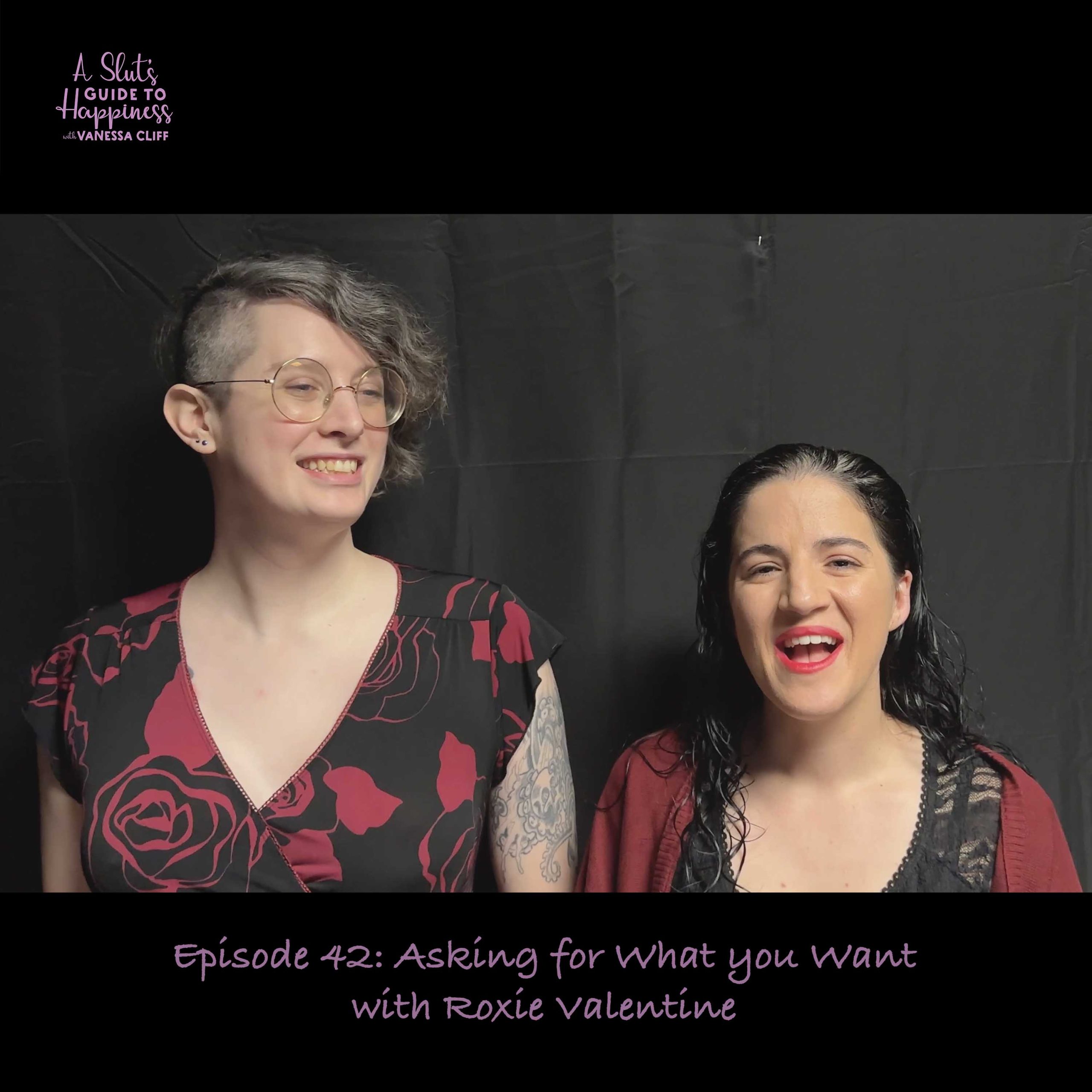
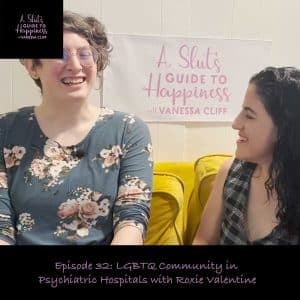
In this episode, Roxie Valentine describes the process of learning how to ask for what she wants. A recent experience stands out in her journey when she expressed to her polycule a kink fantasy that took some bravery to request. She examines what parts of herself changed to reach the place of self-acceptance and belief that she is worthy of having and expressing her own desires.
Welcome back to A Slut’s Guide to Happiness, where your body is perfectly imperfect and it’s safe to be as sexual, kinky, queer, or as slutty as you want.
Today, I have the pleasure of talking with our dear friend and formerly the Chaos Queen, now the “Community Whoreganizer” of Cliff Media. She’s been doing a ton of work helping to coordinate people producing small group scenes in between our big group shoots so that people are empowered – particularly LGBTQ, BIPOC and people with disabilities are empowered – to share their own fantasies and make this come to life in the world.
Because we need more knowledge and fantasies out there than just the mainstream cis white male-dominated porn industry.
Roxie:
Oh my gosh, do we ever?
Vanessa:
Yes. Today we get to talk about empowerment in a different way, because it shows up in all aspects of our lives. We’re going to be talking about setting your own boundaries, asking for what you need, and feeling confident in being your whole self in your life. This impacts your choices in general and in community and in romantic relationships, I think in particular, including in non-monogamous relationships.
I’m really excited to talk with you again, Roxie.
Roxie:
Yeah, I’m happy to be here.
Vanessa:
Yay! So I’d like to start with thinking about a time when you had, in your past, felt less confident in expressing your boundaries, or in asking for what you need. Why did you think you couldn’t express your boundaries and what were the consequences of not being able to do so?
Roxie:
That’s a good question. I think a lot of my early life, I had difficulty with boundaries and expressing what I needed. One thing I learned early on in life was that my needs didn’t matter and no one was going to help me.
I developed certain coping skills to get around that, and it sometimes can feel very manipulative. Because I was never just directly asking for things. But most of the time, I’m not good at manipulation, so it was just me ignoring my needs. I think that’s what it really came down to was me deciding my needs aren’t important. I need to just get by without them.
Vanessa:
And how did that impact, let’s go, for example, to romantic relationships?
Roxie:
Oh, boy. During that new relationship energy, you’re love-bombing each other, and it’s great. But the relationships that went past that, and they were few because I wouldn’t stand up for myself or my standards. I would just take on anyone that was attracted to me. In most cases, even if I wasn’t per se attracted to them. I would just feel like, if you’re attracted to me, great, that’s all I need.
Vanessa:
So you’d have these relationships that would go through the NRE (new relationship energy) period. But then once you got past that you were starting to feel like you weren’t comfortable and confident expressing your needs. And so what happened in that moment after you got past that point?
Roxie:
After you got to that point, it was kind of the same thing. I never taught them how I needed to be loved or appreciated. I just wouldn’t speak up in most cases. They would make plans for their own needs and I would help fulfill those.
One just occurred to me. This was when I was with my ex-wife. We had an issue where, when she was sick, I would wait on her hand and foot because I thought that was what was expected of me. So I would do that without her asking or without being prompted. But when I was sick one time with a fever, she went out with her friends. When she was on her way back, she said, I’m bringing people by the house, can you clean up?
I was ill, and I should have just drawn a line and said, don’t bring people over and I’m not going to clean the house when I’m feeling this sick. Instead, I cleaned the house because I had no boundaries.
Vanessa:
What was the fallout from that? What were you feeling as you were cleaning the house?
Roxie:
Crazy levels of resentment. Maybe not crazy. That’s a bad word to just bandy about, but massive amounts of resentment. I never resolved that.
Now, looking back, we both had really bad boundaries, and we both resented each other for it. It’s not anyone’s particular fault. We just didn’t have the skills. We didn’t know what the skills were. We thought we were fine just not talking about certain things.
Vanessa:
I think things that I have experienced, from myself and other people, is that conflict avoidance maybe feels better in the moment, but there’s this long term kind of building effect. Is that something that you’ve experienced?
Roxie:
Very much so. Yeah. There have been a number of relationships where there were taboo topics or rules for me. I didn’t have good boundaries and to deal with that, I didn’t have the strength to say, actually that’s kind of bullshit and I want to talk about this.
I just kind of let things roll off my back until tension would be building up. I would get snappy about the littlest things.
Vanessa:
I know that a lot of the experience of difficulty setting boundaries can come from socialization, including things related to gender and roles and norms around monogamy. And it can also come from our personal childhood experiences. So I’m wondering, if you have some thoughts on where the difficulty with setting your boundaries or this idea that your needs don’t matter came from? What are some of the origins of that for you?
Roxie:
I have to admit that I never learned, in whatever normal way that people do, to speak up for my needs, whether that was something that family placed on me or whether that came from like an internal factor, I’m not sure. I know that I always had difficulty expressing myself. So self-expression has been a long journey.
I would even get into fights as a kid because I would have feelings that I couldn’t sit in and I couldn’t express properly. They would just boil up, and I had to go to anger management. I had to see a therapist. All these things.
Vanessa:
To the extent you felt comfortable sharing, have you since learned things about yourself, whether it’s about childhood trauma or parenting or neurodivergence or any other factor that you think may have contributed to that experience you went through of unlearning anger and finding other ways to express yourself?
Roxie:
Oh, boy. It’s a big question where to start?
Vanessa:
What feels true for you?
Roxie:
You know, my ex-wife actually helped me a lot with my anger issues. She didn’t put up with me being angry at her. Or sometimes around her, which was its own issue. She didn’t put up with that. I learned to moderate that a lot. I found ways to cope with it and outlets.
This is tied into it, both when I was younger and more full of emotions – not that I’m not full of emotions now, but you really feel them when you’re younger – that’s the kind of thing that I would use substances to get through. I would isolate and I still isolate when I have big feelings. But I’ve dedicated part of my journey to avoiding substance abuse.
Vanessa:
That’s awesome.
Roxie:
Or even substance usage when I’m having big feelings.
Vanessa:
I hear multiple pieces of ways that you have tried to cope with big feelings that perhaps were maladaptive or weren’t working for you. One, anger. Two, use of substances to numb out. What is the flip side? What have you learned that does work for you when you have big feelings that come up?
Roxie:
I’ve learned that I have to process externally. I had a few good friends who are also external processors and helped me realize that that’s a really important thing for me to be able to do. I’m slower to make snap judgments.
I kind of take a step back and I have to remind myself I’m not going to say what I really mean in the first draft. I need to let it cultivate in my mind a little bit until I get what I want to say and how best to say it, because that’s where neurodivergence really plays a role. I have a wise mind. It’s not always the fastest, and it’s not always the most direct. Or rather, it’s not direct in the way that neurotypicals would think. So people perceive that as an inability to think sometimes.
Vanessa:
Interesting. I really like direct communication a whole lot. We were just talking this morning about whether that’s a trait of autism or if that’s simply a positive thing in the world for human relationships. But regardless, I really like it. You mentioned that sometimes people who are neurotypical misunderstand your way of communication. Can you say more about that?
Roxie:
Sure. Probably the strongest case for that is, when I was in the Army, there was a noncommissioned officer. He and I did not get along. He made that very clear in a number of ways. The way he showed his concern was by telling me that even the way that I emoted and showed emotions was wrong. The way I walked was wrong. The way I talked was wrong. The way I acted was wrong.
He was always correcting me instead of telling me what he expected of me. I would have difficulties expressing myself around him because I didn’t feel like it was a safe environment. It wasn’t a safe environment. I very much would seclude myself to preserve as much energy as I could. I wasn’t as socially apt. I was more socially anxious back then.
This is someone who was told multiple times by his wife that her blue eyes cause her pain when she walks from a dark room to a bright room. And only when I, at the time, a man said it, was he like, oh, is that a thing? This is not someone who listens to people, he’s not someone who takes the time to understand other people and other walks of life. So that’s probably the deepest ingrained memory of that one.
Vanessa:
So you’ve had a variety of experiences of times when it wasn’t working to express what you needed or even that you chose not to express what you needed and you tried to stuff it down. I know that you have been expressing that you’re experimenting with different things. You mentioned one about external processing. What are other things that have changed in terms of you expressing what you need or the way that you communicate with people?
Roxie:
I still feel my emotions boil up at times. But now realizing that I’m an external processor. I’ll let it sit. I’ll let it cultivate and then I’ll bring it up with someone. It’s interesting, I have an urge to tell people what is on my mind because I’ve learned that it is beneficial to me to express myself. So now I’ve got not an actual voice, but a part of me that’s like, just tell them what you think.
Vanessa:
You trust that your truth will be heard or that your truth matters, that what you have to say or think matters. So what changed about your self perception that gave you the confidence to take up the space?
Roxie:
Yeah. That’s a good question because I didn’t nor I didn’t used to take up space. Doing some self-work has helped a lot. It’s given me a lot of confidence.
Being a trans woman has taught me that I need to fight to take up space in a system that doesn’t support me. I guess that’s been a really big influence.
Sorry, I’m getting a little choked up. Being a trans woman has been a fight more often than not. It’s gotten a lot easier with facial feminization surgery and my other surgeries, but it doesn’t stop being difficult. It doesn’t.
You learn that that’s just a fact of life, there are certain difficulties that come with the territory. You learn that taking up space helps with that. Making your mark on the world helps with that. It helps people understand you talking to them about what’s on your mind or what you need. Help them understand you. The people that don’t understand, they can take a long hike.
Vanessa:
That makes sense. You went through the choice to be yourself, to present to the world in the way that you authentically are. I know you shared in a previous podcast that was really hard, especially because it meant you were ending your marriage.
Now you have gone through that process of fighting to articulate who you are to the world and to create space for yourself. I’m understanding that that had an impact on other areas of your life where you applied that practice of valuing yourself enough to be who you are and say what matters to you?
Roxie:
Yeah.
Vanessa:
That’s really beautiful and powerful that you had that carry over into other aspects. I know that you have shared that this has changed your relationship practices too. Can you tell us about how it was before and how it is now?
Roxie:
The best example of how it is now. I had a fleeting idea that I never would have floated before. I have a BDSM dynamic with my partner. I told them, I want Christmas spankings. I was like, I would like to get beat up for Christmas in a consensual way. I don’t know whether it was the exhibitionist in me or whether I wanted to have a group activity. But I was like, why don’t we have the whole polycule beat up on me.
I knew that it would be a big ask. That’s a lot of poly scheduling. A lot of poly scheduling. And also navigating boundaries for people. I’m really new to the polycule.
I knew that it might be a big ask, but I’ve learned now that I need to ask things. The worst they can say is no. Well, the worst they can do is make fun of you for even asking. But most of the time, if you’re honest in that way with people, they’ll be honest back. Yeah, I appreciate that. And if they’re not honest again, long hikes.
Vanessa:
Right. Because if you’re saying I want this thing, it’s not like you’re inappropriately demanding. You’re just expressing your truth.
Roxie:
Yeah.
Vanessa:
So did you get spankings?
Roxie:
Oh, I got a lot of spankings.
Vanessa:
So they agreed to do it?
Roxie:
Yeah. And they actually applauded me for being able to ask for that. They all said that it was very admirable that at my age I’m able to ask directly for things like this, even though I knew it would be a bit of an ask. They were proud of me for that.
It caused some wobbliness in the polycule. But that wasn’t connected to me asking. That was connected to me just being new in the polycule and poking some boundaries, pressing some envelopes.
Vanessa:
Right. They agreed to do it. That was them saying that it was within their boundaries. If they had crossed their boundaries by saying yes, it is their responsibility to learn how to set boundaries better.
Roxie:
Exactly.
Vanessa:
And I think that that’s something that’s beautiful about that experience, about your choice to ask, like you’re offering them an opportunity, and they can say yes or no. In the same way it was your responsibility to set that desire out there, otherwise I think it’s pretty unlikely that someone would just guess that you want five people to beat up on you for Christmas.
But you gave information about what you want which is a beautiful gift. And then it’s their opportunity to say yes or no.
Vanessa:
That’s something that my partner has been helping me with. They often say, don’t take away my no. They’re like, you can’t just assume that they won’t want to do something. You have to give them the choice of it. Previously, what I’ve been doing was assuming a no and asking anyways. But sometimes I would assume a no and not ask and they’re like you have to give me the chance to say no.
Vanessa:
I think one of the reasons that people don’t express what they want is that fear of the no. So how do you process receiving a “no” now?
Roxie:
I don’t think I process it any better than I did before. It doesn’t upset me because I want them to be enthusiastically consenting to whatever we’re doing. If it’s not a “hell yes”, it’s a “hell no”. And I’ve come to terms with that. I started saying that more than a decade ago. And it’s been a really good guideline for me.
Vanessa:
Yeah. That’s awesome. And it applies not just to sex and Christmas spankings but within the context of your relationship too.
Roxie:
Yeah.
Vanessa:
I’d like to talk about the impact of you asking for what you want on the quality of your relationship, perhaps to the extent that you feel comfortable, especially the quality of a non-monogamous relationship. Just because I know that when you add more people, you add more emotions and complications and communication required. So how has asking for what you wanted changed the relationship?
Roxie:
I’ve definitely had to learn. This is my first full poly experience with a large polycule, or large for me. I don’t know how large polycule can get. And I’m long distance, so I have learned that, and my partner has been helping me out with this a lot. They like to outline things very clearly, which is their prerogative.
It helps me think about things and express those things because they’re poking and prodding. They want to know. What are the boundaries so that they can color inside the lines and not violate my boundaries? And that has helped immensely.
It took someone else leading me, but I’m so happy with where I am now with that. The next relationship I get into, I am going to copy what I did here and make sure that we have a full understanding of each other before we start getting into the full relationship.
Vanessa:
I love that phrase you just provided. So that they can color within the lines. The boundary setting is not necessarily a restriction. It allows for more freedom within the context of the boundary where it feels safer.
Roxie:
Yeah.
Vanessa:
So how do you navigate when you are feeling like boundaries come up that may be crossed, or when you’re concerned about the potential for it being crossed? What strategies do you use if it’s come up thus far, or do you think you would use to express that, to get back to a place where your boundaries are respected?
Roxie:
I still have trouble with this sometimes. In an ideal world, I just speak up the moment a boundary has been crossed. I’m good at that for some things. Like when someone sticks it in my ass and there’s not enough lube, I am on it.
When someone inadvertently hurts me because of just part of their personality or part of their neurodivergent, they don’t mean anything by it, but some action of theirs has made me feel a way. It can be harder to speak up about that because, especially if the feeling is annoyance, I feel like I need to just deal with it. It feels like it’s a personal problem and they’re just being themselves.
Sometimes I don’t very well distinguish the line between something I can speak up about and something I can’t. So to play it safe I don’t speak up about it. But I have found now that like if a thing persists I can’t just sit in it if it continues to be a thing. I have to express myself to someone.
If it’s something that I just need to vent, I’ll go to someone else. But if it’s like a continuing thing, I’ve learned to talk to the person directly, and that’s hard. It’s hard to just go up and be like, hey, this thing that happened between us bothered me.
The way you do it is important, which is why I let things cultivate now. But I learned in college how you approach conflicts, and then I learned again in mental health inpatient, how the two people in a conflict are on the same side. You’re not on opposite sides. You’re trying to find a middle ground for your personal relationship.
Vanessa:
You both have the desire to not be in conflict, to get some of your needs met and to maintain a relationship that doesn’t feel painful.
Roxie:
Very few people want conflict in their life.
Vanessa:
Yeah. You also identified something that I think is really beautiful to acknowledge that, at least my perspective is that most of the time, people are not trying to be malicious. People just have something going on with their personality, their misunderstanding of their perspective, or the way they think, that is resulting in there being a problem action. Or perhaps they don’t even know about your boundaries and don’t realize they’re crossing them.
And yet that’s an explanation, not an excuse. You can still say, hey, I need this thing, or you’re doing this thing that’s bothering me and I’m feeling this way.
It’s interesting that, even as you learned the concepts in college, it seems to be, for all of us, an ongoing process of recognizing that we’re worthy and knowing that our needs matter. It’s okay to ask for your boundaries.
So I would like to leave it to folks who are in this process of working to express their boundaries, which is maybe all of us at different stages. What would you like to share with folks?
Roxie:
When you’re talking to people about your needs, be careful not to use “you” language. Always use “I” language. It’s about how something affects you. It’s not about the other person’s behavior. If you need to let things cultivate, take that time. If you need to express something to a friend so they can help you communicate it to someone else. Do that.
There are people out there who are open here. And they’re wonderful to find.
I feel really grateful for you joining and sharing your wisdom and love and the empathy that this is something we’re all working on. It sounds like you have found more power and happiness in expressing your boundaries, which is really cool. We can do hard things.
This has been another edition of A Slut’s Guide to Happiness with your host, Vanessa Cliff, and our amazing guest, Roxie Valentine.
If you are over the age of 18, you can find a whole lot of videos, including many featuring this amazing lady, on our website, cliffmediaproductions.com
Please help us out by liking and sharing this podcast to spread the word of positive, empowered sexuality and life.
And most of all, I invite you to join us in the pleasure of being awkwardly human, naked and without pretense.
Let’s get free.













Materials found in this section may be sexually explicit in nature. To view materials on the site, you must affirm all of the following:
I am at least 18 years of age (21 in some localities). Any sexually explicit material I am viewing is for my own personal use and I will not expose minors to the material under any circumstances. I do not find images of nude adults, adults engaged in sex, or other sexual material to be offensive or objectionable and I desire to receive and view sexually explicit material.
The viewing, reading and downloading of sexually explicit materials does not violate the standards of my community, town, city, state or country. I am solely responsible for any false disclosures or legal ramifications of viewing, reading or downloading any material on this site.
This website and its affiliates shall not be held responsible for any legal ramifications arising from fraudulent entry into or use of this website. This warning page constitutes a legal agreement between this website and you.
All models, actresses and actors whose images appear on this site are over the age of 18. Bookmarking to a page on this site whereby this warning page and/or terms and conditions are by-passed shall constitute an implicit acceptance of the terms and conditions herein.