


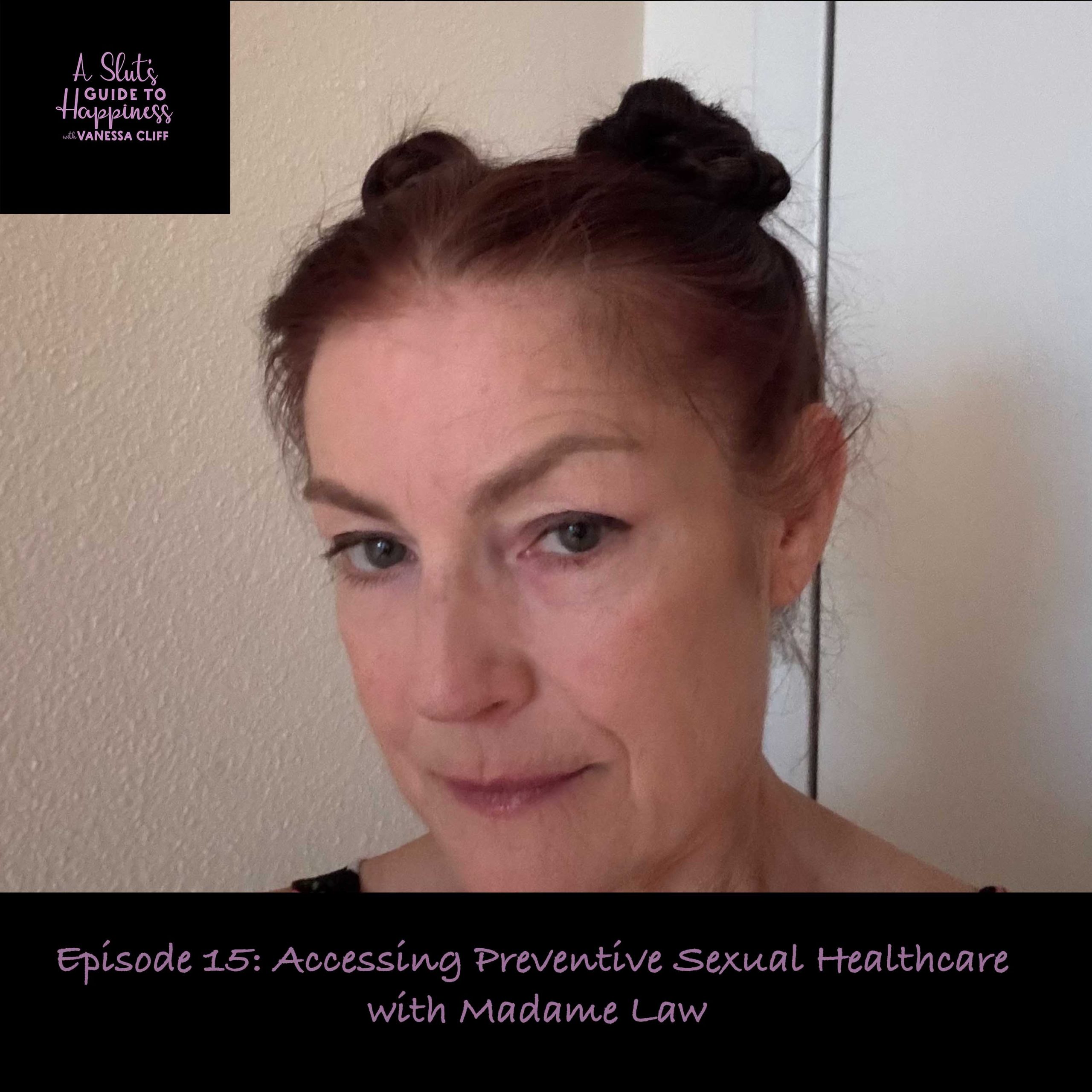
STI testing is the bedrock of a sustainable sex life, for everyone and especially for happily slutty adults. Most STIs today are easily identified and cured or treated. However, without easy access to testing and early detection, STIs can have devastating life consequences. Stigma, discrimination, fear, and lack of financial investment in preventive sexual healthcare all contribute to more difficulty accessing testing.
Madame X, a career-long nurse, joins us to discuss her experiences and perspectives on STIs. In her teens, Madame X contracted chlamydia. Without access to testing, she ended up finding out about the disease only after it had progressed to the point of needing hospitalization and causing irreparable damage to her reproductive organs.
Although information about and access to testing has improved over the years, today Madame X continues to see barriers to STI testing both in her personal and professional experience. She identifies some of the structural problems that limit access to preventive sexual healthcare and also describes ways that patients can advocate for themselves and help each other to access care.
Welcome back to A Slut’s Guide to Happiness, where your body is perfectly imperfect and it’s safe to be asexual, kinky, queer, or slutty as you want.
I’m excited to be talking with a kind and open-hearted woman, a friend and medical professional joining us today from California. I first met Madame Law through T.Max, another kinky queer friend you’ve heard on this podcast.
I’ve heard from T.Max how long Madame Law has been supportive of their journey coming out as queer and polyamorous, embracing this new version of themselves, which I think is amazing. Madame Law is now on her own vulnerable and amazing journey of exploring ethical non-monogamy and kink. It’s been inspiring to me to see the way that she has shared it with her partner, friends and community as she re-imagines her relationship to sexuality.
What isn’t new to Madame Law is her long-time role as a professional nurse, as well as her strong feminist values throughout her life. Like me, Madame Law is also the mom of a daughter. So Madame Law has long thought about how to support girls in becoming self-authored and powerful women in a patriarchal society. She’s been an inspiration to me in how she raises her child and thinks critically about a future that makes health care and society safer and more empowering for women and girls.
Today I have the pleasure of talking about an issue that, if you’ve heard my previous podcast “10 Wicked Hot Ways to Wait Out an STI”, you know this is dear to my heart. I also believe that sexual freedom is life-affirming and sexual health is part of well-being in our lives.
I often think about the line from Mary Oliver’s poem “Wild Geese”: “You do not have to walk on your knees for a hundred miles through the desert, repenting. You only have to let the soft animal of your body love what it loves.”
To live that whole life as authentic, loving beings, as whole complex people, as soft-bodied animals, we need access to sex-positive health care. Any of us, anywhere in the world, who are having sex, which is almost all of us, need access to prevention and treatment to sustain our health, free of stigma and judgment.
We’ve talked about some of the important and lesser known ways to promote sexual health, including preventive medications like PrEP that reduces the risk of HIV and Doxy-Pep that reduces the chances of contracting syphilis, gonorrhea, and chlamydia.
In addition, just like getting mammograms to test for breast cancer, regular STI testing allows for early detection and easier treatment of STIs. But a whole bunch of structural and cultural barriers prevent people, especially women, from having easy, supportive access to STI testing.
Today, Madame Law is going to share her personal experiences accessing and sometimes trying to access STI testing, as well as a really powerful personal story from her early adult life about the impact of undetected STIs.
Before we proceed, I want to take one last moment to honor something that’s often missed or communicated in a way that is potentially harmful. In discussions about STIs, people sometimes use the language of “clean” and “dirty”. This can imply that someone who tests positive for an STI is somehow “dirty”, they did something wrong, or they are something wrong. It perpetuates slut-shaming.
Live your beautiful sexual free life, including if you want to be slutty. And also, it’s important to know that anybody can get an STI. Let’s take away the language of clean and dirty. Let’s take away the stigma and shame. Let’s talk about STIs in the same way we talk about catching a cold. Let’s talk honestly, openly and publicly about chlamydia, syphilis, gonorrhea and HIV, things that are just part of the experience of having a human body.
Madame Law, thank you so much for joining us today. I’m excited to talk with you and grateful for your willingness to share your values and experiences.
I know your experiences with STIs goes way back, but I want to first start with this very recent experience that we were talking about. A month or two ago, you were trying to access STI testing. And even though you’re a nurse, you’re a highly educated professional and a feminist, confidently speaking your mind, you also had difficulty accessing testing, both emotionally and logistically. Can you tell us what happened?
Madame Law:
It’s kind of emotional. The way I want to feel about it and the way I actually feel about it are so different. I want it to be science. I want it to be that anyone reaching out for health care is able to receive it. It should be affordable, accessible, no judgement.
I grew up in the Midwest, in the Bible Belt. Even after years and years of working to undo some of these super negative messages I got from growing up as a girl and a woman, there’s still a lot to unpack. Even just finding fun in the word “slut” is hilarious and still that’s just so amazing because it’s been such a word to shame women for so long.
Sexual health is so important. Recently I wanted to participate in a Cliff Media event and that required testing. I think that’s awesome, because that’s keeping people safe. It should require testing and it should be simple. You shouldn’t even have to explain why you want testing. I should be able to walk in and just say, I want these tests done.
But I also work in an environment where I don’t feel that my chart is private. I work at an organization where people I work with may be in my chart because they might be providing care. I did have an experience where I was hospitalized for pneumonia, I had started dating someone who, we were in a new relationship and he had slept with someone else. We had not been using condoms. When I asked him if he had used a condom with this person, he told me he didn’t.
I asked him to please get tested. He felt shame too. I asked him several times, please get tested. He dragged his feet. So I just went to get tested because I want to take care of myself. I went in and asked to be tested. I remember even being asked by the woman at the front desk, why do you want to get tested? I was thinking, why the hell do you think I want to be tested? Are you going to make me say it in the middle of the gynecological lobby?
I just said I might have been exposed to a sexually transmitted infection. She said, oh okay. But of course that’s why we get tested, why make patients say that.
I got tested and my results came back. Within a couple of days, I got a really bad case of pneumonia and wound up in the hospital. It was already pretty emotional for me going through this with my partner. It was hurtful. I was mad at him for not getting tested faster. I felt like my diary was open to people in the hospital setting, and I’d worked in this hospital.
Some people coming in the room were just there to say hi, some people were my friends who were caring for me, coming in as my nurse, as my doctor. It felt like everything about me is in the chart. I’m a married woman. There’s STI testing within the last two weeks. They don’t know the status of my relationships nor do I want to talk about them. I felt super uncomfortable and exposed.
Fast forward to recently wanting to participate in filming. I reached out to my doctor and it took me having to pump myself up. Okay, here we go, I’m a grown-up, I’m going to ask for this, it’s my right, it’s my healthcare. So I just asked, I’m in a new relationship and I want to get tested. They ordered tests, no big deal.
But then I was trying to get tested afterwards, and the algorithm does not allow it unless I have symptoms. It’s every three months or so. I can’t speak to all the rules around it because this is not my speciality.
I also felt like I wanted to establish care in a more private way. It’s hard for me to ask for testing at my place of work. It makes me feel uncomfortable. I don’t want to explain. So I reached out to an organization that I love. Because I have insurance, they didn’t want to serve me without it being an out-of-pocket cost and very expensive.
So I decided to look for other organizations. At San Francisco City clinic, they serve queer culture patient population. They were very good to me, but every time they would review my chart again, even on my way in to receive testing, somebody had called me to tell me not to come in, they were going to cancel seeing me. I’m glad I didn’t take the call. I said, this is why I want to do this, it’s really important to me. They have their own algorithms too. So on paper, I’m a married professional white woman.
I feel like I have to give a whole lot of backstory to receive care. It doesn’t feel comfortable. I don’t want to always have to be empowered when I go and ask for testing. It was hard, it was emotional. I wish the healthcare system had an attitude of thank god you’re doing follow up, or good for you for taking care of yourself.
I know some of this is my own personal years of negative messaging about being sexual as a woman. Some of it is always a healthcare system that perpetuates this culture. It’s challenging.
I had another time where I was having a lot of terrible symptoms and I had to ask. I said, Are you going to test me for STIs? They were doing all these work-ups and they said no. I asked, why not? I’m having unknown symptoms. Why would you not test me for this? I just wasn’t considered part of the care, even though I was having symptoms of anal bleeding.
Vanessa:
I think it’s interesting that you’re naming that part of this is your own fear, but that’s not personal. All of our ideas are part of our socialization, including doctors and nurses. Our structures, including healthcare, are based on the values and priorities of our society at large. There’s a lot of shame, stigma, discrimination and assumptions that are attached to whether we need testing. Who needs it? What does it mean to get testing?
I’ve gotten to the point where I walk into a clinic and say, I’m a high-volume sex worker. I need regular testing. I’ve had one doctor in my life who said, good for you, we love our regulars who are taking care of themselves. Most doctors or nurses ask, are you being safe?
It is now written in my chart that I’m a high-volume sex worker, which I know then results in discrimination or ideas by some people when I’m interacting with them in the health care system. I know that there are a lot of people who don’t want to have that kind of record, who don’t want to have that in their private, confidential conversations with their doctors. I have heard people express a desire for confidential, easy access STI testing without judgment.
I want to go back in your life. This one is particularly sensitive, especially since you were really young. I don’t know if you would describe it as traumatic, but it seems pretty traumatic from my perspective.
Madame Law:
It was.
Vanessa:
Okay, yeah. In a hospital. Can you tell us what happened, how you ended up there, and what was your experience?
Madame Law:
I had a boyfriend. We were having intercourse, I was using birth control but I wasn’t using condoms. I was on a birth control pill. I started developing terrible pain, pelvic pain. This was before the internet and Google.
I called my gynecologist and I described this pain. I was having trouble walking because I was in so much pain. I went to the E.R I was diagnosed there with a yeast infection, Gardnerella Vaginalis. I had a hands-on exam. They didn’t do any testing. The pain was incredible. They gave me medication for a yeast infection and discharged me.
That’s when I called my doctor’s office. I said, please describe the symptoms of Gardnerella Vaginalis to me because I’m really in pain. They said, mild itching and irritation. So they told me to go back to the E.R. I was admitted, on I.V. antibiotics for three days.
I was 19, in the Midwest. My mom wasn’t local and it was just my dad. He wasn’t comfortable with this. He was not a good support. I remember he even called my mom and said, please don’t tell me if I don’t have to know what’s going on. He literally said that to my mother.
I felt very alone. There was no testing for my boyfriend even after I was diagnosed with chlamydia. This is a sexually transmitted infection. Nobody said, do you have a boyfriend? Do you know the source? Nobody did that. Public health, no one. I told him he needed to get medication but I wish somebody just handed me the meds and said, he needs to take this. And here’s a couple of others for the people he slept with. Just pass it out with some instructions.
I was in the hospital, I still remember it. This was obviously before I was a nurse. I still remember my nurse’s name, Connie. She took such good care of me, but it felt uncomfortable already. I’m the young girl in the hospital in the Midwest with a sexually transmitted disease.
At one point, I woke up and there was a doctor taking the blanket, I was asleep, he was taking my blanket and starting to pull down the blanket to expose my body. I woke up and my bed was surrounded by men. They were hospital staff, but he didn’t wake me up, he didn’t ask permission to touch me. I grabbed my blanket and said, what are you doing? Get out of here.
He said, we’re doctors and these are medical students and they need to see this for medical learning. I said no. Fortunately my mom did raise me with a backbone. The doctor said, we need to do this. He pushed back. I said, get the fuck out. I remember using that language because this was so upsetting. I hit the call button. Connie came in and she told the men, get out.
The fact that the guy even considered, what are they going to do? Show an angry infection? This is internal infection. What were they going to do? It was just so disrespectful. It was really upsetting. I will never forget about that.
Vanessa:
I had a friend who was a larger black woman. Her son had been in prison, she had experienced addiction. So all these different vectors on which she had the potential for experiencing discrimination based on structural norms in society. And she had a similar experience. Doctors just physically held her down in order to provide the things that they thought were good for her body, rather than asking her or having a conversation.
This isn’t judgement on doctors or nurses specifically. This is about what society says about whose bodies are worthy of consent and autonomy. I think about someone walking in with an STI. There are so many assumptions that are built into that, about your relationship to sex and sexuality. It shouldn’t matter, but even in your case at the time, you just had one partner, which is kind of the norm and expectation for young women.
Madame Law:
Well, one partner who gave it to me. He was not my first partner. I knew because that that was my source because that was when my symptoms developed rather quickly.
Vanessa:
So you’re in the hospital, which is not the standard experience of having chlamydia. It’s usually, at least in my experience, a week or two of treatment. What was it that resulted with you in the hospital for this?
Madame Law:
The infection had been untreated long enough that it shifted from chlamydia to active pelvic inflammatory disease, which is very painful and can have long-lasting effects. It can lead to scar tissue.
For me, I did have a lot of scar tissue develop. I had pregnancy issues later in life. I had a tubal pregnancy which went undiagnosed, bleeding for eight weeks, and then I had to have emergency surgery.
I work in healthcare, I’m not here to malign healthcare, I understand how difficult it can be to provide the right care. But I also know that we bring our values and judgements to the work. We are all capable of making terrible mistakes.
My fertility was really compromised. I wound up needing to have emergency surgery because of a tubal pregnancy. Then I had a diagnostic that found all the scar tissue and identified that’s why I was having trouble getting pregnant. I did go through a round of in-vitro fertilization which had its own unpleasant endings.
I had a lot of trauma. Had I received care, had I been able to seek care sooner, I’d like to believe that most people can avoid those kinds of outcomes, if there’s testing after an exposure, even before symptoms.
Vanessa:
I’m so sorry that happened to you, and I’m so happy that you were able to have the child you wanted eventually. I think about the sterilization of women that has happened throughout history. Your access to sexual health also impacted your ability to have a child and your experiences of trauma through your pregnancies.
I imagine what would have been different if in high school, during sexual education classes, they had said go get STI testing. Or if your doctor had said, it’s time for your routine STI testing, as a normal part of healthcare. Instead it took so long for you to have to figure out on your own that you had a serious illness, that chlamydia had progressed, and by that point it was already impacting a lot of other parts of your body.
Madame Law:
If you do have a new partner, ideally you should be able to just go get tested together. It should be simple. I’ve worked hard to have that approach when I have new partners. I can’t say I’m always perfect but I’ve tried to do that.
I can think about one person I dated, who was so lovely. We started dating, we had sex a few times with condoms. I remember we were getting more serious and I said, I’d like to get tested together. And I remember he just like, great okay. We went together. It was just so easy. His support meant a lot.
I’ve had so many experience where I’d ask, will you get tested with me? There’s pushback, because I know there’s the talk about feeling “dirty”, the good and the bad, only “bad people” have STIs.
It’s like the flu symptoms. If you have sex, you’re at risk, period. It’s just that simple. Early detection prevention is better. I still feel like even as a nurse and a feminist and someone who has spent a lot of time thinking about it, there’s so much stigma. It’s hard.
I remember just recently trying to get the testing done and I cried a few times. It’s very emotional. I actually pulled over on my way to the clinic. I called T.Max. He was on the call the whole time. I knew I could count on him to understand the emotional toll but also be supportive and not say anything stupid. I knew I could count on him to just be there for me.
Vanessa:
I used to have a crew of people who had a solidarity pact that if any of us ever needed to get an abortion, we would be the people that would hang out and hold each other’s hands afterwards.
I also love that you went to get STI testing with your partner. I had a date recently that felt really cute when we went to PLanned Parenthood together and got STI testing. It felt like we were supporting each other, this is lovely.
Madame Law:
This is such a great conversation to have with your partner. If you can’t talk about that, what are you doing having sex?
Vanessa:
If you are putting your body parts in other people’s body parts, but you can’t talk about how to take care of those body parts, what are you doing?
Madame Law:
I still think having these conversations can be really challenging. I’m a grown-up, I’ve thought a lot about it and I still feel like when I bring it up over the years, people have just been very resistant to getting tested.
They’ll say things like, I’m not a slut, I don’t sleep around, I don’t sleep around. I say, weren’t you just dating somebody? Did you guys have sex? Did you use condoms every time? No.
Then I’m having sex everyone she’s having sex with and everyone you’re having sex with since you weren’t tested. It’s just that logical. I’d like to be able to relax when we have sex.
Vanessa:
One of the things that you shared with me that I think has similar ties to this is the slut-shaming that prevents us from accessing health care. I don’t know if it was in high school or young adulthood, you were helping some of your friends access birth control.
Madame Law:
Where I grew up, a lot of young women felt so bad and so guilty. It’s against God, it’s against family, you’re supposed to wait until you get married. And at the same time they’re alive and human and have sexuality. But they’re denying it and feeling so guilty about it because of all the messages around us.
I had several friends that I would just say, we’re going to Planned Parenthood. I would just go with them and help them get started on birth control.
My mom was very supportive of me coming into my sexuality. She always said, if you ever want to start birth control, I’ll pay for it. You can go to the doctor, I’ll receive a bill. I won’t ask you any questions. You can do that without me. But I hope that you feel comfortable telling me because I want to be there for you. That’s what she always said to me.
So I saw my friends and just how it was so painful for them. They really were struggling with how guilty they felt. I went with several of them. Then I remember being in college. My roommate was very sexual and just a beautiful woman and loves sex. But also really had this weird Christian background, super virgin whore.
The way I would just say it is, I prayed for her period every month, and I don’t even pray, because I was just like, this is exhausting. Because using birth control means that you’re admitting that you are going to have sex. That’s planning. And she can do that. Unless the boy put a condom on, she wasn’t pushing for that and she didn’t plan for it.
I had another girlfriend, she had a serious boyfriend. She was in a monogamous, loving relationship. I finally dragged her to Planned Parenthood. It was month after month of prayers for the period. She just kept saying, we’re just going to stop. We’ve just agreed it’s the wrong thing to do.
I said, you guys have sex. You’re never going to stop. Why stop? And she said, I’m afraid my mom’s going to find my birth control pills. I said, your mom’s in Tennessee. She’s several states away, and you can hide these little tiny birth control pills somewhere, better than your belly when you go home at Christmas.
So she finally started birth control, but I felt like I had to really wear her down. It was because of the shame she felt around being a sexual person.
Vanessa:
I recently heard about this project in Portland. Your work that you were doing just as yourself with your friends, it makes me think of this. There’s a project for specifically black and brown folks, Black, Indigenous, and people of color who are also queer, reaching out to every person and to people in their community, encouraging them to get STI testing and get birth control, access to sexual health.
There was an incentive built in that for each person that you bring in to access sexual healthcare, you get $25 as a way of compensating people for being sexual health promoters in their community. We know that a lot of it is about undoing that shame and stigma and the people who are best equipped to help undo that shame and stigma are other people who are already emotionally close, trusted in people in their lives.
The Affordable Health Care Act has money for health promoters in the community. I could imagine sexual health promotion is also a really important way to protect people’s lives. For example, could your pregnancy challenges have been prevented if there were more people who were having conversations?
I know that as a medical professional, you’re interacting with lots of different patients and different medical professionals. Can you describe some of the assumptions that people may have about why they would want to limit STI testing? Why, for example, you were standing in that waiting room and the professional there asked you to explain yourself for why you wanted testing, as opposed to being glad you were there?
Madame Law?
This isn’t my focus, medically, so I don’t know all of the workings, but I know providing health care costs money. If you’re going to have a blood draw or a urine catch, you need a tech, a nurse, somebody, a doctor to order the tests, you need a phlebotomist or a medical assistant to draw the blood. You need somebody to courier it to the lab. It needs to be processed, put into the computer and read. Then someone needs to notify the patient. That’s a lot of work.
I don’t want to dismiss that. That costs money. I know that in healthcare, we’re always trying to identify what’s the right amount of care to provide. You want to provide safe care and you also want to provide necessary care.
My health insurance covers me. If I were to break my arm and I need a cast that’s covered. I can’t just demand to have a cast put on my arm if my arm is not broken. That’s unnecessary care.
So they’re trying to develop these algorithms because we have to keep a lid on healthcare costs. I appreciate that. I don’t know the true cost of STI testing. I know a lot of the antibiotics now have become generic, pretty affordable. I don’t know the costs of PrEP and doxy-Pep, some of the meds that are used prophylactically.
I know for a long time, HIV meds were super expensive. There were huge movements around trying to make these medications accessible and affordable.
I know that even when I went to the clinic recently and said, I might want to be testing more often. I don’t know what is next for me, but I want a safe place where I can do this, if I want to get tested. They said the max would be every three months.
I can’t speak to all the different costs. But I would believe that having an early detection is cheaper than a hospitalization, like what I went through when I was 19. Being on IV antibiotics, being hospitalized is very expensive. If you can prevent those more heroic interventions, it’s cheaper.
It’s not part of my wellness panel every year. If I were to go in and do my annual labs, which I just did, having my red blood cell count for example, chlamydia is not part of that panel unless you ask. I really feel like that would be smart.
We just have so much shame and judgment. We already have stats on people not in ethically non-monogamous relationships, and of course there are even more people who cheat and have sex outside of their relationships, and they may not tell their partner that there was an exposure. Everyone can have potential exposures. Why can’t we just roll this into the standard annual panel?
But I know for some people, it gets into the ethics of people not wanting to be tested. So I’m not saying I have the answers, it is tricky.
Vanessa:
One of the things that I’m hearing is that the cost calculation makes sense from a fiscal perspective. Fiscal efficiency that it is. Without having the exact numbers, it is likely cheaper to have preventive testing than pay for treatment in a hospital.
I also think investment in health care is related to our values. There is a long way to go for people to understand that sexual freedom, supported in a way that is healthy and sustainable, is part of being whole people, is part of having well-being and happiness.
So whether or not we invest in preventative sexual health care also reflects our values as a country and as a population. I think that there’s lots of conversations to have about the structural changes, in addition to the cultural practices and norms of doctors and nurses themselves.
As a country, where are we investing our money? What does that look like on a policy level?
Madame Law, you have had a lot of experiences of this from 19 in the hospital to today, just a couple months ago, trying to access care and still going through these thought processes and seeking out a friend to release challenging feelings about this experience.
I particularly think about how incredible you are as someone who is thinking about supporting girls and young women coming up into this world.
I’d like to leave this episode with a love note to those young women who maybe don’t have access to health care, maybe don’t feel comfortable, aren’t having those conversations in their sexual health education classes or with their doctors or their parents. There are young women trying to figure out how to be a sexual person in this often slut-shaming world? What would you say to young women in this position?
Madame Law:
First of all, I just wanted to say Planned Parenthood, I love you, thank you for being there. I hope that they remain an institution. I hope they remain funded. I know my daughter and her friends feel safe going there, and I feel like they’ve had good experiences there. That means a lot to me.
I’m so surprised when I talk to my daughter. it really bums me out how much slut shaming is still present. I just want to encourage them to continue to interrogate that.
I want to remind young women that their sexual health and sexual appetite is a sign of health. Wanting to have sex is a sign of being in your body. It’s just like having an appetite. That’s a sign of health as well. Wanting to eat food, wanting to have sex. These are healthy thoughts.
I do my best to ask questions when I talk with my daughter and be supportive. Some of the stories that her friends have shared with me when I’ve been with my daughter and her friends, they’re pretty upsetting.
I feel like there’s an explosion of social media that they have access to that I didn’t. One of the things that I think is powerful is, there’s information they support each other. But I also think that this is when people start to question gender roles, and I see that with my daughter, she has friends who define themselves in lots of different ways.
I feel like nothing is going to break a stereotype, break down gender roles more than when people just let go of these gender roles. If you truly believe that a woman doesn’t need a man to have sex, then you have to believe that a woman is capable of being sexual. My daughter and I talked about that. I think it really does just threaten these super traditional, just upsetting, patriarchal ideas of sexuality.
I see a lot of really exciting things. And again, on a bummer side, I’m really nervous about access to abortion and birth control. I know my daughter talked about turning off the period trackers. I feel like they’re living with some really scary things.
I hope they can just continue to grow into their sexuality and have great experiences and talk, and not consent, but enthusiastically participate. I don’t want consent. I want for her and her friend, I want enthusiastic participation and excitement for them.
Vanessa:
I think that’s one of the beautiful things about owning our sexuality, even our slut lives, to say that I am enthusiastically choosing this life.
I know that we shouldn’t, especially as young adults, have to be the one advocating for ourselves because we should have structures, we should have teachers and parents and doctors who are supporting us and learning how to do this. But we don’t always have that way.
So being able to advocate for yourself and saying, hell yes, I am a sexual being, I’m choosing this in my life. I’m being a whole person. So please help me to be healthy.
It’s so important to find your tribe, like you’re describing, like your daughter and her friends have done, supporting each other and having these open conversations. You can have someone who will hold your hand or answer your phone call when you need to process the stigma of trying to access this healthcare.
Thank you so much for sharing your personal experiences, your perspectives as a health care provider, and as someone trying to access health care.
Viewers, thank you for listening today.
This has been another edition of A Slut’s Guide to Happiness with your host, Vanessa Cliff and our guest, Madame Law.
You can find us wherever you get your podcasts, including Apple and Spotify, as well as on cliffmediaproductions.com.
If you’re over the age of 18, you can also check out our video content on our website, cliffmediaproductions.com.
And most of all, I invite you to join us in the pleasure of being awkwardly human, naked and without pretense.
Let’s get free.




















Materials found in this section may be sexually explicit in nature. To view materials on the site, you must affirm all of the following:
I am at least 18 years of age (21 in some localities). Any sexually explicit material I am viewing is for my own personal use and I will not expose minors to the material under any circumstances. I do not find images of nude adults, adults engaged in sex, or other sexual material to be offensive or objectionable and I desire to receive and view sexually explicit material.
The viewing, reading and downloading of sexually explicit materials does not violate the standards of my community, town, city, state or country. I am solely responsible for any false disclosures or legal ramifications of viewing, reading or downloading any material on this site.
This website and its affiliates shall not be held responsible for any legal ramifications arising from fraudulent entry into or use of this website. This warning page constitutes a legal agreement between this website and you.
All models, actresses and actors whose images appear on this site are over the age of 18. Bookmarking to a page on this site whereby this warning page and/or terms and conditions are by-passed shall constitute an implicit acceptance of the terms and conditions herein.