

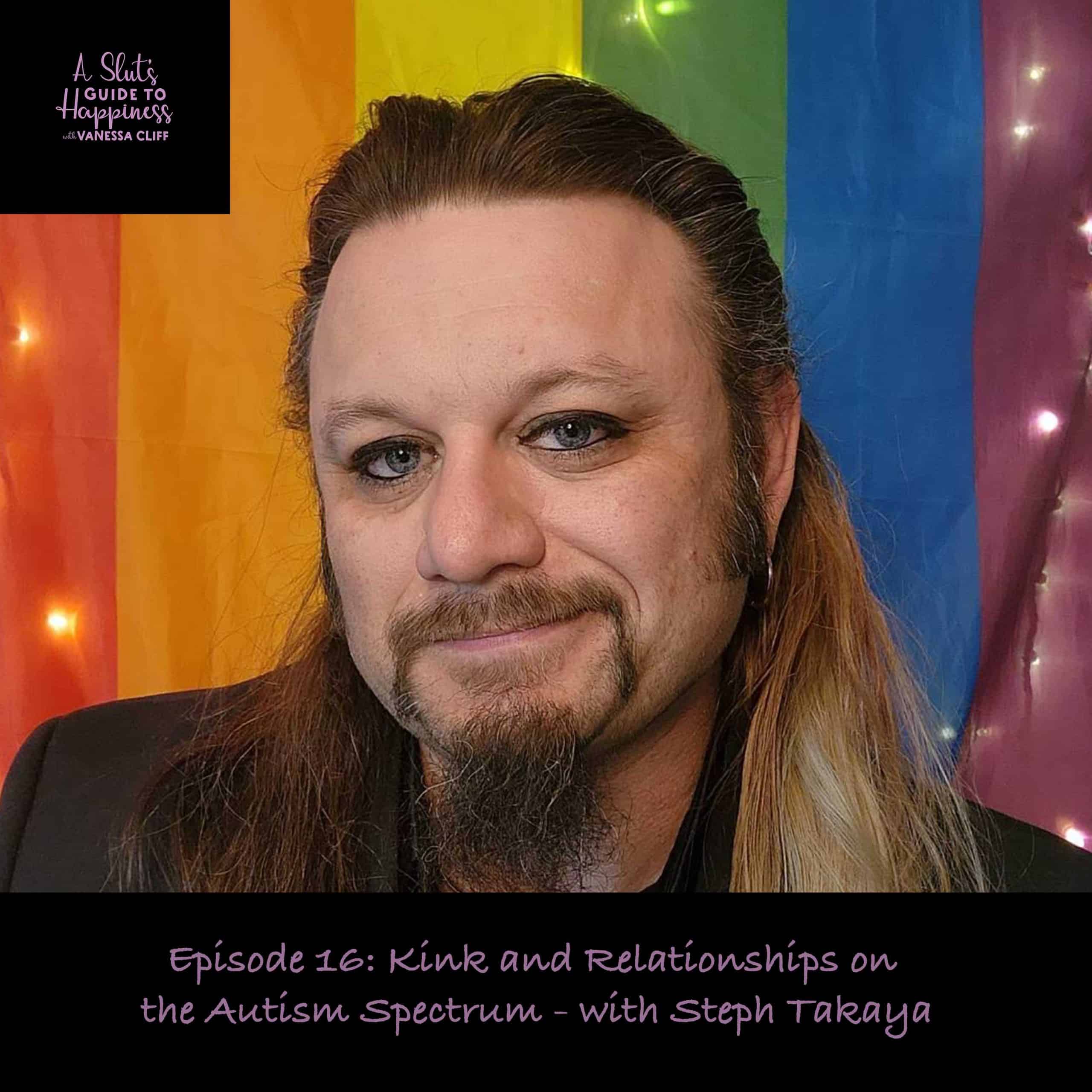
In mainstream media, autism is often depicted as a deterrent to successful romantic or sexual relationships. Steph presents an alternate perspective: autism is a different way of thinking and being that can be harnessed as interpersonal superpowers. For example, autistic people are often highly empathetic, have a strong moral compass and are more comfortable with direct communication. Autism can also be associated with different sensory and sexual desires. Embracing, rather than trying to “fix” these differences allows for a world of exciting freedom and possibility.
Both academic research and Steph’s personal and community experience suggest that forms of non-traditional sexuality, including kink, polyamory and queerness, are more prevalent among autistic people than the general public. Steph describes how BDSM kink allowed them to reconnect with their sexuality as they discovered the importance of novelty and sensation for the way they think and experience the world.
Comfort with thinking outside social norms and communicating their feelings directly with others now helps Steph sustain successful polyamorous relationships. Their partner joins us off-camera to discuss ways they interact with Steph’s neurodivergent thinking and communication styles.
This episode offers autistic people and their loved ones support and ideas in their journey of self-exploration and authentic sexual and romantic connections.
Welcome back to A Slut’s Guide to Happiness, where your body is perfectly imperfect and it is safe to be as sexual, kinky, queer or slutty as you want.
I want to start by sharing a message we recently received from a listener. They said:
“I have always been bi. I have known since I was seven and was seeking my best friend’s dick in my tree house, but I was beaten severely and by both of my parents when I was caught doing it. I was told that I was dirty, immoral, a sin, and wrong.
I spent the next 30 plus years fighting with myself, hiding my true self. I have always loved a slutty girlfriend, enjoyed when a girlfriend cheated on me and then came over and let me go down on her. She thought I didn’t know, but I did and loved every part of it. But I always had to keep it a secret because “men” don’t do these things.
I watched your podcast on “Pursuing Loving Relationships with Slutty Women” and everything you and Orion said was spot on. I was like, yes, finally, I’m not alone. This isn’t weird or an isolated thing. I’m not dirty, wrong, or sinful. Thank you so much for reaffirming I’m not broken or weird and effective. Thank you for making me feel like I am part of a community.”
Honestly, I cried a little when I heard this because I love hearing from people who are listening. Knowing that we’re not just sitting alone in a house talking, but that we are connecting with you listeners and viewers. I really appreciate you being here. And this is why I do this, because I want to be building a community in-person and online.
I want to say I see you, I love you. We can release shame. We can be ourselves. We can be who we are in the world. We can have desires, we are soft animal bodies and all of that is beautiful. Thank you so much for sharing this, and I hope you’ll join us in this community.
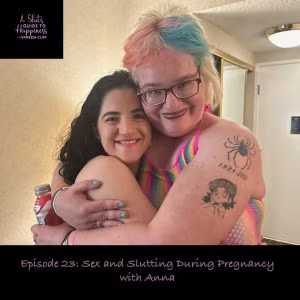
Today I am so excited to be talking with my friend, a fellow content creator and a lead Emotional Support Slut with Cliff Media, our female and queer-led porn production company. Steph is genderqueer, kinky, slutty and polyamorous, and beautifully unafraid to be themselves and support others in doing the same.
Steph also has a big squishy heart secret, and that’s a secret. They’re trained in mental health aid, which I think is a super cool way of preparing to support people. And also they just radiate love. I’m seeing that happen during group shoots when people are having emotional moments or growing. Steph will just reach over and offer words or affection cuddles, if that’s what the person wants.
I really appreciate that Steph also has two other superpowers that I want to share with you, and one which we’re going to dig into today.
One is they grew up in a biracial family and have the experience of multiple languages and cultures.
And they have also learned later in life that they have autism or they’re an autistic person. If you read about some of the common traits of autism, which are not necessarily applicable to everyone, but tend to happen among autistic people, they include highly empathetic, strong moral compass, comfortable with direct communication. So in my opinion, autism is a pretty powerful way of being in the world.
Today we get the fabulous privilege of talking with Steph about how their autism has influenced and relates to their sexuality, relationships, and interest in kink. I think this is a look into a part of sexuality that often isn’t discussed.
Steph has some beautiful insights for anyone who is themselves autistic, for autistic folks out there in the community and for anyone who loves someone on the autistic spectrum.
Steph, thank you so much for being here.
You were telling you before, I’ve had this experience, I think it’s pretty common. A while back, you were starting to find sex boring, a chore, repetitive.
If any of you has seen Steph’s spicy content, both in Cliff Media and as an independent content creator, you know that their relationship to sex these days is anything but boring.
But we’re going back many years ago, as Steph was figuring out their sexuality and desires. I think it’s important to name that continuing to grow and explore sexuality is a beautiful thing.
So I want to start with the background. How was it during the time before your first experiences with kink, in particular as it related to times that you were figuring out your autism?
Steph:
I had what a lot of people would call the perfect life. I had a beautiful wife, 2.5 kids, a dog, a housewife, a picket fence. I had two cars, an RV. I was in the military. Everything was just what people want, stability in life.
And yet, I was miserable. I couldn’t figure out why I was miserable. All I know is that I didn’t like where I was, and I didn’t like where I was going. It didn’t fit.
I had a lot of questions I had to ask myself. And it started back in 2016. It’s the only New Year’s resolution I’ve ever kept. I decided I’m not going to be an asshole anymore. A lot to unpack in that little statement. A lot of self-challenging, a lot of self-reflection.
Back when Tumblr was cool, I had Tumblr and I was seeing all of these wonderful images that were just turning me on. The porn I was watching, one of the first flags was lesbian porn doesn’t really do it for me. I have to have a dick in it. I have to have a dick in the porn. That’s when I started questioning, why do I like seeing cocks?
All of this comes from when I was a child, like the person who submitted the message. When I was young, 5, 6, 7 years old, there were dicks in my mouth, consensually. As they do, children exploring sexuality, perfectly healthy.
Your email from the viewer really touched because I’ve had similar experiences. Growing up in a Latino household, in a Catholic Latino household, that was verboten. You just didn’t do that stuff. So I had a lot of shame.
Vanessa:
Was it a secret for you in your life?
Steph:
Oh yes, absolutely it was a secret, because of shame. I have a beautiful family, what are they going to think? I was in the Navy, what are they going to think? I’m going to become the typical sailor.
It wasn’t until I was older that I started to challenge things that didn’t make sense.
Vanessa:
While you were in your marriage, I know you described that there was a while where you were starting to feel like sex was not exciting for you?
Steph:
Sex was becoming a chore. There was a dynamic imbalance. What I mean by dynamic was I did a lot of the giving during sex. It was super vanilla, if there is such a thing as “super vanilla”.
I didn’t have the communication skills nor the knowledge at the time to express what I needed, and that produced resentment. Resentment became angst and angst became repulsion. Once you get to the angst stage in a relationship, it’s over.
I feel bad about it. I wish I could have come back and changed to make it different. But until people learn the skills of communication and learning their feelings, you can’t ask for what you want properly.
Vanessa:
Uncovering who we are and what we want, and feeling that it’s okay to have desires and talk about and ask for them, that’s a process, a journey.
So what was it that started happening in your life? When did you discover that you had autism? How did that happen relative to the timeline of when you were discovering new aspects of your sexuality?
Steph:
This happened all at the same time. Everything blew up around when I turned 40. The autism piece was we were having a get together at the house, and I had some friends over. They said, man, you act like your kids. I said, my kids act like me. That was the spark.
I realized I need to figure this out. I was struggling. I had gone to college after I retired and I was struggling so bad. That’s the ADHD piece. I have ADHD and autism, so they’re constantly pulling at each other.
Vanessa:
When you discovered that you are like your kids, your kids are autistic as well?
Steph:
Yes, my two youngest ones are. I call them beautifully autistic. They are 23 and 20, and they are starting to flourish in society which makes me so happy. It’s been a slog, a beautiful slog.
Now as far as the sexuality piece, all these thoughts happened, looking on Tumblr, and I was having questions about my own sexuality. I was wondering, am I good enough in sex? Everything because so routine and I hated it. I was starting to have erectile dysfunction problems. I didn’t want to go to bed with my wife.
I would stay up and watch the news and become angry and become a social justice warrior on Facebook. It was challenging. Then I discovered Tumblr and I realized this is a place where people were expressing themselves, where people were open.
I went to see a sex worker, worrying, am I good enough?
Vanessa:
It’s interesting that you were asking, am I good enough? As opposed to, am I getting what I want?
Steph:
It was through the sex worker that I was seeing that I learned about polyamory.
Vanessa:
Wow, interesting that the sex worker wasn’t just teaching about kink and sex, but also exploring relationships.
Steph:
Yeah, I call her my signposts. I will always have a dear place in my heart for her. As a signpost, she showed me that there were alternatives with consenting adults. I don’t have to go up the escalator of relationships, that monogamy escalator.
So between seeing the sex worker and learning about polyamory, finding out about my ADHD and autism, and learning I’m not straight, my 40th year was transformative. And here we are eight years later.
I’m finally at a place where I feel like I’m starting to fill the space that I deserve.
Vanessa:
You were learning all these things about yourself that required a process of acceptance and expanding your mind. I know you mentioned that it was during that time, maybe a little later that you were starting to explore kink as well.
Steph:
Yeah, it’s a sensory issue which I know we’re going to get into in a little bit. In the Navy, I like to handle lines, mooring lines and rope. We would do things with shot line and parachute cord. And that really gave me something tactile. I got into this Zen state.
That’s how I realized I might like Shibari, kink rope ties. On Tumblr, you’re seeing these gorgeous people tied up in rope. I thought, I can do this.
I bought my first rope kit from Twisted Monk. I loved how it felt and how it smelled and the hemp and the oil. I get goosebumps just thinking about it because it’s so therapeutic for me. I am definitely a rope top. That was my entry right there.
Then I started seeing impact play and started doing a little reading about how impact play, flogging, caning, stuff like that releases the same endorphins that I’m looking for in my meds.
Vanessa:
That’s one of the things I wanted to ask you about, that there’s, I think some underlying assumptions about autistic people. The real experiences of autistic people are sometimes different. We know that people with autism, autistic people, are as diverse as any other group. At least currently in my life, I haven’t been identified as a person with autism, so please correct me as I’m going here.
But one thing I have heard is that people with autism may experience touch differently than non autistic people.
Steph:
Absolutely. Sometimes it looks like wanting more touch or avoiding touch.
Vanessa:
You talked about this a little bit, but can you describe more about what you have experienced or what you know about touch and autism?
Steph:
Absolutely. I’m going to bring up a metaphor that I believe has worked for a lot of people, which is that our brains are like computers. You’ve only got so much random access memory to use at a time. When this Ram starts to run out, you start to skip, you start to shut down.
For people on the spectrum – I’m going to go from autism to spectrum, because it’s all over the place – the Ram, the apps that are running overwhelm what’s happening. If you have an anxiety app, the anxiety app takes up a lot of space, just like Facebook, and you can’t get rid of it, you can’t shut it down. All you can do is learn how to mitigate it, put it in background mode, and work with that.
For some people with autism, touch overwhelms. So they stay away. Those are people that tend to be on the asexual. You can say, I want to be in a relationship, but touch is overwhelming.
Then you have people that are like me. I forget how much I like touch. I need to be flooded with sensation.
Vanessa:
I have seen that in like the aftercare after Cliff Media shoots that you want the cuddles.
Steph:
That’s one of the things I ask for, can I just stim?
Vanessa:
I love that word, stimming. Can you help define that?
Steph:
Oh yes, I can. Stimming is the act of self-soothing, to help you deal with things that are overwhelming. Right after a shoot, I am really overwhelmed. I am so fortunate that I have found people at Cliff Media that are really accepting. They say, can you come cuddle, can you come over here. After the shoot, I’m also texting my partner, can I get cuddles? I need the stim.
But sometimes the background apps in my brain get so overwhelming that I forget I need that. So I just carry on with my day and I get more and more miserable. Then I get burnt out. Autistic burnout is a thing. It all depends on how the computer is rigged and how many apps are running in background mode.
The best analogy I have is for people who are processing chronic pain. If you have chronic pain, that eats away all the RAM, and if you’re running four gigs, and three gigs are caught up on pain, how do you be mindful? How can you stay emotionally calm? How can you do all the things if the brain isn’t cooperating?
Vanessa:
It sounds like the experience of being an autistic person has been really helpful for you to figure out how you’re happy in the world, how you connect and relate to people in ways that work for you personally.
Steph:
I had to learn what emotions were when I started. All I did before, I experienced everything through anger or sarcasm. I was an asshole.
I didn’t want to be an asshole anymore. In 2016, I said I’m done being an asshole. So I had to learn what emotions were. I had to find tools.
Here’s a tool that I have. This is the “Emotions Wheel”. Everybody should know about the Emotions Wheel.
Vanessa:
For folks that are listening on Spotify and not seeing us in video with the visual, this is a really colorful chart. Here in the middle I see things like happy, mad, fearful, and then as it goes out, it gives us more complex words to define those different emotions.
Steph:
Everybody I thin should figure out what the Emotion Wheel is. When you’re having a time of crisis, you ask yourself, what am I feeling? You’ll find out that when you’re angry, you’re actually fearful or you’re actually something else. The first time I did this exercise was when I was learning about jealousy.
Vanessa:
This comes up both in monogamous relationships and maybe especially in poly relationships.
Steph:
Yes, we are taught that jealousy is good. If you’re jealous of your lover, you must love them. But we can’t talk about jealousy. Jealousy is so difficult. I’m sure we have all had it in our relationships. H
What is jealousy? Jealousy is anger. Jealousy is fear of loss. Jealousy is sadness. Those are way easier to talk about than jealousy, once you figure out what those underlying emotions are.
Then I worked on anger. What is anger? It’s all these other emotions. When you start breaking it down, all of a sudden you realize what you’re actually feeling and what you can do about it.
Vanessa:
I recently had an experience with jealousy where one of my partners, who I refer to as daddy, and another partner were planning on using the same language. That was tough for me. I actually expressed to her, “I’m feeling insecure about this, would you be interested in him writing “daddy” on your chest?”
I want to lean into getting past this insecurity, to know that actually my partner loves me no matter what their other connections are. It was really tough to unpack that.
I think one of the things that I really admire about people who are autistic, I’ve seen that as I interact with autistic people recently, that there’s often more willingness and capacity to identify those emotions and then directly communicate about it.
Steph:
Exactly. I comes from not knowing what they are in the beginning, I don’t speak for all of us, but we have to learn what they are. What is anger? What am I feeling right now? And then we dive into it.
What I have noticed from my anecdotal experience is that people on the spectrum are highly empathetic. We’re really good at feeling things that are wrong. But if we don’t have the language to describe what’s happening, we get squicked out.
Another train on the other side of that is we don’t have a lot of sympathy.
Vanessa:
There’s a lot of emotional empathy, like absorbing the feelings of other people, but not sympathy. Can you help me understand that?
Steph:
So, you’re having a bad day, okay? You had a shitty day at work and all you want to do is just talk about your day to get off your chest. You tell me that.
I’d say something like, you had a bad day, I am so sorry. And then you keep talking, but because I know everything that caused that bad day isn’t attached to me. I’m just kind of shrugging. It’s not that I don’t care, it’s just that it doesn’t resonate.
Luckily, I have found partners that understand when that happens. It’s really hard when something comes off as aloof. People that are aloof, they’re not caring. I have a difficult time being in in the room because I’m trying to sort out the emotions that are happening.
Vanessa:
Are you getting a lot of information at once?
Steph:
Yes. That goes to the computer reference. Clubs are great, I can’t be there very long. The music and lights are sensory overload.
There’s a great video on YouTube about what it’s like to be autistic. This kid at the mall is going apeshit. But then it flashes to what the kid is experiencing, all these flashes, noises. It gets overwhelming.
I’ve learned that I used to get angry. I would stay in the space because we’re supposed to have fun. We’re going to have fun and dance. I had to learn that I’m overwhelmed.
One of the hardest things for me to learn is that this is on me. This is nobody else’s fault. I have to take responsibility for my actions.
If I’m overwhelmed, I step away. It’s important to have people who understand that this is not about you. You haven’t done anything wrong. I just need to step out.
Such a long journey for that realization.
Vanessa:
It reminds me of my experience learning about bipolar, that sometimes I get agitated and I just need to put myself down and take a nap. Sometimes that’s stepping away from a social situation.
Steph:
The journey that you have done to recognize when you’re manic, when you’re getting into depression. Stay away from mixed state. That’s similar to the journeys that we have to do.
Not everybody has the resources to do this. That’s the hard part. How can we tell people to find the resources they need?
Vanessa:
What I’m seeing is the ability to be self-aware and know there are differences in experiences that you may have. I have heard, and I experience anecdotally, as we’re organizing with queer leaders – there is a disproportionate number of the folks who show up to Cliff Media shoots who are autistic, which I think is amazing. I’ve heard and have read articles that there is a higher frequency of queerness and polyamory among people who are autistic.
I’m wondering if you can help us understand, is that your experience and why might that be?
Steph:
Absolutely. I am a firm believer, there is a study that’s out there. It wasn’t LGBT as a whole, it was just trans individuals, about how spectrum works and how trans individuals, it’s almost a circle. It’s not much of a Venn diagram.
But there are tons of us out there, and it makes me so happy to see them come out of the woodwork.
We got people like Dan Aykroyd, Albert Einstein, Daryl Hannah, Anthony Hopkins, Emily Dickinson, Bill gates, Sir Isaac Newton, we think was freaking autistic. Tim Burton, all those cool spooky movies. He’s autistic as fuck.
It is my humble opinion that the reason why we are advancing as a society is because someone who is on the spectrum had the the focus, that weird autistic focus, hyper-focus on a subject to get things done.
Vanessa:
We know that autism as you’re describing is showing up for a lot of different people expressing themselves in all kinds of ways. The incidence of queerness and polyamory is interesting to me. You mentioned that folks who are trans are more likely to be autistic. Why is that? As someone who is not in that community, help me understand.
Steph:
We don’t know the official answer. I have my opinions and my opinion is because we see things through the nonstandard lens. We tend to challenge things that don’t make sense. We have to follow the rules until the rules don’t make sense.
When you start questioning things, it’s like, wait a minute, why do I have to say “excuse me” when I burp?
Vanessa:
Why do I have to be straight? Actually that’s a very narrow part of sexuality in the world.
Steph:
It is. Why am I being told that liking a person that looks like the gender I am, why am I supposed to be repulsed by that? It was only three or four generations away from when it was okay for men to still go to men’s only bathhouses. Something happened during WWII where it became verboten.
Challenging the status quo, the social norms. Who created that? That’s the big one. What is a social norm?
For example, when you’re at the holiday meeting, your kids are supposed to hug grandma and grandpa and that creepy aunt that smells funny. your kids say, I don’t want to hug Aunt Matilda. And what do we do as a society? We tell them, go hug them, it’s just a hug.
We have taught them that they don’t matter, their opinions don’t matter, them speaking up doesn’t matter. So these social norms we question all the time.
Vanessa:
I relate to that, in that when I was 14, I came out as bisexual. Even though that’s very different from slutting, I think that actually helped me feel okay with stepping outside the norms of monogamous relationships, because once you’re realizing that you don’t have to follow one of the social norms, the next step is questioning what other social norms might be unnecessary.
So maybe once you’re realizing that you don’t have to follow neurotypicality in the world, maybe you also don’t have to follow straightness or monogamy.
Steph:
Yes, that opened up so many things because I started seeing people not for what they presented at the time, but as human beings.
There are some people at Cliff Media that I absolutely adore and we do not fit the norms. It is so wonderful just to sit and interact with these people. We go out to dinner, we have all kinds of fun things. I’m attracted to humans. I don’t care what body shape you are, I don’t care what color you are, I don’t care what genitals you have. I want them in my mouth.
I am so much happier because I don’t have these restrictions placed upon me.
Vanessa:
Another thing I’ve heard the stereotype or characteristic about some autistic people is that they may be either less interested in sexuality or, on the other end of the spectrum, hypersexual. I think there’s some truth in that. Maybe that’s a stereotype.
One of the things is that not all autistic people are disinterested in sex, because I’ve seen a lot of amazing autistic people fuck their brains out at Cliff Media. But I want to ask you, what have you seen as the range of sexuality expressed by people with autism, and why do you think these stereotypes exist, are they just discriminatory assumptions? Is there some degree to which they’re helpful?
Steph:
The main stereotype I get is Dustin Hoffman and Rain Man. Everybody thinks we’re like that. Or they have the nonverbal stereotype. It’s a spectrum for a reason. This is why some autistic people are more asexual and some are more hypersexual.
That goes back to how the brain works with background things. If you’re highly sensitive to touch or if you get a repulsion to body fluids, why would you want to have sex? And the there are some people saying, pee on me, the sensation fo the warm, that’s my kink.
So it’s how they experience the world. It depends on if you’re going to be an asexual person. I like cuddles and connection, quality time. Or, do I just want to fuck your brains out? Do I want a more sexual connection? I hope that explains it.
Vanessa:
It does. And I think one of the things I’m hearing is that there’s not one story, but it may be different from the assumptions about a neurotypical person. So asking questions to find out what the things are that you need is probably pretty helpful.
Steph:
The thing about asking questions: be direct. One of the hardest things that I have noticed from my experience with people on the spectrum is, nuance and inferring things go over our heads. It’s really difficult to pick up on those things.
My prime example is flirting. Everyone and every relationship has had an argument over flirting at some time in their lives. Someone says I was flirting, I say I wasn’t flirting. What does this autistic do? I go to the dictionary and look up flirting. Flirting is with intent. If you have no intent, then it’s just fun. But if you’re explicit with me and say, hey, I would like to have sex with you, I will say, hey, have a nice day. You may be like, what did I do wrong? I was giving all this vibe that I wanted to have sex with this person and they just walked out the door. Now you feel bad and I’m completely oblivious.
This is why, from what I have found in personal experience, people on the neurodivergent spectrum, we’re comfortable in dungeons. We’re comfortable making porn. We’re comfortable in sex clubs because consent is explicit and people ask for what they want.
Vanessa:
Yes, I love the phrase we use “May I [verb] your [noun]?” in Cliff Media. I think it’s so useful to be really direct about what you want. It goes back to another thing about autism as a superpower, because what you’re talking about regarding autistic communication actually could be helpful for lots of people. Direct communication and asking for what you want can benefit everyone.
You talked about how you have been poly as part of your experience coming out as kinky, queer and autistic. I know that that can be challenging. I’m curios about the experience of navigating that as an autistic person and how other people relate to you. One of your partners is watching us today, joining us from the side. Do you want to introduce yourself?
Miss Elaina:
Hi, I’m Miss Elaina.
Vanessa:
I love that they’re here to support you as you’re doing this.
I’m interested if you can describe how people who have loved you, who have been in relationships with you, have been effective in giving you what you need as a person who has autism.
Steph:
Oh my lord, it’s been a journey to try to fill my circle with people who understand who I am and are able to accept who I am, but not take my shit. And it’s also my journey to learn to own my shit.
I have always been polyamorous, but I didn’t know there was an ethical way of doing it. I was not ethical. I remember in high school, I had a picture we found of me in high school with all the girls I was dating at the time.
Vanessa:
Did they know about each other?
Steph:
No. I was completely unethical. I cheated on my wife. All these things are unethical. I always felt I could. I felt like love isn’t pie. That’s how my autistics, at the time 16 year old, figured out polyamory.
Trying to find people that are willing to learn with me, willing to have the uncomfortable conversations, there’s a lot of uncomfortable conversations. Most of it is around linguistics, what does this word mean? Does that word mean when you say that? How does it work?
You know how we talked about “flirt” earlier? Everyone knows the definition of flirt, but nobody does. And I have found that Miss Elaina here, she’s super curious and hyper-empathetic to what is happening. We allow each other to sit in our own uncomfortability to let the other person tell us what they need.
That is hard, because when you see someone who’s sad, we want to fix that. We’re uncomfortable with sad. Being able to let them be sad and have them come to you when they need you, oh my god, that is so nice.
One thing I love is that she’ll have a bad day, she’ll be crying, she’ll say, I’ve had a bad day, I’ll let you know when I’m done. She goes and has her cry, she comes and when she’s able to talk, we go through it and we can deal with whatever she needs to deal with.
But it’s about allowing. Not forcing the emotions. That is huge. Let them happen. Sit in it. It’s okay to be sad, to be angry. As long as you have a way to deal with it in a healthy way. Emotions are not bad.
Miss Elaina:
One part of that that is really nice from my end is that so often people are so uncomfortable. I’m very emotive. I’m okay with the vulnerability of feelings. I actually don’t have much choice about it. When the feelings are there, everybody knows what I’m feeling. It’s just right out there. It’s really difficult for me to mask when things are not okay.
If I tell him, you didn’t do anything wrong, I will be okay in a minute. I need A, B, and C, or I need you to not take responsibility for this, it’s not yours, he believes me. How big is that? It’s so important.
I want to say I have responsibility for my own feelings. They don’t need to be fixed. I need to process and deal with them. And when I need to talk about them, if you’d like to share that with me, okay. So it’s nice to be believed so that I’m not trying to care for everybody’s discomfort with my tears.
Vanessa:
It sounds like kind of undoing the very common experience of codependency in relationships, where you’re trying to take care of each other’s emotions as opposed to being responsible for your own.
Steph:
That brings back the polyamory piece. In the norms of a monogamous society, I have to be codependent on my partner for all of my wants, all of my needs, all of my fantasies, everything else. You’re my therapist, you’re my counselor, you’re my friends. All these things wrapped into one. And that is so unfair.
I thought this for a very long time before I realized what polyamory was. It is not fair to have my spouse know everything I need. What if she doesn’t like water sports? Am I supposed to go without something that fulfills me just because she doesn’t like it? No, it’s okay to go find somebody else. Everything’s consensual, grown adults. Oh my lord, adulting.
That’s the beautiful piece, to be able to openly communicate and believe what your partner says. Some of that literalism actually is really useful.
Miss Elaina:
That is hard to unpack because when you are immersed in a society that has innuendo and double meaning, and there’s so many connections being made about a couple of words. It’s difficult to hear someone be direct because the impulse is, what do they mean by that? And I have to remind myself, what exactly did he say?
Vanessa:
What they mean is what they say.
Miss Elaina:
Exactly. What did he say? What he said is what he meant. Then if I am feeling something about that, my job and one that is still hard for me is to say, okay hold on, I’m having feelings about that word or this conversation that is not about this conversation. So I need to take a minute because I can’t hear you anymore. I’m not listening to you, I’m listening to the internal connections that are not about the conversation.
So what I used to do was try to set aside feelings and focus, but I couldn’t. That’s where I have to speak up and be responsible. I’ll say, wait, I have a feeling you’re saying something that you’re not intending to say. And now I have to figure out where I’m coming from so I can continue to listen when I’m done. Like saying, “My turn to process. Now, your turn to process.” That’s a very difficult habit to break.
Steph:
There was a study that found that only 7% of communication are the words people are saying to us. In my experience, people on the spectrum live in that 7%. The other 93%, we’re watching body language, we’re listening for inflection, we’re trying all these other things. And my brain is like, why are you working so hard? Just listen to the words you’re saying.
Vanessa:
It sounds like one of the things that has been effective for you all is that, Miss Elaina, you are understanding how Steph is expressing and learning to take what they say at face value, while also in your experience of being neurotypical, you are accepting that you process emotions differently. So you’re respecting that you have those differences and allowing yourself to explore that.
Miss Elaina:
Right. And for my part, not being defensive unnecessarily. That is a huge piece for me.
Steph:
One of the things for relationships that I put out to the people that I’ve coached or mentored is you need to trust your partner’s intent. What they say if they say something mean, were they saying it to be mean and malicious, or did they not have the language to express what they really meant. It’s like saying, you look really fat in that shirt, instead of saying, say that shirt is not fitting you really well.
As soon as you think that your partner’s intent has some sort of malevolence to it, there’s the angst piece. Bringing it back to what I was talking about before, once you have angst in your marriage or in your relationship, it’s over.
Vanessa:
I love this, allowing yourself to explore the kinks, water sports or rope and more, allowing yourself to explore different relationship dynamics and have tough conversations. So I want to end with a love note, as we do, and particularly this podcast is ending with a love note to other autistic people who are pursuing their authentic sexual or relationship desires in the world, perhaps especially at the beginning of their journey of sexl-exploration.
Steph:
Listen to yourself, and if you don’t know what you’re hearing, ask questions. It is so difficult to start this journey because it doesn’t make any sense. You hear what people were telling you, but that doesn’t make any sense.
It’s so difficult to stick with it. I have been on this path for eight years and I’m still not done. I’m going to be in therapy for the rest of my life. So stick with it and listen to yourself.
Learn how to tell what your body is telling you, how your body is feeling. It is worth it because once you figure out what is causing the discomfort and the anger, the sadness, everything else, those things are easier to deal with than just saying, I can’t do it.
I am by no means the autistic guru, but what I can offer is tools to help navigate between mental and somatic, which is my whole thing. How can I connect mind to body? Which is why I do this work, because that’s how I can stick with it.
Please, for your loved ones and for the love of yourself, just stick with yeah, loving yourself, listening to yourself, being self-reflective even when in a neurotypical world, in a vanilla world, in a monogamous world that often feels scary. Allowing for those possibilities and just breathe.
I love the way that you have accepted yourself, and accepted that your autism is a beautiful thing. I love that you’re connected to other people who are autistic, and find ways to make that a source of connection and freedom and happiness.
Steph, thank you so much for joining us and sharing your experiences.
And thank you all for listening today. This has been another edition of A Slut’s Guide to Happiness with your host, Vanessa Cliff, and our beautiful guest today, Steph Takaya, with their partner, Miss Elaina.
You can find us wherever you get your podcasts, including Apple and Spotify, as well as on cliffmediaproductions.com.
If you’re over the age of 18, you can also check out our video content on our website, cliffmediaproductions.com.
And most of all, I invite you to join us in the pleasure of being awkwardly human, naked and without pretense.
Let’s get free.










Materials found in this section may be sexually explicit in nature. To view materials on the site, you must affirm all of the following:
I am at least 18 years of age (21 in some localities). Any sexually explicit material I am viewing is for my own personal use and I will not expose minors to the material under any circumstances. I do not find images of nude adults, adults engaged in sex, or other sexual material to be offensive or objectionable and I desire to receive and view sexually explicit material.
The viewing, reading and downloading of sexually explicit materials does not violate the standards of my community, town, city, state or country. I am solely responsible for any false disclosures or legal ramifications of viewing, reading or downloading any material on this site.
This website and its affiliates shall not be held responsible for any legal ramifications arising from fraudulent entry into or use of this website. This warning page constitutes a legal agreement between this website and you.
All models, actresses and actors whose images appear on this site are over the age of 18. Bookmarking to a page on this site whereby this warning page and/or terms and conditions are by-passed shall constitute an implicit acceptance of the terms and conditions herein.