

For many people, polyamory offers a host of benefits, like sexual and emotional freedom, deep connections with multiple people, and an abundance of love. However, it’s not without challenges, like balancing time between partners and managing jealousy and expectations.
The transition from monogamy to polyamory can be rocky for people new to an idea that isn’t often represented in media and societal expectations. Adrian describes their first transition into open relationships, including their initial struggle with self-doubt and shame. Eventually, they found other polyamorous partners and developed self-acceptance around their relationship desires. They also continued learning through the experience of dating a previously monogamous partner and exploring polyamory for the first time.
Today, Adrian leads a discussion and support group on health polyamory. Through this group, they have seen many couples new to polyamory studying and discussing how to enter this world. They share patterns they have observed and recommendations on how to best shed the “monogamy hangover” to enter into sustainable and positive non-monogamy.
Welcome back to A Slut’s Guide to Happiness, where your body is perfectly imperfect and it’s safe to be as kinky, slutty, queer or sexual as you want.
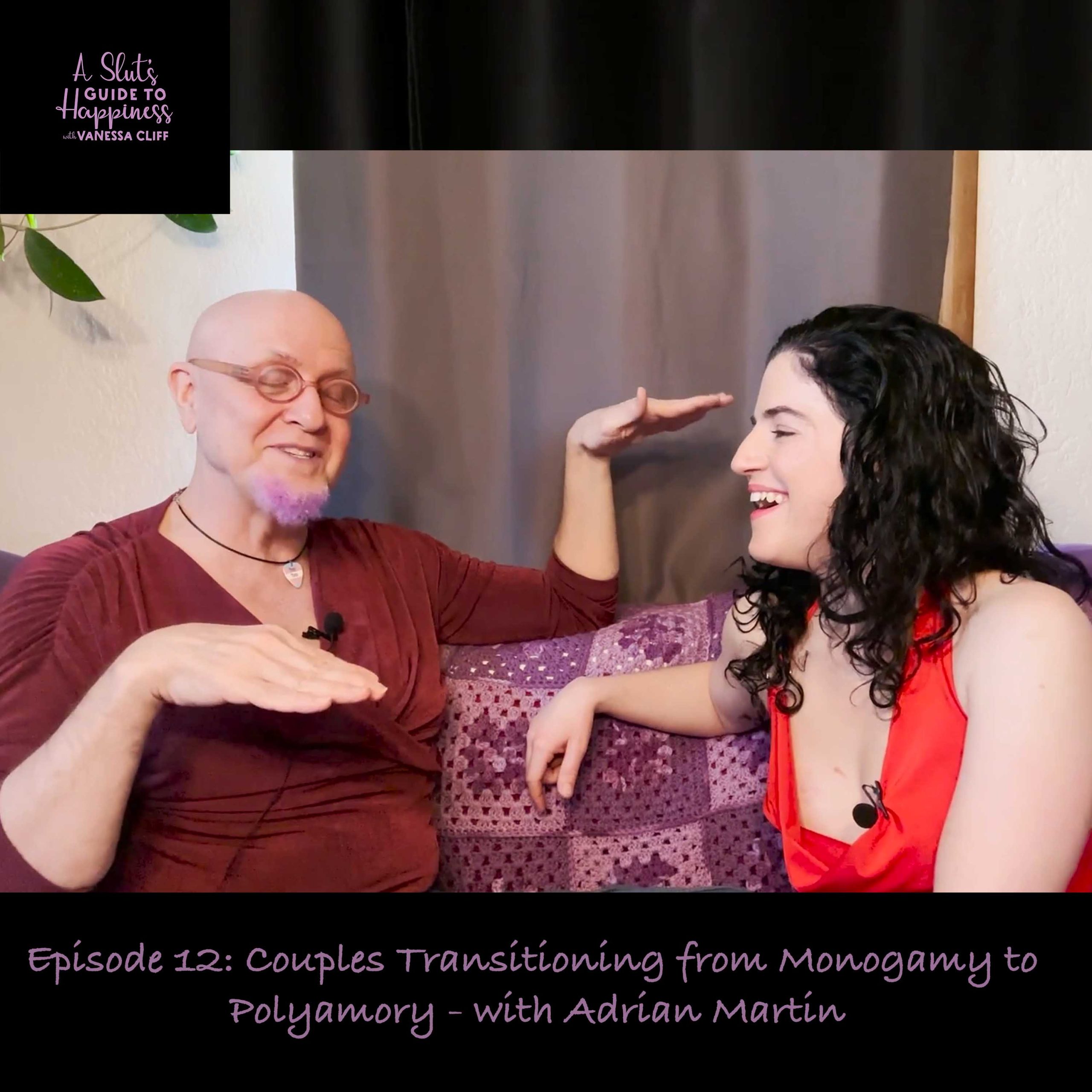
I’m your host, Vanessa Cliff, and today I will be talking with a dear friend and our consent educator and scene director at Cliff Media, Adrian Martin.
Adrian has been polyamorous for a long time, and more recently involved in community organizations and supporting people who are in polyamorous, open or swinger relationships.
But like all of us, Adrian didn’t just come out of the womb ready to fuck and love a bunch of people, especially in a society where that isn’t considered the norm. It’s just like coming out as queer, deciding you’re poly often is a decision that you have to make.
I can’t wait for the world in which people also have to come out straight or monogamous. But unfortunately, that’s not the world we live in yet, where we can just normalize all gender, sexual orientation and relationship structure decisions.
Adrian will be talking about an experience many people who are now polyamorous go through: dating outside the poly bubble, dating people who may be monogamous or have mostly experience with monogamy and are just learning about different options of relating to people.
Adrian has a lot of personal life and community organizing experience so I’m excited to hear some of these lessons gathered over time.
Today we’re going to talk about a specific aspect of polyamory, because polyamory is such a huge umbrella. Our primary focus will be on mixed marriages or mixed marriage-like relationships, where one partner is more inclined toward a traditional monogamous relationship, and the other partner is more inclined toward poly life, loving all the people.
Adrian, thanks for joining us again.
Adrian:
So happy to be here.
Vanessa:
Can you tell me about your progression with entering non-monogamy?
Adrian:
My general progression from moving through relationships really was, I was a cheater for a very long time. And, then I moved into more of a swinger community. The swinger community at least did not shame me for having more than one partner or desiring one more or the one person at a time.
Vanessa:
Was that you and your partner going out with other couples?
Adrian:
Occasionally I had someone to do it with me, but I was mostly a solo male at the time. Honestly, I was one of the creepy guys. It was back in the 1980s in the middle of the Midwest. Everything was very hush-hush. You had to give a code to get in. You go to these swinger clubs and undoubtedly there were just a bunch of dingle dudes hovering around any women that happened to be in the place. Most of them were there with partners.
It wasn’t a good fit for me, but it was a place where I felt a little less shamed for what I was feeling and doing. I had some good times, I still have beautiful friends from the swinger community.
Vanessa:
So even though it was difficult for you to step in, at the time identifying as a solo male, it became a space where you did receive affirmation?
Adrian:
Absolutely. Maybe got laid a couple times. So from there, I discovered this word polyamory. I had never heard about it until I moved to Portland, Oregon. I asked, what are you all talking about?
Vanessa:
Polyamory was not something that you heard talked about in the Midwest.
Adrian:
It was not, no. So the story about my marriage, the rough part of my marriage is that it was basically based on drugs. That is not a good foundation for a relationship. When we quit the drugs, it was like, who the fuck are you? Sobriety makes people a little different. That was funky to go through.
I kept drinking heavily, I was a mess back then, but after the marriage I did decide to just try to be a little bit more like myself. I tried serial monogamy, just brief relationships, trying to be true and not cheat on people, until I felt like I couldn’t in that relationship, then I’d go with the next person. I’m just slicing through people’s lives, not a great time.
Eventually, I just decided, I don’t know how to do this. I guess I’m a bad person.
My big surprise happened when I was dating a person who just came out and asked me, “So what’s the deal with that girl at work?” And I decided, I’m tired of lying, I said, “We’re fucking, we’re meeting up.” And to my surprise, my girlfriend said, “Do you thinks she’d be interested in both of us?”
Vanessa:
What a fantastic alternative to someone saying, you cheated, get out of here.
Adrian:
Yeah. Which had happened many, many times before. But because I was caught and so this time I was honest, she was like, maybe we should talk about it. So I was blown away that that was an option.
After that, I decided I would just try to date people who were okay with me dating other people. There was no name for it that I knew of.
Vanessa:
That’s very brave to be doing something before you found the community and names that help to validate what you want.
Adrian:
It helped to be a horrible horndog. I felt like I had to do this because there’s no alternative. Every once in a while, I would meet someone and think, oh this one is special, so I’m going to stop my old shameful ways and try this. Then I would fail, cheat, and she’d be mad, and repeat, repeat.
So in the midst of this, I found there is this community of people who are open around each other. At the very least, they don’t shame me for the fact that I preferred to have only one sex partner.
I’ve grown and come through all sorts of changes. One was finding my identity as a non-binary person. But at the time, I was seen as male in those spaces, there was a saying a long time ago, an explicit rule at swinger clubs that there was “no male-male contact”. You could be ejected from the club for it.
Vanessa:
So it was straight married folks coming as a married heterosexual couple.
Adrian:
The idea was you come with a couple then you both swap. That’s the typical way. But the swinger culture has come a million miles since those days too. But at the time, it was within the idea that “girls are hot, boys are not”. I was still closeted that way.
We could go behind closed doors, go in this door and lock it. The funny thing is almost every time I went in with a couple, the guy was like, yeah let’s go. But he wasn’t telling, and then as soon as we walked back out into the common area, we’d be saying, yeah we both fucked her. It’s part of the process of all of us moving forward. Hopefully it will continue.
That’s my story, from cheater, to swinger, to poly.
Vanessa:
I’ve heard a lot of people share that trajectory. When you only have the model of a monogamous relationship to lean on, it’s very challenging to talk about what you want. The assumption is either you don’t have sex with other people or you do, but you can’t talk about it because that would definitively break the relationship.
There’s a lot of shame attached to cheating. You have to be dishonest. And that is corrosive. I personally think that the truth is a source of freedom, it relieves you of shame. When you’re having to hide things, that can be personally painful.
I imagine, at least from things I’ve heard from other people who went through that journey, that there was some kind of relief around being able to be open to having a different kind of relationship. What was that like for you? How was that emotional process?
Adrian:
Well, one of the identifying factors for me was that, a big reason for my alcoholism was that I didn’t want to think of myself as a cheater. Since our culture allows for getting drunk and doing something that you didn’t really mean, then it wasn’t my fault.
I love the Brené Brown definition of shame and guilt – shame meaning you are something bad and guilt just meaning you did something bad. I was trying to hide the fact that I really felt I was something bad, that my being was unacceptable as a human.
Vanessa:
I think there’s so much attached to “being” a cheater, like it becomes your identity as opposed to just a thing you’ve done. We destroy political leaders who have cheated, as if you can’t run a nation if you have violated your sexual agreements with your wife.
But being able to take a step back from that and say, I’m a horndog, I’m not a liar, okay great, how can I find other people who are into the fact that I’m a horndog?
Now that you have realized your horndog polyamorous identity is welcome and accepted, there are people like you and you have found something positive out of this, you are now helping to provide that space to other people and supporting them. You’re involved in an organization that is doing that work. Can you tell us more about that?
Adrian:
Yeah, I belong to an organization that’s called Sex-Positive World, and the local chapter here is called Sex-Positive Portland (SPP). And it’s an organization interested in the whole sex-positive movement.
The piece of it that I tend to wiggle around in and do stuff in is the poly side of things. I facilitate a monthly meeting called “Poly Is as Poly Does” and then once a year, at a big convergence event, I host a class discussion group called “Poly Calendaring”.
Vanessa:
Oh my goodness, Google Calendar, my partners and I have a deep relationship.
Adrian:
Yeah, that’s an interesting thing because some people come in and think I’m going to teach them tech and how to use Google Calendar. And that’s not what we’re doing. We talk about things like hierarchy, priorities, and agreements on who gets what time and all that kind of stuff.
In these discussion groups, over the years I’ve gotten to hear stories from hundreds of people. Some of these folks come in and are just big ‘ole sex nerds, they just love delving into the deeper end of sex and relationships. Then a lot of people are couples who are opening up; that’s probably the majority. Then there are other folks coming in for various reasons, some on their own.
A lot of the people are coming in not because they are poly themselves, but because they’re in a relationship with someone who is. They’re seeking support for understanding their weirdo partner. They found a horndog.
Oh, I’m going to back up, I do want to identify and recognize that asexual people can also be polyamorous. So I can joke about horndogs, but that’s just me. So just put that aside, because I want to include asexual folks because you’re beautiful, too.
Often people will come in as a couple, frequently the male half of a straight couple is more drawn to poly and the women not so much. A couple that came in recently, to their credit, they started studying and they came to this group. They would come every single month and say, we just want to be prepared so we know what we’re getting into.
Vanessa:
During that time, they were not sexually or romantically involved with other partners, they were preparing themselves?
Adrian:
Right.
Vanessa:
Like physics 101, before you enter the physics labs, you study in textbooks.
Adrian:
It makes so much sense. In any other part of your life, you would do that. But there’s just so much shame and lack of support in our culture for anything to do with sex, even in a healthy relationship. So these two people blew my mind that they walked in there and wanted to do that.
Every once in a while, you also get a single person who has fallen for someone and they don’t consider themselves polyamorous, but the person they’re dating is, and they want some support.
I was involved in a relationship like that several years ago with a woman who I met doing sex-positive theater. That was just a blast. You make bonds while you’re putting those shows together, and oftentimes it turns into a romantic thing.
I asked her out and she was hesitant but said yes and we got along great. I asked, do you want to see more of each other? And she said, I don’t want to do polyamory. To my surprise, she didn’t say, that means you can’t.
Vanessa:
She wanted to be with you. She accepted that you wanted to also be with other people, but she wanted to be monogamous with you.
Adrian:
Yeah. I’ve bumped into this as a problem before. As soon as someone finds out I’m poly, they say, excuse me, I have to go. For someone to actually say, let’s give it a try because I’m not asking her to change, and therefore she’s not asking me to change. But there is a disconnect.
I call these “mixed marriages”. It’s a real challenge to make it work. We did it for about a year and it was a great time. There was a point when it seemed like it just got to be too much for her, the polyamory.
Vanessa:
What was it about polyamory that you think was particularly challenging for her?
Adrian:
It was learning how to deal with jealousy. That’s a big one. We were supposed to do something and there was a calendar error. She thought I was going to be spending the day with her and I couldn’t. It was very important to her. I said, but I made plans with this other person. And she said, I can’t deal with this shit anymore. It was unfortunate, but the two of us are great friends now. It’s a challenge when there’s a mismatch like that.
Vanessa:
How do you deal with it? I know there are some people for whom monogamy genuinely is the better relationship style for them, and that may remain true even if they learned about polyamory. How can a person who prefers monogamy navigate a relationship with someone who prefers polyamory, and bridge these different headspaces and relationship models?
Adrian:
I think this is what I jokingly call a mixed marriage. It’s kind of similar to when two people get married that are from very different cultures. We have to figure out what we’re doing. One of my oldest memories of what was called a “mixed marriage” was someone Jewish with someone Catholic. In these situations, you learn ways to accept and pick and choose how you deal with each aspect of the differences – I can participate in that, but not this.
As with every aspect of polyamory, it takes a lot more communication. If you’re both certain you’re monogamous, then we have all that cultural support that we are doing the right thing, we’re doing the normal thing. We are 100% supported. If we’re both polyamorous, then there are groups to find support, far fewer, but at least we’re kind of trying to do something similar. But in mixed marriages, it’s really tough.
What I mostly remember is her response when I was saying, very matter of factly, something that had happened between me and someone else. Her response was like, that sort of simplifies things, in that she knows I’m not going to try to pull anything. I’m not going to lie or cheat. I’m just doing it right out in front.
Vanessa:
She doesn’t have to try to figure out if you’re cheating because you’ve already described exactly what you’re doing.
Adrian:
It’s sort of thrust people into, instead of “guess culture”, you’re in “ask culture”. I remember one time she said, this is much easier because we have to say it, and because of the lack of assumptions.
Vanessa:
One of the things that I have found difficult about dating people who are monogamous, or who even just come from monogamous backgrounds and are very influenced by the dominant culture, is understanding the idea that if I love other people, that doesn’t mean that you are less important. That doesn’t mean that I love you less.
It’s not a zero-sum game or cookie that you cut up into pieces. The more you put into the well, the more love there is. That has been a very challenging concept to get across because I think that the narrative of competition and scarcity is so internalized and there’s a lot of fear attached.
Adrian:
I’ve heard people make the analogy about children: If you have two kids, when you had the second one, did you stop loving the first one so much?
Vanessa:
I no longer care about Billy now that I have Jane.
Adrian:
Right, it’s absurd to think of it that way. But when it’s an adult relationship, for some reason that seems impossible. We all know where that comes from, way back to when you got married to expand your kingdom and property holdings. We don’t do that, there’s no need for that construct to continue, but we’re still stuck in that idea.
Vanessa:
Another thing I’ve heard from some couples who are in more monogamous marriages and then decide to open it up is fear of opening Pandora’s box.
For example, if I say it’s okay for you to go for someone else at the sex club, or it’s okay for you to have a secondary partner that you see every fifth Wednesday, then therefore, that’s going to lead to a whole plethora of things, and all of a sudden there’s going to be someone sleeping next to us in bed every night. You’re just going to be going out and falling in love with a bunch of other people. You’re going to have 10 different partners and I’m never going to see you.
I’m wondering if you can describe some of the different approaches that you’ve seen to polyamory where people can open Pandora’s box, but then they can still exercise agency in which of the things they pick up from the box.
Adrian:
Yeah, it’s not exactly Pandora, you still get to pick and choose. In these discussion groups, the vast majority are couples that have been monogamous for many years, coming in saying, we’re going to open up our relationship, how do we do it?
The first thing that usually happens is they start making rules. You’re allowed to do this, I’m allowed to do that. I can’t do that, and we can’t do this. When it comes down to it, most of those rules, the long-term goal is to keep someone from falling in love.
Vanessa:
You can spread your legs, but don’t spread your chest.
Adrian:
Right.
Vanessa:
How does that go?
Adrian:
Never. Not once have I actually seen that turn out that way. But it doesn’t keep people from trying.
Vanessa:
It makes sense that would be someone’s deepest fear.
Adrian:
Of course, it makes sense because of that zero-sum love. We’re talking about before where people think that if you go out there and you fall in love, then I’m going to be left behind because that’s the way monogamy works. So the hard part is to shift into the new idea that, if we’re dating and I fall in love with someone else, I have to dump you. That is the only way.
Vanessa:
There’s only one prince in shining armor that can come rescue me from the dragon.
Adrian:
Exactly. I lost my armor though, I can’t find it.
Vanessa:
Well, this other person that showed up at the door can, so you can rescue me together. Or I can rescue myself and then have relationships with people who don’t need to rescue anyone.
But yeah, absolutely, that’s the model of monogamy, that you’re going to go love someone else. You couldn’t possibly love a second person. So even people I think that are wanting to intellectually embrace the idea of polyamory are still scared. I think it’s so much easier to say you can have sex with multiple people, you can go out and enjoy other people, but come home to me. I’m the only person that you can have that kind of loyalty and walk through like with.
Adrian:
Yeah, that’s the tricky initial stage. People will outline all their rules.
Vanessa:
Can you give us some examples of those rules?
Adrian:
Sure, one big one is you can’t do anything sexually with someone else that you and I haven’t already done.
Vanessa:
So if you don’t like eating ass, I better not be eating anyone else’s ass.
Adrian:
I don’t know if I’ve ever heard that specific one brought up, but it’s valid. I’m amazed by how often people come up with that idea.
Then there are rules about staying overnight with someone, because that looks more like their own monogamous relationship. Even time limits, like you can go and have sex but I want you to be back in three hours.
Vanessa:
It’s a quick date, it’s not an overnight kind of relationship with time to build deep emotional intimacy.
Adrian:
Right. Or rules about frequency, like once a month is all you can get with any one person. These rules are to make sure the relationship stays second, the marriage is the primary focus of emotions and time.
From that perspective, it makes sense. It simply doesn’t actually work.
Vanessa:
Tell us why it doesn’t actually work?
Adrian:
You can only warn people so much, they have to live it. Usually the first time a couple comes in, if it’s a traditional straight couple, then often it was the guy that decided he wanted to open up the marriage. The woman is hesitant then agrees.
Then the woman has 40 people chasing her, asking to go out with her, and the dude is sitting by himself. So now he feels really threatened and he becomes insecure and jealous. He’s trying to prevent this thing he started from becoming a way that he loses his partner.
To do that, he has to be hypocritical and roll back what he said before. Let’s make these rules and set limits.
Another common rule used is veto power. You bring someone in and if I don’t like him then you can’t date him.
Vanessa:
I have heard that one be a real source of cheating – because cheating can happen in polyamory relationships. So if you say, you can’t date Wendy Bear and you go out with her anyway, even though you’re in a polyamorous relationship, that’s still cheating.
So then veto power creates a vulnerability in the relationship because it precludes the ability to be honest, in the same way that someone who wants to be with multiple partners but is in a monogamous relationship has a struggle.
Adrian:
Another form that this will take is Don’t Ask, Don’t Tell. This can be a wide plethora, including “I don’t even want to know where you’re going”. I knew a gay man who was in a long-term marriage with a woman. They just pretended when he would say, I’m going to San Francisco for the weekend.
Vanessa:
She knew and she supported it, she just didn’t want to think about it.
Adrian:
Right. She just said, please don’t tell me. I don’t want to know what you’re doing. Hear no evil, that kind of thing.
Vanessa:
I can understand that as a way to cope with jealousy because you don’t have to deal with it. What I have found works best for me is the opposite. If someone tells me the deep, juicy details, I get off on this. It increases the compersion for me, it turns jealousy and fear into erotic energy.
Adrian:
One of my favorite memories, I met someone through a poly meeting, and we started our relationship together as polyamorous, knowing we were going to continue to be polyamorous. So there was no opening up. But she did have this, I don’t want to hear about the sex. I don’t want to hear about that at all.
There was one time I went on a date the night before, then I picked up my primary partner at the time and we headed to my house. She asked, so, how did it go last night? I said, really great, it was a great date. She asked, can you tell me what you guys do? I said, we went to an Italian restaurant. She said, what about after?
She wanted to know more but there were mixed feelings going on there. She kept biting, until I asked, do you want to know what we did? Really? She said, yeah, I guess.
Vanessa:
I can tell you the color of the butt plug if you like.
Adrian:
So I went into these details the whole time I was driving home, and by the time I got home, she was so hot for me. She just wanted to take me inside.
Vanessa:
So she had that transformative moment. I know not everyone would. Sometimes that could be really risky for you to share like that. It could result in someone having a panic attack, spiraling, worrying if you’re going to leave them. It can bring up insecurities, like this person must be so much better than me. But instead, in that moment, fortunately she responded with arousal. Which I think comes from this other person is enjoying my partner.
As we talked about, there is no superior form of relationship.
If you are a person who is happily in a 27-year marriage and you genuinely don’t want to interact with anyone else in a sexual, romantic way, I can’t do that personally, but I’m so glad that you’re happy and that’s working for you.
I know there are also some people who want to explore polyamory, whether that’s because they personally want to or because they love their partner or they want to support them in being able to do it.
Based on your personal and organizational experience, what are some things that you’re recommend for folks who are getting started in opening their relationships?
Adrian:
The main thing is to realize that non-monogamy, or ethical non-monogamy, is a million times harder than monogamy. Sometimes people think the grass is greener on the other side of the fence. You need to be ready to do a lot of deep diving into yourself, tossing away the shackles of your social and cultural upbringing. It’s hard.
Vanessa:
It reminds me of when people have asked me, should I have a child? I think the answer is, only if you really, really want a child.
Adrian:
The other part of this, if you want to try poly, do it because your relationship is able to sustain it, that you’re strong in your relationship, not to fix it.
It’s like when people think that they can have a kid and that’s going to pull them together. It just makes everything harder. The same thing is true if you want to have a polyamorous relationship. You’re going to struggle. You’re going to go through all kinds of things and you need a strong basis to start it with. If you’re having troubles, this is not the time to do it.
Also, I recommend you find support groups and read every book. There are so many good books.
Vanessa:
Do you have some book recommendations for us?
Adrian:
Oh yeah, my personal favorite is called “Stepping Off the Relationship Escalator” by Amy Garon. It’s not only incredibly insightful and helpful, it’s also really fun to read, mostly stories of people doing things very differently.
To understand oneself and one’s partner at a really deep level, the big book that people are going to now is called “PolySecure” by Jessica Fern.
Vanessa:
My counselor recommended that one.
Adrian:
In August, Sex-Positive Portland is going to hold a weekend event called Polytopia. We’re talking to some of these authors about maybe being speakers. Lots of entertainment and fun stuff, deep dives in workshops. That’s all happening in Portland the last week of August if anyone is interested in that.
Vanessa:
One of the reasons I love the name of that convergence, Polytopia, is because in my favorite book, Woman on the Edge of Time, a woman in a mental hospital is envisioning a utopian future that she has to fight to come into existence. One of the many beautiful things about that future that she imagines is that people really relate to each other and have all different kinds of polyamorous relationships freely.
She is derided as being mentally ill for having these ideas, and she has to fight to recognize that these are possible. You can have beautiful, healthy, wonderful relationships and also explore polyamy.
Any last recommendations for folks?
Adrian:
Seek out education-oriented community events. There are lots of poly spaces to meet at a bar and hit on each other kind of events. Nothing wrong with those. They’re fun.
But especially if you’re just starting your journey, you should also look for groups around your area that are holding classes or discussions on polyamory. Through a little bit of work ahead of time, you’re going to be in a lot better shape. It can make it a lot easier on yourself if you learn from other people’s mistakes, rather than having to stumble through them on your own.
Vanessa:
Adrian, my horndog friend and sexy nerd educator, thank you for joining us. I hope that people who are considering opening their relationship can find support, learn some healthy ways of communicating about it with their partners and potentially enter a new, life-affirming phase of their relationship.
This has been another edition of A Slut’s Guide to Happiness with your host, Vanessa Cliff.
You can find us wherever you get your podcasts, including Apple and Spotify, as well as on cliffmediaproductions.com.
If you’re over the age of 18, you can also check out our video content on our website, cliffmediaproductions.com.
And most of all, I invite you to join us in the pleasure of being awkwardly human, naked and without pretense.
Let’s get free.
















Materials found in this section may be sexually explicit in nature. To view materials on the site, you must affirm all of the following:
I am at least 18 years of age (21 in some localities). Any sexually explicit material I am viewing is for my own personal use and I will not expose minors to the material under any circumstances. I do not find images of nude adults, adults engaged in sex, or other sexual material to be offensive or objectionable and I desire to receive and view sexually explicit material.
The viewing, reading and downloading of sexually explicit materials does not violate the standards of my community, town, city, state or country. I am solely responsible for any false disclosures or legal ramifications of viewing, reading or downloading any material on this site.
This website and its affiliates shall not be held responsible for any legal ramifications arising from fraudulent entry into or use of this website. This warning page constitutes a legal agreement between this website and you.
All models, actresses and actors whose images appear on this site are over the age of 18. Bookmarking to a page on this site whereby this warning page and/or terms and conditions are by-passed shall constitute an implicit acceptance of the terms and conditions herein.
One Response
this was great information , well done