

“Complex personhood”, a concept from sociologist Avery Gordon, refers to the truth that we are all full of contradictions, neither victim nor perpetrator, neither fully wounded nor fully healed, always somewhere in between and both, stumbling as we search for ways to survive and thrive.
Sexuality is a huge part of our complex personhood. It can be a source of spiritual pain, destroying our sense of self and disconnecting us from others. And, the exact same sex acts, when given different meaning, can bring joy, passion, self-confidence, and deep connection.
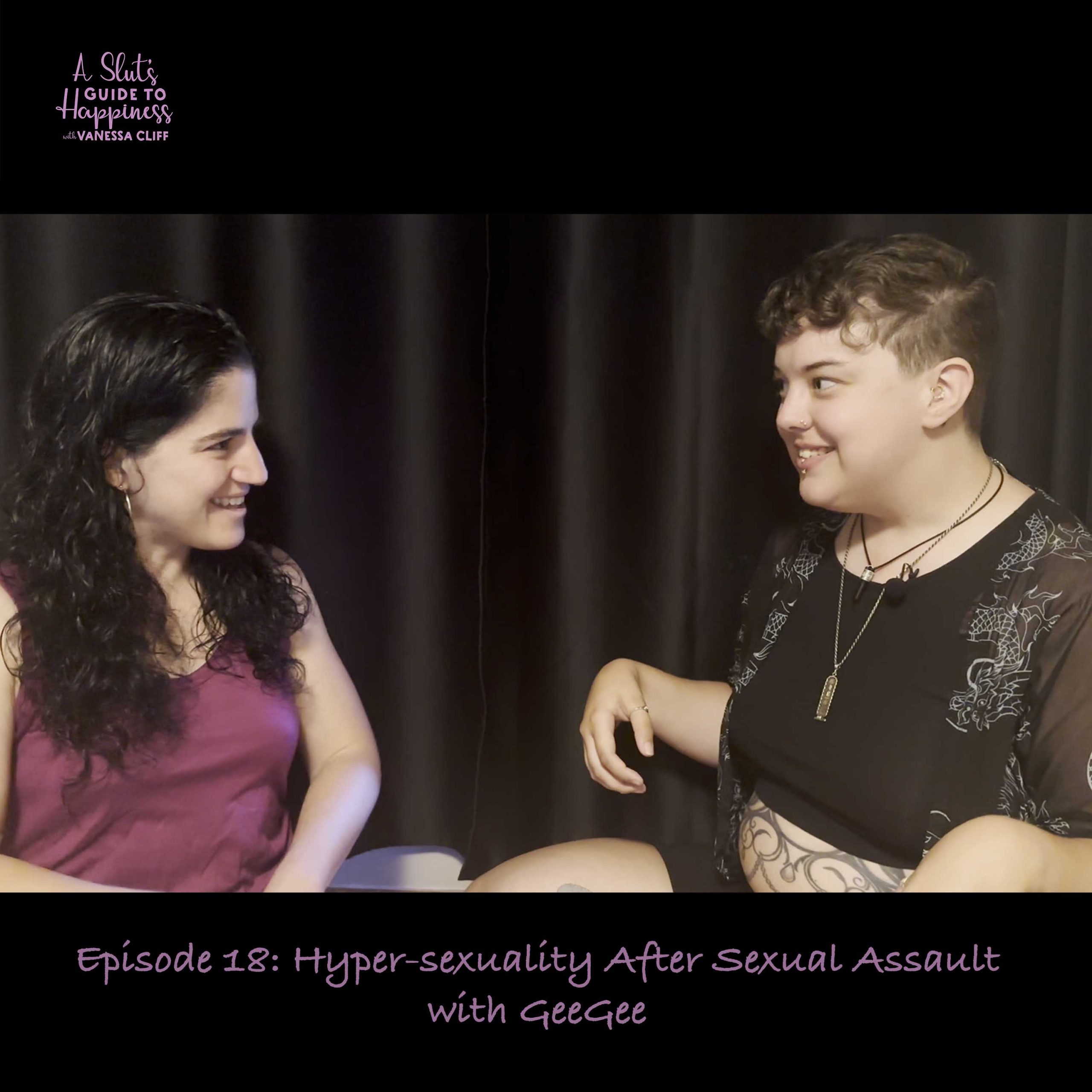
In this episode, GeeGee shares their experience with sexual assault and its aftermath. In the months following the assault, GeeGee became hyper-sexual. This had a rough impact on their self-esteem and social life, including leading to a non-consensual encounter that left them struggling with long-term guilt.
Eventually, GeeGee embarked on an intentional journey of personal healing, finding it in their heart to forgive both the person who assaulted them and themself. They learned that slutty sex itself was not the problem, but rather how they pursued sex and what it had meant in their lives. Today, GeeGee continues to have sex with lots of people, but through social connections and strong personal boundaries that are life-giving and positive.
This episode steps away from the often over-simplified narrative of sexual assault. GeeGee’s story offers survivors a reminder that everyone processes and responds to trauma differently, including the nonlinear path of reclaiming a sense of autonomy and personal power.
Welcome back to A Slut’s Guide to Happiness, where your body is perfectly imperfect and it’s safe to be as slutty, kinky, queer, or sexual as you want.
I’m so grateful to be joined today by an incredible queer leader with Cliff Media, GeeGee. They have been starring in and directing scenes and now mentoring new folks coming into the community.
They have also already been doing that mentorship in queer, sex-positive communities, which is beautiful. That’s actually how I met them. They were on the dance floor, really hyping it up at a sex club around here. One of the things I love about GeeGee is that they’re so open about who they are and what they’ve experienced.
We often talk at Cliff Media about the principle that the truth sets you free when you share your truth, even when it’s hard, even when it reveals complex personhood. Your vulnerability becomes your strength. What can someone say to you about something you accept about yourself?
Moreover, sharing your truth also creates space for other people to be their authentic selves, lose the shame about their experiences and identities and desires. GeeGee has already experienced so much and developed a deep understanding and compassionate concern for the trauma and shame that many of us experience.
I want to highlight today that we are going to be talking about tough subjects, including sexual assault and non-consent. I think that these are really important topics to discuss because so many of us experience them. But I also want to encourage you to take care of yourself and decide now if this is the right episode for you.
If you’re ready to dive into something intense, powerful, and important, we’re here and I’m glad you are here.
I want to return to that concept of complex personhood that I mentioned before. The phrase “complex personhood” actually comes from an incredible sociologist that I love, Avery Gordon. I think about it a lot. To me, it’s one of the most grounding concepts of what it means to be human.
Avery Gordon writes,
“Complex personhood means that all people remember and forget, are beset by contradiction, and recognize and misrecognize themselves and others. Complex personhood means that people suffer graciously and selfishly, get stuck in the symptoms of their troubles and also transform themselves.”
This is so profound to me because it reminds me that no one is just one story or one truth. We are all complex, full of contradictions, healing and growing in a non-linear path. We’re trying our best to make sense of the experience of being human, stumbling as we search for ways to survive and thrive.
So it is from this perspective that I’d like to enter this conversation today, remembering that all parts of being human, including sexuality, power, and assault, are complex.
Today, we’re going to be talking about the experience of hypersexuality after assault. GeeGee will be sharing personal experiences with this early in life, the way that trauma repeats itself, and their perspective on unlearning shame around a hypersexual lifestyle.
There are some powerful perspectives for anyone who has ever experienced a change in their sexuality after assault, as well as for anyone seeking to understand the way assault may affect the sexuality of their partners, friends or lifestyle community.
So GeeGee, thank you so much for your generosity and open heart and sharing your experiences today. Your willingness to share today means so much to me, and I believe it’s a gift to our listeners.
I want to start by asking you to ground us in the understanding of your first experience of sexual assault. I realize that we’re starting in a heavy place, but I think that, as you were describing, that this has become a foundation for the rest of this conversation. Please feel free to share only what feels comfortable for you.
Can you describe what happened and how it influenced your mental health and sexuality in the days and weeks immediately thereafter?
GeeGee:
Yeah, absolutely. First of all, I didn’t lose my virginity. It was taken from me. I was about 11, 12, 13 years old. And I had my very first actual real life boyfriend. He was very Christian. I thought he was a good Christian boy, which is not always the case it may seem.
We discussed getting intimate multiple times. When it came to the actual event, I was hesitant, and I did not want to do it. His words to me were if you love me, you would do this. I kind of just let him do what he wanted to do to me.
Afterwards I hated it. It was this very intense thing that happened to me. It wasn’t violent. It wasn’t like I was beaten with an inch of my life like some people are. But it was something that I did to please him, even though I didn’t want to do it.
After that, I realized that I had two options. Either I could continue to let him just do whatever to me, or I can enjoy it, for lack of a better term. So over the course of our relationship, we continued to have sex, even though at my core I didn’t want it. I wasn’t ready for it, I was too young. There were so many factors that went into me just not wanting it. But I did it for him.
Once we broke up, I was the first of my friends to lose their virginity, people came to me for comfort, for advice. They would say, I’m thinking about losing my virginity with my boyfriend. Nobody knew at that point that I had basically just let this person do that to me. So people just assumed that this was a consensual act.
I had friends coming to me for advice and comfort. It became a part of my identity. So I became very hypersexual very quickly, before I even knew what happened, before I even realized I was sleeping with anybody that would give me the time of day.
It took me years to realize this. I slept with anybody that would give me attention. I slept with friends’ brothers. I ruined multiple relationships because, again, I would just sleep with anybody, and I would go to parties, and, anybody that looked remotely cute, I’d sleep with them. This continued, I just had sex with anybody.
It took me years before I realized I did that because, if I slept with you first, you couldn’t assault me.
Vanessa:
It was self-protection.
GeeGee:
It was self-protection, yeah. I didn’t even really enjoy sex. Sex was just a thing I did. And, looking back, I had a little notebook, which is why I’m going to write a book one day, where I took notes of every person I slept with. Looking back on that notebook and realizing, wow, all of that sucked. That wasn’t good for a 14, 15, 16, 17 year old to be sleeping with all these people.
A lot of these people are way older than me. I put myself in a lot of very vulnerable positions. I was sexually assaulted multiple times after that. I’ve been sexually assaulted so many times that I’ve literally lost count of how many times people have taken advantage of me. It was because I was hypersexual.
I look back on that and I think about men and women today who I’ve spoken to, who’ve had similar experiences, who’ve been sexually assaulted and then became hypersexual. And a lot of guilt comes with that because it’s like, why am I hypersexual? Why is it that some people get assaulted and then they want nothing to do with sex? Why would I want everything to do with sex?
I just want people to realize, like, it’s because you have this power dynamic of if I do it to you first, if we have sex first, you can’t assault me. And that’s okay. That’s an okay space to be in. That is your coping mechanism. And if you’re there, I’m here for you.
I don’t want you to feel guilty. I don’t want you to shame yourself. I don’t want you to think you’re a bad person just because you became hypersexual after a sexual assault happened to you, but it’s just your coping mechanism.
If you want to one day get out of that. Writing my book is letting people know you can get out of that, and you can come to a place where I am.
Not only do I enjoy sex and have a lot of it, but I’m also doing porn and I’m okay. This isn’t a coping mechanism anymore.
You can’t just tell yourself I can never have sex again or I can never enjoy sex. You can get to a place eventually, after your sexual assault where you can enjoy sex, it can be fun for you and it can be healthy even.
It is. Sex is a stress reliever for me. Me and my partner, wwe go crazy, we’re feral on each other. It took a long time to get here, took a lot of therapy, and most importantly, took a lot of conversations like this, talking to my excuse me, talking to my friends, telling my friends, telling people, making those connections out in the world with people.
I give off this very comforting energy for some reason. I do have people that are strangers to me that I just need out in the world, whether it be like sex parties or clubs. People tell me about their sexual assaults and what happened to them.
I feel this desire to be there for people. I know what it’s like to be very hypersexual after your sexual assault.
Vanessa:
Yeah. So many of us in bodies assigned female at birth (AFAB) are assaulted, estimates are something like one in three or more AFAB people have experienced sexual assault by this time, this age.
I’ve heard a lot of powerful things, one thing you said is that you experienced a sexual assault that wasn’t necessarily like what mainstream media may depict. It wasn’t a dark alley where you were violently hurt, but it was still sexual assault in the sense that there wasn’t enthusiastic consent. It had these big impacts.
I think the fact you were able to honor your truth, that it was assault, even though that’s not how sexual assault is often represented, it’s significant and allows that ground for healing.
Then you also mentioned the idea that everybody responds to assault differently. For you, it looks like self-protection through hypersexuality, even if for some people it looks like completely avoiding sexuality. Both of those things are like valid trauma responses.
The third thing I’m hearing is that today you are still hypersexual, but it means something radically different for your life than it meant back then. The problem wasn’t inherently sex itself, so much as what it meant for you and why you were having sex.
GeeGee:
I want to highlight boundaries. Boundaries are what make me be able to be hypersexual without it being an issue. I talk to myself and I assess what’s okay and what’s not okay? What have I done in the past that led to drama, that led to ending the relationship with friends, or that led to me being assaulted again?
Now that I’m older – I’m not going to use the word can’t or shouldn’t – I’m just saying for me personally, I looked at these things that I went through and I felt it would be a good idea if I avoid it, this would be a good idea if I did this instead, and it would be a good idea for me to have conversations with people.
For example, me and my boyfriend, we are open. But we have boundaries and we have rules for each other about what we can and can’t do, what’s allowed and not allowed.
He totally respects me being hypersexual and he totally respects me like in every right of who I am. And I respect myself now too. That’s a big thing is for a long time, I didn’t respect myself.
A lot of people think, you can’t have sex and respect yourself. You can have tons of sex and respect yourself. I do, I love myself, I respect myself, and part of that is having boundaries around sex.
Now if I want to sleep with a friend’s brother, let’s use an example, I’m able to ask, hey, I think your brother’s cute, would it be cool if I slept with him? No. You can’t. Okay, thank you, I love that we had that conversation.
That is just one of the many boundaries that I’ve had for myself that allow me to be hypersexual now. And it’s okay. It’s not a coping mechanism anymore, it’s just what I do.
Vanessa:
I love that. By respecting your boundaries, knowing them, asserting them, asking about the boundaries of others, even though it seems like creating limits, it actually allows for massive freedom and joy, because you know the container that feels safe in which to play.
I want to say I’m really sorry for what happened to you, that even if this is common for many of us, it’s painful. What you’re describing at such a young age, I can’t imagine how you were processing through that particular experience and going through that for a long time with your boyfriend.
One of the things that we were talking about before is the way that trauma repeats itself. If you feel comfortable sharing, you alluded to this a couple times, about your friend’s brother. Can you tell us happened at that time, back when you were still really young and struggling with your experience of trauma?
GeeGee:
When I was 15, I had this really good friend. We partied together, we drank together. We hung out. Yeah, we did everything together.
She had an older brother that I thought was very cute, and I wanted to sleep with him. There was one time she was having a party at her house, not a big grand party but some of her friends. I was there and the older brother was there, and we were all drinking.
My friend eventually went upstairs with a guy that she had brought over, and they were doing their thing, so it was me and two of her friends that I had never met before. Her brother had gone to bed.
I want to highlight again. We were all drinking. We were all drunk. These two friends, I confessed to them that I found him very attractive and I would love to sleep with him. They told me, he would love it if you got naked and crawled in bed with him.
So that’s what I did. I got naked, I crawled in bed with him, one thing led to another, and we had sex. Just as we’d finished and we were cuddling up, he said, “In the morning, don’t tell me we had sex.” I asked why, he said “because I’m a virgin.”
The next morning, of course I followed what he said and I told him, “nope, we didn’t sleep together, we just cuddled naked and made out.” But eventually he realized what happened. It took a couple weeks, but he did realize what happened.
It was in the grand scheme of things, non-consent. He was not fully aware. He was drunk. He was not sober enough to consent to something like that. Even though I had been drinking too, I should have known better at that point. I should have known multiple things. That’s my friend’s brother. In general, friends’ brothers are off limits.
I was aware of the fact that he said he was a virgin, but I didn’t know if it was a lie or not before we slept together. And who in their right mind just crawls naked in a man’s bed? Especially at that age, if that was my partner, that’s one thing. But this is a guy that I barely spoke to, barely knew and, we had non-consensual sex together.
That destroyed me for many years. And it is still something I am working through in therapy because that’s so wrong. What I did was wrong. Doesn’t make me an evil person. I’m not evil. I made a mistake. I did apologize multiple times over the course of many years.
I was told just a few months ago, she got in contact with me, the friend, she said, we’re never going to forgive you for this. You will never be forgiven. I have to be okay with that. That is her truth. Those are her feelings. Those are valid feelings, she can feel that way, and he can feel whatever way. If they want to believe I’m an evil person for the rest of their lives, they’re allowed that, they’re allowed that space, and I’m allowed to to accept that and move on.
The only way that I know how to move on, which is to work through it in therapy and accept that this is a wrong that I did and never repeat it.
It did teach me a lot, taught me a lot about things like alcohol and mixing sex and stuff. There have been many conversations with my therapist over this. I have spoken to other men and women who were sexually assaulted and then did something similar as I did at one point or another.
I feel like that is something like we should kind of think about sometimes, when assault does happen to us, maybe give yourself space to forgive that person in any capacity you want to. Never forgiving them is also valid.
I have forgiven my very first boyfriend for sexually assaulting me because we were so young. I don’t think he realized what he was doing with sexual assault, and I have forgiven him for that. And there were other people who sexually assaulted me over the years that I forgiven. And there are some that I don’t forget because it was a little bit more violent.
Vanessa:
One of the things you’re saying that’s incredible is you’re saying that because you’re able to own this truth: what you did was not good, that was wrong, but you are not wrong. Because what we do and who we are, those are radically different things. Your behavior coming out of sexual assault, dealing with trauma when you are 15 and you’re able to own that is powerful.
I wish that there were 40, 50, 60 year old men in positions of power who are being accused of sexual assault, who could say, I messed up, I own this, I did wrong, I’m going to do better. I’m really sorry, without holding that guilt. There would be so much more healing if that were possible.
GeeGee:
If we could just give that space to anybody, anybody could just go, I fucked up. I’m sorry, I’m genuinely sorry, I’m going to learn from this. I’m never going to do it again.
The world would be such a better place if we all could just accept that we make mistakes. That’s part of being human, it’s learning and growing. You’re going to make mistakes. You’re going to fuck up. You’re going to hurt some people. It doesn’t make you evil.
I’ve had boyfriends cheat on me. I’ve had boyfriends assault me. As I grow and learn, I look back on those things and I think to myself, they were learning and growing as well.
Vanessa:
For me, one of the first people that assaulted me, he had a childhood where his father was really abusive to him. His actions were a repetition of the trauma. At the time I was angry. But as I’ve been able to heal, the main thing that I want for him is to receive enough care and love and that he is able to heal himself, forgive himself, and then have different kinds of relationships with people with more boundaries, more loving and consensual.
I think that for me, it kind of comes from a place of recognizing, like you were saying, that we’re all human, we’re on our journeys and struggling the capital T and lowercase t traumas of what it means to be human.
I think it’s so brave to share these moments, both your experience of self assaults to you and your experience of non-consent in that dynamic. I want to dig into how you worked on this. How have you gotten to such a different place now than what you were experiencing then? You mentioned therapy and the personal processes of reflection. What were those processes? How did your thinking about this change?
GeeGee:
I hated myself for a long time. I hated myself, I did not like who I was. I had this moment where I was alone. I didn’t have any friends. My family aren’t the most supportive people. And I felt really alone.
I thought to myself, why am I alone? It was because I took my anger that I had for myself out of other people. Who wants to be around that? Nobody. I thought, how do I change? That’s the next step. How do I change? How do I become a different, a better person?
The first thing I did was research. I researched mental health issues, things people have gone through. I read article after article and I came to a conclusion that I had borderline personality disorder.
Then I got diagnosed. I went to my insurance and asked for a psychiatrist. The psychiatrist gave me an assessment for borderline personality disorder. You have to score 5 out of 9 and I scored 9 out of 9. I had every single symptom that you have when you have borderline.
She said, next up for you is to find a therapist that wants to take care of people with borderline. There are a lot of therapists out there that refuse to take people with borderline. There’s stigma associated with it. You are basically considered like non curable.
A lot of psychiatrists and therapists think that when you have borderline, you are not curable and you are just a bad person. That’s it. It’s like narcissistic personality disorder. They don’t want to deal with you.
So I went online, found a therapist who believes in taking care of people with borderline personality disorder. I got on the right meds, got on the right treatment plan through Dialectical Behavioral Therapy (DBT), a therapy I will promote to the end of my life because it really saved me.
Before I knew it, three years later, I’m a new person. I hated myself three years ago. And I’m in this place now where I can feel love for myself.
Vanessa:
I felt that radiating from you the first time I met you.
GeeGee:
I’m fun to be around now. People tell me I’m fun, radiant. It’s because I put in work to be here. I wanted to change. I knew that locked away inside of me was this person I was hiding. I was protecting that person with a lot of bad behaviors, a lot of negativity. I wanted to protect myself from being hurt again.
You are very vulnerable when you are 100% authentically yourself. You can get hurt a lot, but the point is to have coping mechanisms to handle that hurt and be at a place where when someone hurts you, you can move on and say, what are my next steps? Grieve, feel, move on.
The main thing was being diagnosed as borderline. For those who don’t know, typically people who are diagnosed with borderline, 9 times out of 10, were severely abused in childhood. It comes from not being able to express your emotions in childhood.
When you’re a child, you have big emotions. Everything feels like the end of the world. Everything is like, I dropped my lollipop, I’m going to die. When you’re given space to express these big emotions, you eventually naturally learn to cope with them.
When you’re not given that space, when you’re told to be quiet, don’t cry, I’ll make you cry even worse, all these terrible things, you never learn to cope with your emotions. Now you’re an adult having emotions of that of a child. A lot of people see that as you being overdramatic, being manipulative, or not a good person.
But really, I just felt emotions at a higher level. I felt hate, I felt love, I felt sadness, everything was a 10 emotion. I dropped my ice cream and I literally want to kill myself. I’m now in the space where I dropped my ice cream and I go, oh man, that sucks. What can you do?
I’m in this place now where I can cope with my emotions and I can accept myself and be 100% authentically myself. And by the way, that is so much more fun. Life is so much more fun when you’re 100% yourself.
I came out as non-binary when I was 14. Nobody believed me. At 24, I got to come out again. Now actually telling people why my pronouns are they / them. I get to live authentically in my gender. I get to have as much sex or as little sex as I want, and have fun sex with fun people in porn.
I get to just be myself in such a fun way. I get to go to sex clubs and dance all night long, dress the way that I like to dress.
Look at me like I have a big belly. I don’t give a shit. I want to show it off anywhere.
Vanessa:
There’s also a beautiful tattoo on your belly.
GeeGee:
Yes. Being 100% yourself is great.
I want to go back to something you were saying earlier. There’s a sociologist and writer, Brené Brown who says the best way to battle fear and guilt and all these negative emotions is love and acceptance and friendship. That is so true.
When people come to you and they’ve got these fears and guilt and they’ve got these negative emotions surrounding themselves, the best way to help them is to accept them, is to love them, to just give them that space to feel what they need to feel.
My therapist has done exactly that. He’s so wonderful.
Vanessa:
I think everyone should be in therapy and have a therapist who accepts and believes in you and believes that everybody is capable of and worthy of love.
I think it’s incredible you’re talking about the impact of vulnerability on your life. Even though that’s risky, that’s the heart of connection. Your desire to seek understanding of your diagnosis – to reach out and to not accept the narrative that this means that you’re a bad person, but to continue seeking support – that means that you already were coming from a place of self-love.
Some part of you knew that you were worthy of a life where you feel more connected to people, where you feel happier. Even that is a brave step and must have taken a ton of work.
I’m interested if you can help us understand the connection between borderline personality disorder and the early childhood experiences of not having space to express your emotions. Do you think your experience of assault also played into the way that you struggled with mental health?
GeeGee:
Yeah, I do. I was so young, in a developmental part of my life that had such an impact on me and how I handle emotions today.
Vanessa:
You were talking about guilt. You have the experience of assault, and then you had an experience where you did something non-consensual, and you were wrought with guilt. I’ve seen partners go through that. Sometimes the guilt itself becomes even more corrosive to the spirit. How did you work through both the assault and the guilt and make sense of it, come to peace with those things today?
GeeGee:
I’m going to talk again about forgiveness. A lot of people say, you have to forgive people. I want to say, you don’t have to forgive anybody. Does it help you heal? Yes.
When I was going through therapy and we were working through like the assaults that I’ve been through and the abuse that I’ve gone through, like my therapist was like, who can we forgive and who can we? Once we started working through that, he asked, how can you forgive yourself for the things that you’ve done?
At first I was said, I don’t deserve to forgive myself. As time went on and we worked through other things in therapy, I started realizing, I’ve got high emotions where I think some people are the worst person in the world just because they made a mistake.
He said, when can you do that to yourself? When can you go look inside and decide, I am not a terrible person just because I made a mistake? When can you forgive yourself for that? I eventually looked at that big monster inside of me that is guilt. And I just said, I forgive you.
Vanessa:
Yes, when can you stop punishing yourself?
I’m interested in if you can help us understand also, this transformation that you’ve had in your understanding of hyper-sexuality. You’re still having lots of sex today, but you’re loving it. That’s what I’m hearing, that you’re having awesome sex, with your partner, at the sex club. People experience you as fun, not because you’re giving them pleasure but because you are happy abut yourself. You’re confident and love yourself.
How did your mindset about this change? What are some of the narratives you had about yourself and your sexuality back then, and what does that self-talk about sexuality look like today?
GeeGee:
It came from a lot of different coping mechanisms. I learned what other ways I can take care of myself, other healthy things for me to do when I’m feeling down, when I’m feeling suicidal, when I’m feeling angry, upset or guilty. That took a long time, at least like two years of me trying to figure out better coping mechanisms.
The second was talking to people, telling my therapist, telling my friends, telling people that are close to me. These are things that happened to me. This is something I’m going through here. I’m feeling suicidal right now because I spilled milk. Things like that. I know it sounds ridiculous, but it’s true. These are things that actually happen to me. I would feel suicidal over something as small as a crack in my windshield.
You find those coping mechanisms. I do things like take really long baths. Self-care. Sometimes I clean. I look around and notice my space is so dirty. I deserve a clean space, so let’s clean it.
The second step is boundaries. Finding a place where you can assess what is okay and what’s not okay? What makes me feel good? Does it make me feel good to have sex?
The third thing is being vocal in sex, being able to express if I don’t like something. Telling someone, this isn’t this doesn’t actually feel that good to me, I want it to end. Using communication in sex is so much more fun than people think it is.
Then I’m going to add, don’t fake orgasms, people. Just don’t do it. It doesn’t feel good for either person, you’re doing yourself a disservice.
You have that communication like, even, can you turn your finger like 90 degrees to the left?
Once you have these three things – coping mechanisms, boundaries and communication – sex becomes so much more fun and it’s so much more enjoyable.
And when you are enjoying something, why deprive yourself of it?
I’ve come across people, especially back when I was single and trying to date, that would ask the number of people I’ve had sex with. I would have to say, I don’t know, I lost count a long time ago. They would be grossed out or have negative things to say.
Part of loving yourself and growing is to look at them and say, “bye”.
Vanessa:
You deserve people in your life who love that sex is a source of joy for you, however many people you’ve had sex with.
GeeGee:
Yeah. And once you come to the part of your life or sex is enjoyable, why wouldn’t you want to have a lot of it? Cumming is awesome. We’ve all had that one orgasm that we’re chasing.
Vanessa:
I love that you’re talking about boundaries that serve your pleasure. When you’re experiencing pleasure, it makes your sexual partner happier, too.
Despite the fact that I’ve been trying to learn to center my pleasure and joy and being honest about my boundaries, it still comes up because it’s so ingrained in us to want to please. Recently I was having sex with a partner who really likes anal sex. And I’ve gone through the process of becoming an anal slut. My ass is down for whatever.
But that particular day, I was feeling tired, I wasn’t up for it, anal sex felt painful. So for me to say, “Sorry, not today” took some emotional labor. But I think that ultimately that serves me in knowing I am having sex I want, I’m choosing sex on my terms in a way that feels good.
Being confident in asserting your desires is a long and learning process. It’s different from how we’re taught, especially for people assigned female at birth, queer and trans folks as well, we’re supposed to be providers of sexuality and recipients of the desires of other people. But we also have our desires and boundaries, and being able to embrace and express those has a huge impact on how we’re able to relate to being slutty.
GeeGee:
I love that you bring up emotional labor. I’m going to talk about the concept of spoons. It takes a lot of spoons for me to do the work that I do. It makes me tired a lot. I call myself a sleepy bitch because I am sleepy all the time.
My best friend, whenever I hang out with her, I always take a nap because she’s such a safe space. I can really be myself around her and my body just decides it’s nap time because I don’t have to do any emotional labor around her at all.
Whereas there are a lot of other relationships in our lives, regardless of who they are, we’re going to have to do a little bit of emotional labor. That’s just how it is. And for me, emotional labor is like 3 or 4 spoons and I only have so many spoons in a day to choose from.
Vanessa:
My absolute favorite memory from a sex club is when I got so close to this friend group, a sexy swinger friend group. You’re not supposed to fall asleep at sex couples. But I was exhausted as fuck and I did fall asleep during the orgy and I felt like completely okay with that because I felt safe with those people. It was beautiful to realize I didn’t feel like I needed to perform.
GeeGee:
I don’t have to perform. That’s a good way to put it.
That’s another thing about sex. I don’t have to perform even in porn anymore, especially the porn that you’re leading. I can just be myself and just lay there like I need a cock in my mouth.
Vanessa:
Totally.
GeeGee:
That’s not me performing, that’s just me enjoying the sex that I’m having.
Vanessa:
I think that’s so much harder.
You mentioned that sometimes people come to you to talk about their experiences of assault because they feel like you’re a safe space to talk about it. Can you share, what are some of the things that you do in response when people are talking about assault? What do you think about or communicate to them?
GeeGee:
The number one thing I do is I give them that space to talk about it. A lot of times that’s all they need. They just need one person who’s going to sit there and listen to them completely judgment-free, and who understands them.
If they need more support than that, then I just give them feedback or I ask them questions like, what are you feeling in this moment right now, as you were telling me about your sexual assault? What emotions are you feeling?
Then we go from there. How can we tackle these emotions? How can we talk to them like they’re our friend? Because that’s what they are essentially, these emotions are there to protect you. And so I suggest, let’s talk to them.
Let’s look at emotions and ask, why am I feeling anger? Why am I feeling sadness? Let’s talk to them. Hey. Hi, anger, how are you today? Can you kind of explain to me what’s going on a little bit? That helps people, too. Especially when I start telling them, why don’t you visualize your emotions?
Who do they look like to you? Everybody always gives a different answer to me. One person said hey look like a little girl, which is hilarious. They just look like a little five year old girl with devil horns that just wants to run around and scream. I had one person who told me that they look like just two itty bitty rabbits running around their head.
I ask, how do we corral these bunny rabbits into a little pin and give them the lettuce and carrots they need.
That’s another thing that I do. A lot of times it’s just giving them a hug, too. A lot of times, like, I just need a hug. So let me give you that hug. But most of the time, it’s just giving them the space to talk about it because getting mental health help is very difficult. Getting a therapist is so hard, so hard and expensive. And people don’t always have the resources for that. So when they come to me, they just need a space.
Vanessa:
I think one of the reasons that is powerful is I hear a lot of times the body’s initial response to cope with trauma is to disassociate. The brain just creates a little box to put it away. It’s significant to be able to remember, this is what my body’s feeling or this is what I’m feeling emotionally.
You’re personifying emotions, working with emotions as a thing together, outside of you. You’re not your actions. You’re also not your feelings. You and the person become a team taking care of those little emotional rabbits. You’re offering to the person refuge from feeling alone in coping, with non-judgment for however the response to trauma looks.
I think the fact that you’re even willing to talk about it matters. It’s one of those things you’re told we’re not supposed to talk about. The messages are, don’t talk about sex, don’t talk about politics, don’t talk about abortions. And yet these are things that many of us experience.
GeeGee:
Yeah, I know so many people who have come to me and said, I had an abortion, I just want to tell someone I had an abortion to make it feel real. My response is, yep, I’m here for you, what do you need? They’ll say “Nothing, I just wanted to say that to someone who isn’t going to judge me”. The same happens with miscarriages. Miscarriages happen way more than people say but nobody talks about it.
And like you said earlier, about 1 in 3 people are sexually assaulted and nobody talks about it. These are topics that need to be discussed. Because if we talk about them, not only does it make it real, but it helps us work through them.
Vanessa:
You have gotten to a place of self-worth and confidence and it’s changed your relationship to sex and sexuality and relationships. I think that that is just so important in our ability to be whole, recognizing that we are going back to complex personhood. None of us are good or evil. None of us.
You were able to identify the humanity in the person that assaulted you, to identify the humanity in yourself. I think that that is an incredible message of love to people who are going through this, who have been assaulted and maybe are responding in all different kinds of ways.
One of the things that I’m hearing from your experience as well is that the meaning that you made of your response was really impactful. You weren’t necessarily changing your sexual behaviors, you changed how you set your boundaries, but you’re still hypersexual and you’ve changed the meaning attached to it.
I want to ask if you have any last closing thoughts. You’re such a gentle, loving, open-hearted person. I’m really inspired by the way that you have learned to talk to and about yourself. If you have any other thoughts for people who are going through this, whether they’re struggling with their trauma or struggling with self-recrimination and guilt.
GeeGee:
Talk about it. Talk to somebody, even if it’s a teddy bear or your cat. Just talk about it. It’s real. It happened to you. Let’s talk about it.
Then start making a plan to move forward, because you deserve to move forward. You deserve that love. You deserve that space, and you deserve to eventually move forward from it, not to be stuck on it forever. If you are stuck, that’s okay. But you deserve a space where you can move forward and move forward from the things that have happened to you.
Vanessa:
Yes, all of us deserve love and beautiful sex and joy and great, authentic orgasms, rather than faked orgasms.
GeeGee, thank you so much for sharing your experiences and your vulnerability as a source of connection. What you’re saying is healing me in my process of thinking about myself. I hope that it is for you viewers as well.
Thank you for joining us. This has been another edition of A Slut’s Guide to Happiness with your host, Vanessa Cliff and our guest, GeeGee.
You can find us wherever you get your podcasts, including Apple and Spotify, as well as on cliffmediaproductions.com.
If you’re over the age of 18, you can also check out our video content on our website, cliffmediaproductions.com.
And most of all, I invite you to join us in the pleasure of being awkwardly human, naked and without pretense.
Let’s get free.



Materials found in this section may be sexually explicit in nature. To view materials on the site, you must affirm all of the following:
I am at least 18 years of age (21 in some localities). Any sexually explicit material I am viewing is for my own personal use and I will not expose minors to the material under any circumstances. I do not find images of nude adults, adults engaged in sex, or other sexual material to be offensive or objectionable and I desire to receive and view sexually explicit material.
The viewing, reading and downloading of sexually explicit materials does not violate the standards of my community, town, city, state or country. I am solely responsible for any false disclosures or legal ramifications of viewing, reading or downloading any material on this site.
This website and its affiliates shall not be held responsible for any legal ramifications arising from fraudulent entry into or use of this website. This warning page constitutes a legal agreement between this website and you.
All models, actresses and actors whose images appear on this site are over the age of 18. Bookmarking to a page on this site whereby this warning page and/or terms and conditions are by-passed shall constitute an implicit acceptance of the terms and conditions herein.