

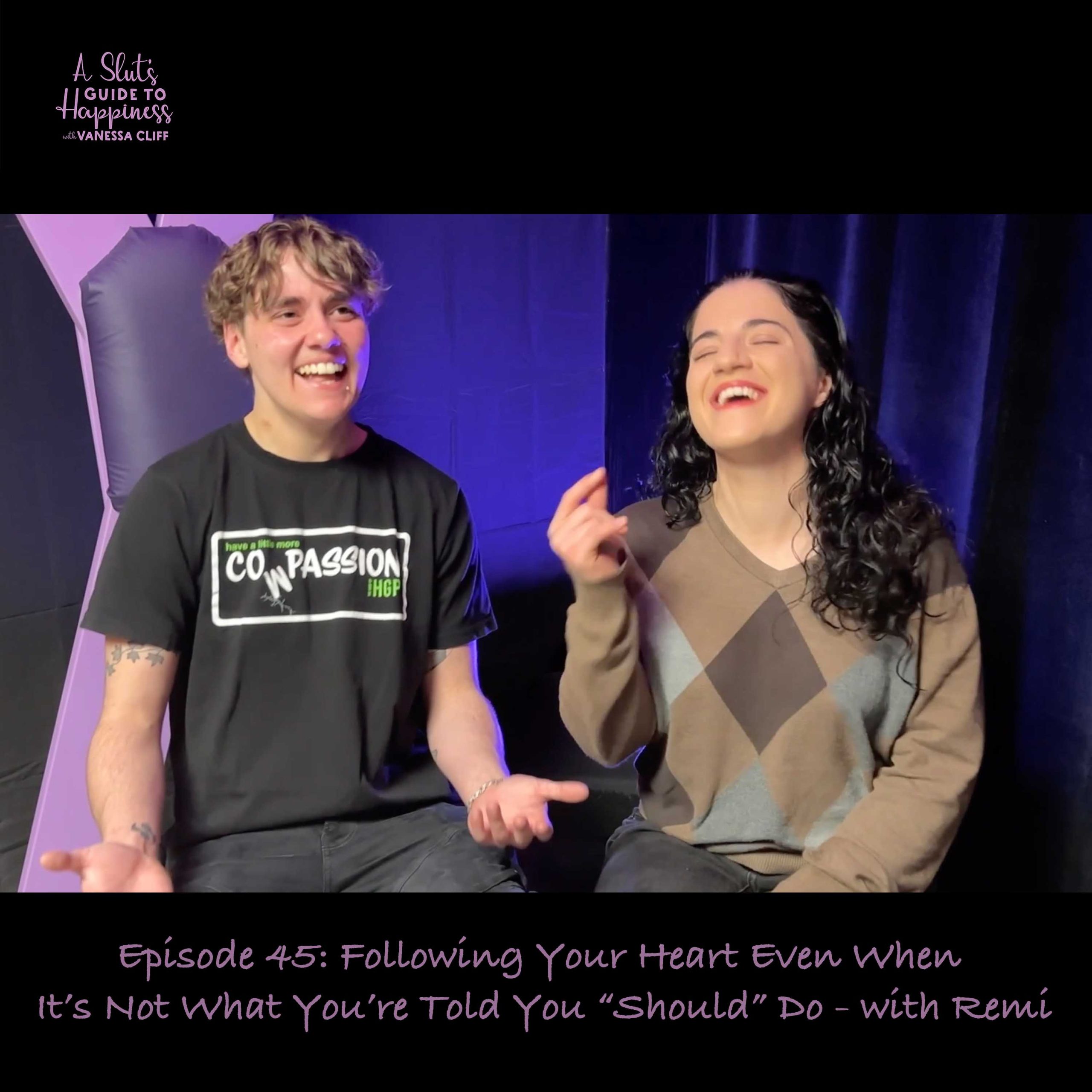
From a very young age, Remi lived outside the dominant social norm. Openly gay in middle school, he later came out as transgender, explored polyamorous relationships, and now participates in porn. Through each of these touchpoints, Remi had to make a choice between maintaining emotional safety in living based on normative expectations or pursuing a life that felt more authentic.
In this episode, Remi describes moments in their life where they chose joy and love. It’s not easy trusting your gut. Even in the absence of violence, the stories that dominant society tells us can be loud. Remi’s ability to follow his heart is an inspiring example of self-trust.
Welcome back to A Slut’s Guide to Happiness, where your body is perfectly imperfect and it’s safe to be as sexual, kinky queer as slutty as you want.
Today I have the pleasure of talking with our friend Remi, who is one of the lead videographers with Click Media, our LGBTQ, BIPOC, and folks with disability-led community organization that produces some loving smut.
We have a lot of fun with what we do and we’re also building community in a time where it feels more important than ever to have loving, queer and trans-positive community.
Today we’re talking with Remi about some of his transitions. I think this general concept is something that we talk about, it’s one of the fundamental concepts that we’re exploring in this podcast.
What does it look like to allow yourself to be whatever makes you most happy in the world, even if that’s not the normative script that we’re told that we should or shouldn’t be living?
I think it’s really brave when I meet people who are going through the process of uncovering their gender identity or sexuality, relationships or sex work, anything that they’re doing in their lives that are their intentional personal choices, that are not just following the script, but following their hearts to happiness.
Thank you for joining us, Remi.
Remi:
Thank you for having me.
Vanessa:
I’d like to start with the first time in your life that you can remember where your desires, whether that’s sexual desires or gender identity or even just dreams for your future, were different from what your parents or teachers or society were telling you.
Remi:
The first time might be hard to pinpoint just because my memory is pretty scattered from my childhood, but as far as gender identity goes, I have always looked and acted like myself, even to the point where my pediatric doctor said, I think that you should have been born a boy.
Vanessa:
Your doctor said that?
Remi:
Yes.
Vanessa:
How old were you?
Remi:
Probably just like 3 or 4.
Vanessa:
That’s a pretty insightful doctor.
Remi:
You know, a pretty good doctor, I guess. In middle school, I identified as gender-fluid for a while, and then I kind of just dropped that because it was overwhelming for me at the time. I just let it slide for a while.
Vanessa:
There’s a lot of pieces in that, and it’s interesting that it started so early. Do you remember being told when you were 3 or 4 that the doctor said that?
Remi:
I was told, yeah.
Vanessa:
How did that land with you?
Remi:
It didn’t surprise me at all. I felt like that checked out. I wish that maybe there would have been more of a positive in that.
At the time, in 2005, it wasn’t considered right. Gay marriage still wasn’t even legal. My mom always thought I was a lesbian or something. She was scared for me that I would never get a job or have a community or anything.
I think she also chose to ignore it. Nobody was surprised when I eventually came out. But I think that maybe if other people had paid a little closer attention to it, I might have really doubled down on it instead of having second thoughts.
I told my grandma very casually, I was probably 11, I said “I think someday I’ll have a mastectomy, top surgery.” I don’t think it was called that at the time. She said something like, “No, you don’t know the consequences”, something about hormones, “you don’t know anything”.
At the time, I trusted my grandma so I felt like, maybe she’s right, that’s something I shouldn’t worry about right now. Maybe it’s something I’ll worry about in the future.
Just little things like that pushed me in the wrong direction. And I wasn’t exactly motivated to run in the right direction. I just put it off for 22 years.
Vanessa:
Wow. I really relate to what you’re saying, because when I came out, as I was, not sure if I was bisexual or lesbian at first, but when I came out, my mom’s response was very much like, “Your life is going to be harder. I’m sad for you.”
I agree with that, that I wish there had been more positivity in the response. There are things that are challenging and there’s also things that are amazing and beautiful about being queer in the world.
So you’re describing some of the challenges about being able to decide whether and when you could be your authentic self. Could you tell us about some of the feedback you got when you were out as genderfluid in middle school? What was the peer response you received?
Remi:
It definitely wasn’t exactly affirming. Even today, people still have a hard time with gender neutral pronouns. At the time, they were very new. The whole stereotype, I remember my dad saying “they is for multiple”. It was very confusing for everybody, for whatever reason.
I definitely didn’t get like my pronouns respected or anything. I also didn’t have that many friends, so it wasn’t like there were that many people that could mess it up. All my queer friends, of course, were supportive friends.
Vanessa:
You had queer friends in middle school?
Remi:
Oh, yeah. I was in the Gay Straight Alliance. My high school class was more gay and straight, I think they even did the statistics and we were like the majority queer out of like a thousand people.
Vanessa:
I generally tend to think that most people are queer than they allow themselves to be. I wonder if, when you’re in that environment, and people start feeling that it’s safe to be openly queer, then people are more likely to come out than in another environment.
Remi:
For sure. You’ll have somewhere in the Midwest has one out gay person maybe and they’re really brave for that. Or in other parts of the country, people will get beat up for that.
So there’s that aspect too, trying to be safe and they don’t want to get snitched on and they don’t want to get in trouble. Some people’s families are from places where it’s considered even worse, literally a crime. Like if you’re Slavic, that’s illegal.
Lots of different perspectives because California is a melting pot. And so it comes from different places. Obviously, associating yourself with the people that you like to fit in with most will help. It was a really big school. I think smaller schools, it’s harder to get away with stuff.
Vanessa:
I’m really glad to hear that you didn’t experience that kind of violence that maybe in other locations people do.
But also, I imagine there is still some degree of difficulty that comes from trying to identify yourself in a way that other people do not immediately conclude about you. You have to choose to express that.
What was important to you about that? Why were you emotionally committed to doing that?
Remi:
At the time, it just felt right. I was learning and growing, learning about what this is. I would learn about gender queer, probably through Ash Hardell’s book, “ABCs of LGBT” that I got, when I was in middle school, or maybe high school. The timelines get away from me.
It was teaching about the gender binary and the scale. I was trying to find where I fit on that scale.
I did get bullied. I just didn’t know I was getting bullied about that.
Vanessa:
What do you mean?
Remi:
I don’t know what it is, but I don’t see the bad in people that easily. When someone’s making fun of me, I’m laughing with them, because I don’t see it as the same thing. I’m just not reacting because I don’t get it. They may be saying something mean, but it just goes over my head.
Obviously, they’re looking for a reaction. So eventually that gets old.
Vanessa:
That’s an incredible response. That’s something I try to tell my daughter. The best way to de-escalate bullying is to recognize that it’s not about you, approach it from the mindset, “that sounds like a ‘you’ problem”.
It’s amazing that you were able to kind of hold on to yourself and you had access to resources like the book and your friends and GSA.
Since we’re talking about gender identity right now, you mentioned it 22 that something happened in your life? What changed?
Remi:
I was in a relationship with a trans woman, and we were just talking about life, as you do. I was explaining what I was feeling and going through, including anxiety, constant depression, not feeling comfortable at all.
Vanessa:
In your body? Well, I didn’t know at the time. I just felt like everything sucks. Life was miserable. She was like, when I started HRT, a lot of that brain fog went away. It’s like chemical imbalance. You don’t have the right hormones that you’re meant to have. Everything is going to be that much harder.
She was right. I started HRT two weeks later. I always used to be anxious driving because I’m scared of car crashes. So I would just be like a Chihuahua while I was driving all the time. Two weeks after starting, I was driving, going to work, and I realized I’m totally calm right now. This is crazy. It was a moment of affirmation, like I guess I made the right choice here.
Vanessa:
That’s really interesting to me because one of the things I’ve been talking with people about is the way that gender is socially constructed and how is it related to your gender presentation and the way that you fit into that socially?
But also, I’m hearing you describe that there’s a biochemical component of it for you.
Remi:
Yean. I think, obviously this is how I always get off, you’re talking about defining gender, that they’ve just created and how it technically makes everybody female. Because you start off all female. I’m thinking what happened here is that this missed that step of just switching over that chromosome.
I’m not a biologist, but that’s entirely possible, especially considering we don’t do enough research on gender and our bodies in that way and in neuroscience or any of that stuff.
Honestly, we just focus on the wrong stuff with science, whatever is going to make the pharmaceutical companies more money is what we focus on.
Vanessa:
So you start taking HRT, you start feeling less anxiety in general. You mentioned driving, but how did it impact other areas of your life?
Remi:
Yeah, just in general, feeling less anxiety. When I was younger, I definitely thought I was the shit and I had a lot of confidence. But I lost it over the years through traumatic experiences and relationships. I became pretty small internally.
Taking HRT helped me find myself again and find my confidence and my love for myself again. That self-love was diminishing pretty quickly before I decided to do something about it and give it a try.
Vanessa:
I love that so much, because I feel like loving yourself is such a core part of happiness and quality relationships.
I would like to know a little bit more if you can go a little bit deeper on that. What about your transition, especially taking hormones like you’re describing, was important to you? What helped you feel like you could love yourself again, feel confident again?
Remi:
It’s hard to pinpoint, it does just feel sometimes that it’s hard to express. It’s a feeling of joy that comes from somewhere unique that you don’t have anything else to compare it to or describe it.
It’s just like one of those warm feelings that you just hold on to. You don’t try to think about it too hard. You don’t want to ruin it.
Vanessa:
Yeah, yeah, I get that. It’s good, why question it, right? Lean into the joy.
Remi:
Yeah, definitely. It helps me with, obviously, my physical appearance. It changed a lot. My voice change was definitely something I really wanted. I also really wanted more hair. Obviously I didn’t want the acne or the way puberty feels.
I’m still traversing the idea of what it is that I do or don’t want. My perspective on whether or not I want bottom surgery fluctuates based on how I’m feeling in terms of dysphoria. But also I just don’t like the way that they do it. So if they find a new way to do it, I’m there.
When I think about that deeper, that means I know I want it. If I’m thinking about it that way and I would do it if the procedure were different, then I guess it means that I want it. But I’m okay with not having it for now, which is sort of what I did with the rest of it for 22 years. It’s not going to take 22 years this time. We’ll figure it out.
Vanessa:
That’s interesting. I hear a lot of you listening to your gut.
Remi:
Yeah. Trust in the process.
Vanessa:
Do you mind if I ask if you had top surgery and how you felt about that?
Remi:
Yeah. I did not have top surgery. I was always pretty small. I haven’t worn bras since seventh grade, but I think I was like a 36-B size. I’ve always been small and working out also helps. I do a lot of wide arm pressure. I do a lot of dancing too, so that helps.
But, yeah, it does bother me sometimes. I was binding for a while, and then I realized that just outs me more like there’s there because there are cis men with breast tissue. And that’s just a thing.
The thing about passing is confidence. If you’re saying, this is what I am, you can’t tell me. You don’t know. That’s the secret to passing.
Vanessa:
You walk through the word as a man.
Remi:
Yeah. Imagine being raised thinking you were a God and there you go.
Vanessa:
I love it. There’s so much stigma against valuing yourself. Like you’re fucking God. Hell, yeah. That’s amazing and beautiful. We can all be gods and goddesses.
Remi:
Sometimes I get that I’m not modest or you’re overconfident. You need to be humbled. But what you speak into the world is what you’re going to get back. So even if I’m not feeling like I’m the baddest ever that day, I am still going to look in the mirror and think, you’ve got this. Put a smile on your face and you’re ten times better.
Vanessa:
However much you love yourself is how much love you get back.
Remi:
I think that love is underrated because I think it’s like the secret to happiness. Really all you need is to find love somewhere in the world.
Vanessa:
All right, let’s go there. Can you tell me about your initial connections, it could be deep friendships or romantic relationships. How did you begin exploring connections and love in your life?
Remi:
Pretty early. My first girlfriend was in seventh grade. I had a few boyfriends before that.
But the thing with the boyfriends was that they asked me out, and I said yes, because I thought that’s what you were supposed to do. I thought, all these other little girls are out there in these little middle school relationships, I don’t understand it, but they asked me and I sighed and said yeah.
Vanessa:
It goes back to the normative script. This is what I’m “supposed” to do.
Remi:
Yeah, hiding in plain sight. But obviously the second that I had a girlfriend, I realized, oh no, that’s the stuff, that’s it. I focused on being the gayest I could be.
Vanessa:
Because at this time you identified as a lesbian.
Remi:
Yeah. And that’s also where the confusion with gender came too. I felt like, am I just a big dyke? Or am I actually more than that? At the time, I decided I’m just going to be the gayest I can possibly be, and that’ll be good enough for now
My first girlfriend, we dated for about a year. It was great, we had a great time. She’s a first generation Vietnamese-American, so her parents didn’t like me. I wasn’t surprised. We were sexually active too, in seventh grade.
After that relationship, it went on. I was kind of a player when I was younger. I definitely broke some hearts. We’re still friends and I have apologized to the people. You live in you learn.
Vanessa:
I’m interested in knowing more about that. When you say “player”, does that mean “slutty”? Is that like promising people things and then they didn’t work out? What do you mean there?
Remi:
I think to me, I like it didn’t come off that way, in my mind I was just doing my best and being honest because I’m just like such an honest person. For example, telling someone that I wanted to break up with them because I wanted to be single for the summer. It’s not exactly what you’re supposed to say, but it was the truth.
That doesn’t come off great. Obviously she got mad at me and I felt bad, I didn’t mean to come off some type of way. Whether you mean it or not, that doesn’t really matter, because the feelings have been hurt. All you can do is learn from that and then apologize and grow.
Vanessa:
But you were advocating for your own freedom.
Remi:
Yeah, definitely.
Vanessa:
I want to fuck around this summer.
Remi:
Yeah. And why shouldn’t I? I gave her all the reasons. I said, we’re young. I like lots of things. Obviously I wish that I would have been a little more kind. Everybody could use a little more kindness.
Vanessa:
Totally. I had a lot of moments like that in my chaotic early relationships, for sure.
How were your parents responding to your lesbian relationships and your gender exploration?
Remi:
I came out as gay. I didn’t even really come out. I just said “I’m going out with my girlfriend. Bye, I gotta go.” They were super fine with it. My girlfriend stayed over.
I even had a girlfriend, later, that lived with us for a couple of years in high school. It was a lot more complicated than that. Her parents were drug addicts. So we were giving her a safe space. They were always really cool about me being gay.
That’s why I was so surprised when I came out as trans and I got a pretty different response from my dad. He was upset. He said, “I’m mourning the loss of my daughter”.
Vanessa:
It’s like, “I’m right here”.
Remi:
Yeah, I was like, I’m the same person.
He said, “I spent so long picking your name out, I should get to pick your new name if you’re going to change it.” I said, I’m not a pet. And he said, “Yes, you are”.
He said, how will you ever find love? And I said because I’m not super old and straight.
He said “I don’t think I could handle you going in for a surgery like that.” I said, “Good thing that won’t tell you what I’m doing with my genitals and you’ll never have to worry about it.”
Vanessa:
Yeah. Falls under none of your business.
Remi:
Yeah.
Vanessa:
So he just initiated this conversation with you? He just wanted to share his frustrations?
Remi:
Yeah. I didn’t even ask. I asked if he fed the cats, and that’s what I got. It was so weird to me because he was crying. I don’t understand. I said, I’m the same person. I’ve always looked like this. This is just me.
He even went as far as to say that if I had asked him to sign off on this when I was 16, that he would not have. And said, why would you make a point to say something like that?
Vanessa:
Yeah, you are not 16. You are able to make your own decisions as an adult.
It’s interesting that he had the mourning response, he even said that. I know it’s tough because also I imagine that was really painful for you, but I’m wondering if you have ideas about what he might have been going through, like why that came up as sadness for him?
Remi:
Honestly, I don’t really have any idea. I think maybe he’s a misogynist. I don’t know, maybe he liked having a daughter because he’s kind of like a control guy. So in his mind, daughters are easier to control.
Obviously you get into thinking deeper about things and it’s weird because I’m avoidant with my trauma. I just block it out and all that. All of my childhood stuff, I don’t really remember a lot of it.
Actually, the girlfriend that lived with me, I was talking to her the other day. She told me something I didn’t ever know, that my cousin had threatened to rape her and my other ex. They went to the school, and the police tracked the IP, and they found out that it was my cousin that I grew up playing with.
I was thinking that I was like, like that kid could have possibly been messing with me, and I just don’t remember. I don’t have any recollection of any sexual abuse in my past, but it’s possible that it’s there.
The reason that I bring this up is because when I was like 20 years old or 21, I had to ask my dad to stop smacking my ass.
Vanessa:
And he was doing a playful way?
Remi:
Yeah, it wasn’t like a spanking or anything. I would walk by and he would smack my ass. I choose not to think too deeply about that kind of thing, because I don’t want to unlock some sort of trauma that I can’t put back away.
I don’t have any idea of how severe it was because I was wrong the first time when I was trying to recollect how bad it was. And I thought it was bad. Like I got sure I got like that spanked. But then I remember, I’m wrong, I was beat. There’s a difference in the severity and context.
So as I get older and learn more about different families and relationships and what love looks like and what I grew up thinking love was, I’m unpacking. I’m trying not to go down the wrong corridor that’s going to drop me down a pit somewhere.
As much as I would love to heal and grow, you can’t do it all at once. You got to take it super slow and at a pace that you can handle. You’ll lose your mind.
Vanessa:
It’s so true. Our jobs are not healing. We go at our pace, when we’re ready.
In my experience, what I’ve heard from other folks, and in some ways, experiences in my personal life too, is when you grow up in an abusive environment, when you’re taught from your primary caregivers that abuse is how love feels, it can take a long time to relearn a different way of being in loving relationships.
Did that come up for you in your life?
Remi:
Yeah, it did, definitely. You seek out what you know.
When I was getting into relationships, I was almost allowing stuff that obviously I knew wasn’t right to happen. I don’t know whether I thought I deserved it or I thought that’s what I wanted or what I needed or whatever it was going on in my head, or if that’s just because that was the pattern, that I was like the groove that I was already in. Like an object in motion continues in motion.
I got myself in a lot of trouble and sticky situations having to deal with relationships. I got myself kidnapped and hurt and physically abused. The craziest part was that there were always witnesses and they always kept their mouths shut. Even my mom.
The one that was really bad and the reason that I moved back here. She was freaking out because she figured out that I was leaving. I was literally coming here the next day. She figured it out and convinced me to get in her car to talk. We talked for a while and it was all fine.
Then I said, I’m ready to go home now. She started driving towards the freeway in the complete opposite direction. I ran out of the car. She chased me all the way home.
I’m sitting in the house with the door locked, and I’m on the phone with my mom. I asked, “Can you use the ring camera to tell her to go away?” My mom said something like, “This is your problem.You need to fix this.” I was like, “Okay, but I don’t know what to tell you, I can’t make her go away. I already tried.”
She kept banging on the door and screaming for about 30 minutes. Theen my mom was finally concerned about the neighbors so she called the cops.
But for her to say, “This is your problem you’ve gotten yourself into”, she didn’t consider that the whole reason that I kept going to that girlfriend was because I didn’t want her coming to me and my neighborhood and messing with my life. It may have seemed like I was choosing this. But really I was too scared to leave or go anywhere else.
I didn’t know what to do. And I was only 19. She was 27. So she just had this obviously manipulative grip on me. She knew what she was doing. It probably wasn’t her first rodeo.
Vanessa:
So you were still figuring out what relationships look like, what you want, who you are as an adult in the world. That’s a really vulnerable time. But you escaped.
Remi:
I did, and it actually helped me figure out the non-monogamy thing. Part of what was so upsetting to me about it is I don’t like being accused of lying because I don’t lie. She would constantly accuse me of cheating. The worst part was she was accusing me of cheating with men. I was like, what are you talking about right now? This is crazy. It made me so mad.
Since then, I will never be with someone that has that type of jealousy. I learned later that the reason that she was accusing me of cheating was because she was cheating and the accusations were deflection.
It drove me up the wall so I decided I would never do monogamy again. I can never do it again.
Vanessa:
How did you come out as non-monogamous? What was that process?
Remi:
That started off pretty slow. I was just trying to get myself out there. Going to Sanctuary [a local sex club] for the first time was definitely a big step. But then it was also a step back because the first night I went to sanctuary, I met a girl and I immediately got into a monogamous relationship with her.
Vanessa:
You went to a sex club to get involved in non-monogamy and the first day, you ended up in a monogamous relationship?
Remi:
Yeah.
Vanessa:
That’s some lesbian U-hauling right there.
Remi:
I know. At three months, we were already talking about moving across the country. It was crazy. But it was all too good to be true. It just evaporated. But that’s fine. It happens. It was a distraction and I fell for it again.
So I decided, okay universe, I won’t fall for it again. I got it. I need to learn these lessons because sometimes I need to be told a few times to really get in there.
Vanessa:
So since then, have you had any explorations of non-monogamy that felt good, or are you still exploring what that might look like in the future?
Remi:
Yeah, exploring things and people, but also figuring out what I like, especially as far as my sexuality goes, because I was just so focused on being the most lesbian lesbian ever. Of course I can identify as whatever I want, and I can still be a lesbian.
For example, I never really gave dick a chance, so maybe I should give it a few shots and see what I think, and try out different types of relationships that have to do with that. I’ve noticed that I don’t really like sleeping with straight or cis men, but it’s very gender-affirming for me to sleep with a gay couple. It’s not because of the dick. It’s more than that.
So I’m realizing I should be more careful and selective with the emotional strength that I give towards more masculine energies just because I have trauma associated with letting that get too far. In the past, when they were pursuing me, I would just accept it because I like attention.
Vanessa:
It sounds like there’s a desire to hold on to your autonomy and define yourself.
Remi:
Yeah, definitely, especially as far as the gender stuff goes, not knowing what I want to do with my bottom. As I mentioned earlier, right now I’m feeling extra-dysphoric about not having a penis. Sometimes it doesn’t bother me at all. Sometimes I like using my vagina. It’s very all over the place.
The one that gets me the most is it feels like an open wound. Like that’s what it feels like inside.
Vanessa:
Like your vagina feels like an open wound? Like it’s not supposed to be there?
Remi:
Right. It’s not like I think that it’s ugly or like, gross or whatever. It just doesn’t feel like it belongs. Like if you had a pimple. It’s this foreign entity. I want it to be gone.
But then like other times, it’s nice to have it.
Vanessa:
Could you have it all?
Remi:
Can I have it all? Maybe.
Vanessa:
Uou kind of went through all of these processes of unlocking your authentic self. For example, I can be a lesbian and still have friends, and GSA was really important for that and that affirmation from community.
You could be slutty even if you’re looking back and wishing that you had changed your communication style, still you were affirming that you wanted to have lots of sex. Now it sounds like you some of your abusive situations are attached to perceptions of monogamy. So you’re exploring non-monogamy, and potentially what that looks like for you.
Remi:
Yeah. Because I’m the kind of person that has so much love to give. If you allow me to fall in love with you, like, that’s it. I am in love with you for the rest of my life.
Vanessa:
You’re a deep romantic.
Remi:
Right. So that’s like something I have to be careful of, because I do get tunnel vision. I get super excited. But then I forget that the faster things start, the faster things end, and I need to take time.
What actually builds a good relationship, a caring and loving relationship, is taking that time to get to know each other and become friends first, instead of just being immediately obsessed, getting a tattoo of their lips on your body after seeing them for two weeks.
Vanessa:
Are you talking from personal experience?
Remi:
Yeah. That was the one I met at Sanctuary. I go in for one thing and I come out something completely different. But I come out with a learning experience. I definitely don’t regret it.
That keeps coming up when I keep unpacking. I’ll get really mad about something and that really sucked. But I don’t want to change it. I don’t regret it because I experienced this or I met this person. For example, I had a terrible time in Alaska, but I met one of my best friends ever, Jenna.
I would never change anything in my life because I wouldn’t end up where I am right now. And I’m very happy to have to be a part of this, to have met you and everyone else. I have have such lovely friends and chosen family.
Vanessa:
I love hearing that you gave yourself space to keep exploring. Like, maybe I’m a little bit pansexual, or maybe I’m monogamous, maybe I’m non-monogamous. Who knows? Exploring those things.
That’s really beautiful to me because I think there’s this narrative that we have to be consistent and like, “choose your lane and otherwise you’re confused”. But actually we have lots of room to play and explore in life.
Remi:
Yeah. Choose your character. But you can have several rounds of the game.
Vanessa:
Yeah, life is long.
Remi:
Very long, unfortunately. That’s that dark humor.
Vanessa:
Sometimes that can be really healing.
Remi:
Definitely, that’s my coping mechanism for sure, humor, laughter and making people smile. I like seeing people smile.
Vanessa:
I’ve been feeling that a lot this week. Seeing little ways that people smile and find joy in spite of the hardship. That’s power.
Remi:
It’s definitely stronger to be able to like, look at things and say, that’s not great, but I’m going to make the most of it, and I’m going to be honest about it. Rather than the people that are pretending like it’ll be all right or it’ll just fix itself if I just put my blinders on and focus on myself.
We’re a community, we’re a people. IAt least we used to be a people together.
Vanessa:
Holding the grief and the fear and also allowing there to be two truths and so holding the joy too.
Remi:
Both can be true. Things can be right and wrong at the same time. People often don’t look in between the lines. They just get stuck on the hard lines, saying I can’t you can’t be right because I’m right. I’m big, you’re little. I’m dumb, you’re smart.
Vanessa:
I think that’s one of the other things that I relate to about the word “slut” is like it can refer to different kinds of romantic relationships, or it can mean fucking lots of people. Really, it’s about whatever you want to do as opposed to having to follow some narrative.
Remi:
It’s actually really funny because like, my whole life, I didn’t know where I belonged or fit in. Then I had this epiphany, oh my god, I’m a ho. I didn’t realize it until now.
Vanessa:
And “ho” can be an entirely gender-neutral, universal term.
Remi:
Yeah. That’s my clique.
Vanessa:
Remi, thank you so much for sharing both the vulnerable and the joyful funny things of your life.
This has been another edition of A Slut’s Guide to Happiness, but your host, Vanessa Cliff, and our amazing guest, Remi.
If you are over the age of 18, you can find some of our video content, including some of this hot person, tied up in a vampire scene, on our website, cliffmediaproductions.com
Please share this podcast and the message of sex-positive, inclusive love and freedom.
And most of all, I invite you to join us in the pleasure of being awkwardly human, naked and without pretense.
Let’s get free.





Materials found in this section may be sexually explicit in nature. To view materials on the site, you must affirm all of the following:
I am at least 18 years of age (21 in some localities). Any sexually explicit material I am viewing is for my own personal use and I will not expose minors to the material under any circumstances. I do not find images of nude adults, adults engaged in sex, or other sexual material to be offensive or objectionable and I desire to receive and view sexually explicit material.
The viewing, reading and downloading of sexually explicit materials does not violate the standards of my community, town, city, state or country. I am solely responsible for any false disclosures or legal ramifications of viewing, reading or downloading any material on this site.
This website and its affiliates shall not be held responsible for any legal ramifications arising from fraudulent entry into or use of this website. This warning page constitutes a legal agreement between this website and you.
All models, actresses and actors whose images appear on this site are over the age of 18. Bookmarking to a page on this site whereby this warning page and/or terms and conditions are by-passed shall constitute an implicit acceptance of the terms and conditions herein.