
Social movements led by LGBTQ people and people with disabilities have achieved radical progress in public policy and social inclusion, in much the same way people have advanced cultural shifts in sex-positivity. Building from these gains, some organizations stand on the forefront of liberation through their work at the intersection of these communities. In the pursuit of more inclusive communities, LGBTQ people, people with disabilities, and other marginalized groups can find common ground in our shared experience of struggle and desire for belonging.
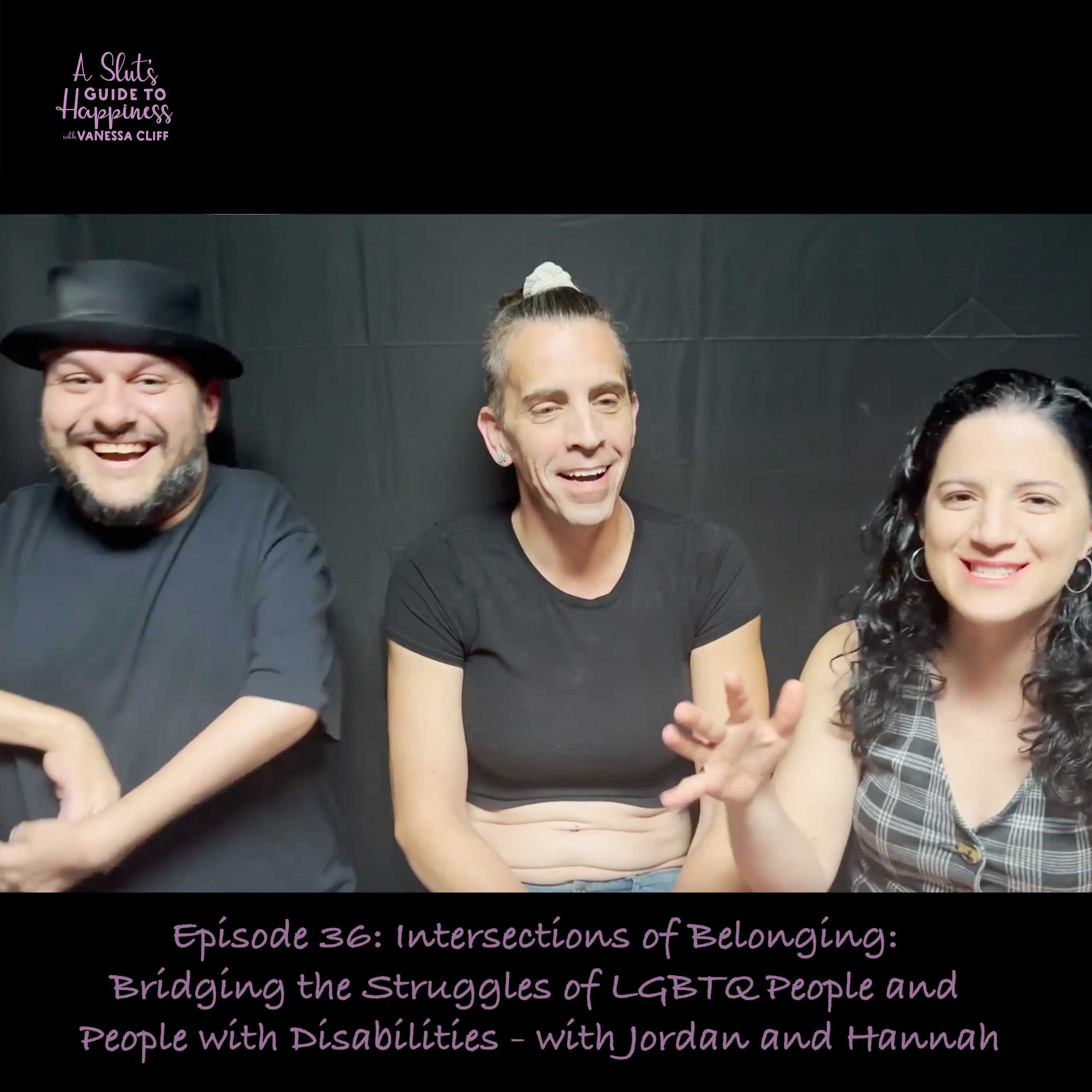
In this episode, two Cliff Media leaders, Jordan, a person with a permanent physical disability, and Hannah, a genderqueer person, talk about the differences and similarities in their experiences living outside the dominant culture. They describe the difficulties of feeling misunderstood or excluded as a child and the challenges of being in spaces where everyone else is able-bodied or cisgender and straight. They also talk about the journey of learning to express themselves confidently for all of who they are.
Through common experiences being in Cliff Media led by queer people and people with disabilities, Jordan and Hannah describe the power of being in a community with people who share and understand aspects of your identity. With empathy toward the healing journey of people who have experienced trauma, discrimination or exclusion, they also describe the significance and value of reaching across identity to build genuinely inclusive community led by people with multiple, often intersecting marginalized identities.
Welcome back to A Slut’s Guide to Happiness, where your body is perfectly imperfect and it’s safe to be as sexual, kinky, queer, or slutty as you want.
Today I have the pleasure of being joined by not one, but two Cliff Media core team leaders. I’m going to use the opportunity of introducing them to also share some of what Cliff Media is up to, because the two of these powerhouses, as part of our incredible growing team, are busting ass making some awesome shit happen.
We first have Jordan, our resident tech guru. Actually, when I say resident, I mean he’s also living at the Cliff House at the moment, which is just fucking cool.
Jordan is overhauling the Cliff Media website from the ground up. Last year we started something scrappy, transitioning from the kind of OnlyFans model to something that is more representative of the community that we are doing in the independent way that we are producing our work. Now we are transitioning to a whole new level of professionalism where you will be able to subscribe to watch premium content and support the community on a more streamlined and functional website.
Jordan is entirely volunteer doing this work, as basically everyone in Cliff Media is right now because it’s a scrappy organization driven by love and hope and dreams. But he is helping us to make this happen. And I am announcing for the second time on this podcast, because I’m so excited about it.
On January 18th, we’re going to have a website launch party and shoot where we are releasing cliffmediaproductions.com, which also means we’re celebrating that forget Brazzer’s and come over to watch real porn made by real people who are rooted in love, inclusion and doing whatever the fuck we want to do with our bodies together.
I need you to feel the gravity of this moment that this little scrappy community, led by queer people and people with disabilities and Black, Indigenous and people of color, who have not been authorized by any mainstream corporation, but who are just doing things because we love it and we want to are getting out there and able to share a joy and laughter in powerful ways with the world.
All right. We also have Hannah, who is a writing whiz and big picture strategist. And, they are currently helping us on a significant strategic planning process for 2025, including questions like where and what type of shoots we’re hosting. So if you’re looking to get involved very soon, you’ll have more information on that as the leadership team figures out the plan, including potentially shoots in multiple geographic locations. If you’re joining us from other cities, don’t worry, we got you, boo.
We’re also talking about how we transition the public understanding of the company away from Vanessa Cliff, because it’s never been about me. We want to focus entirely on Cliff Media and the community that we are building. We’re also thinking about how we make use of this Cliff House, because we have this community organizational space to transform the location of power and allow us to share community-driven plans and make use of this resource.
We’re connecting with other organizations outside the porn universe that share values, because we are rooted in inclusivity and building the power of marginalized communities. That is not just something that happens within the porn industry, but it is a collective goal within lots of other SafeForWork organizations.
Hannah is also the secretary of a 503(c) nonprofit organization that is just getting out the ground called Clif University. It is not porn, but rooted in the same values of Cliff Media. We’re building community around opportunities for education, including in-person and online trainings, this podcast and accompanying blog masterclasses and coaching that will allow us to continue sharing your values and lifting up community power and education. We share knowledge from the vein that nobody knows everything but everybody knows something. We can lift each other up together.
The last piece that I will share about Hannah is that they provided writing support to a lot of people during the LGBTQ soup week that we just hosted. We had 13 scenes, painted a mural, the community at the Cliff House, and conducted film discussions and several trainings.
For most of the scenes, directors from within our community came up with their scene ideas. Hannah helped them draft scripts, and then those directors adapted them to lead their fantasies in the community, with groups of people bringing their fantasies to life. So, y’all, that’s writing for the people
We need all of the people all together building this amazing grassroots, scrappy thing.
Okay, enough about these exciting Cliff Media updates. Jordan and Hannah are going to be talking about a topic near and dear to our hearts in Cliff Media. And that’s the intersection of different communities coming together to produce inclusive, loving joy.
There are three communities that I want to talk about today relevant to this conversation, and also put a pin in knowing that we are talking only about a couple of examples of marginalized communities, while also recognizing that there are many other communities that are organizing, including Black, Indigenous, and people of color, immigrant communities, people who are elders, and lots of other communities that we can continue learning from.
But we’ll start from the perspective of LGBTQ lives, people with disabilities, and sex-positive communities.
In the US, the LGBTQ community has organized to accomplish things like decriminalizing same-sex relationships, eliminating sodomy laws, legalizing same-sex marriage, repealing “don’t ask, don’t tell” in the military, and implementing laws prohibiting discrimination on the basis of sexual orientation and gender identity in employment and housing. These are huge accomplishments from communities of LGBTQ people coming together.
They’ve also worked in creating cultural space that has allowed people to move from closets to living in queer relationships in the public eye, to be their gender in the public eye, to have society with some degree of understanding.
Similarly, the disability rights movement has achieved legal changes, such as the prohibition on discrimination in all areas of public life, including jobs, schools, and transportation through the American Disabilities Americans with Disabilities Act of 1990. Since then, people with disabilities have continued to advance accommodations in schools and employment that allow for more meaningful inclusion, improve the social programs that provide support to allow people to live for lives and take up more visible spaces and public figures.
And finally, one other movement that intersects with the work that we’re doing in these communities is sex-positive culture that has helped society collectively embrace a greater diversity in sex and relationships, including polyamory, swinging, and other forms of non-monogamy. It’s also helped advance the basic idea that women and queer people, in particular, have sexual desire and can consensually act on that desire.
I also want to acknowledge here that I’m talking about context in the US, and as we pursue inclusivity, we can increasingly learn to talk about contexts in other places, especially as we hear from other people in Cliff Media and the people who watch us online. In fact, Jordan is from Canada and can provide us with more perspectives.
But the basic point being that people with disabilities, LGBTQ people, and people who value sexual liberation have been organizing for a long time to make radical changes. And each of those communities are powerful lessons that we learn from and be inspired by.
And, even as these communities have a huge impact on society, there’s also a constant need to continue to examine how we integrate these communities. For example, there are segments of the LGBTQ movement that, especially in the lesbian and gay parts of the movement, organize for same-sex marriage and legal inclusions that sometimes replicate a monogamous marriage equivalent to normative straight couples. The mainstream LGBTQ movement tends to represent and be led disproportionately by able-bodied people and sometimes with judgments about free sexuality.
Somewhat similarly, in the disability rights movement, a lot of organizations that are front and center advocating for disability rights are often disproportionately cisgender, with infrequent mention of the experiences of trans people with disabilities.
Of course, there are exceptions of organizations that are thinking about these intersections and leaders doing incredible work.
And finally, if you’ve ever walked into your typical swingers or sex club, you probably know that the sex-positive culture in the US in general predominantly leans disproportionately toward cisgender, straight and able-bodied couples.
So as we’re thinking about the desire to be freely full and joyful in community, it requires each of these communities to think about what’s going on in other spaces. Learning to connect across differences, following the leadership of people whose own lived experience teaches us how to do better, I think that’s how we grow and find joy with each other.
One of the reasons that this is most dear to my heart right now is in Cliff Media, we host shoots led by LGBTQ people, BIPOC people, and people with disabilities. This includes people like Jordan who is both queer and has a disability, people like Hannah, who is queer but doesn’t have a disability. Just to give an example, we have another leader who helped to lead the shoot weekend led by people with disabilities, Sunshine, who is a person with disabilities and is a cisgender straight man.
So as we build these spaces, pushing greater inclusion, safety and leadership, one of our goals is to move toward integrated spaces where people of all marginalized identities feel welcome, wanted and loved together in this space.
Whew. Okay, that’s what I got to say. And now I want to hear from these amazing, incredible, smart people. So Jordan and Hannah, with that, thank you so much for joining us today.
Just like we’ve been doing recently in consent circles at shoots, I’d like to ask if each of you could start by sharing your name, gender identity, including whether you’re a cisgender or transgender, your sexual orientation, race, and if you identify by as a person with disabilities.
Hannah, would you like to go first?
Hannah:
Yeah. My name is Hannah. I’m non-binary. I think non-binary covers the cisgender / transgender question. Somewhere delightfully right around the middle where I like to be. Sexual orientation is, for lack of a better, more applicable term, pansexual. Everyone all the time, constantly. I’m white. I do not identify as a person with disabilities. Hopefully I’ll be able to talk about why that is later in this discussion. I think the reason why I don’t is germane to this conversation. I think is an important thing to point out to people who may be feeling the same way that I do.
Jordan:
I’m Jordan, cisgender male and identify as pansexual. I identify as well as a person with a permanent physical disability. Oh, yeah, I’m white of European descent. I’m Canadian. Don’t hold it against me. My background is Portuguese. So, pretty much European, but born in Canada.
Vanessa:
Awesome. Thank you. So I want to start by talking with the first time you realized you were non-binary or queer or had a disability. And I acknowledge, and it’s important to be able to talk across difference, that these are very different stories for each of you and also their stories that you’ve had in your lives. Jordan, would you like to share first?
Jordan:
Yeah, sure. I mean, I guess the disability part is pretty straightforward. It’s from birth. I’ve always identified as a person with a disability. A lot of it had to do with early upbringings of getting treated differently than other people or other children in the room.
At a very young age, I was pretty aware that I was different from everybody else. Maybe I couldn’t define disability or had a notion of what that was. For as long as I can remember, I’ve always known or felt different.
Hannah:
I think from a very young age, when you are old enough to start gaining the cognition, to realize that there’s something, something horribly awry, when you look around at the people that you’re surrounded by.
I didn’t necessarily ever feel that sense of belonging, but I didn’t have a context when I was younger for that being an uncomfortable thing. I was just always dancing to a different drum. Always just a wild and very free kid.
But, as we’ve discussed before in a previous conversation, growing up in white, middle-class suburbia is a very insular and information-padded place to grow up. So I didn’t have names for anything that I was feeling. So different is a word to describe it, but, but it wasn’t until much, much later in my life when I started to gain access to, I guess what could be considered counterculture, that I started finding what these things were called, and I could put names to what I was feeling, and then it really developed from there.
But from 8 or 9 or so when I really started noticing that the ways that I was behaving and the ways that I felt didn’t fit with the narrative I was surrounded by, and that was an incredibly uncomfortable process. Once I realized that, growing up through into my teens, and then ultimately into my 20s, where everything I knew was so much oscillating back and forth, I would succumb to pressures or whatever and try to fit that mold. But who you are always breaks out. So, yeah, a very young, very young kid when I realized it and then named it in my 30s.
Vanessa:
So in my personal experience, I don’t have a visible disability, so it’s quite different, but as a person with bipolar disorder and pansexual, I remember both being told that all your life is going to be hard because of this and experiencing challenges. But I also felt that there were some things that were beautiful about these different identities.
I do want to talk about both, but in this case, I’d like to start with some of the experiences that have been challenging for either of you living outside the dominant group.
Jordan:
I mean, I think for me, it was always a little bit more obvious, and the circle was drawn very easily because it wasn’t something that I was battling internally with identity or with mental issues. It was all very physical. It was all out there. I couldn’t hide it. There was no way for me to not be isolated or separated from a group of people whether I wanted to or not. That was the case, and that’s how I was treated.
So for me, being the only disabled person was always very challenging because it did create a lot of isolation and a lot of resentment. I just wanted to be like every other kid. When you don’t understand the reasonings or intentions behind why you’re being treated a certain way, that can develop into a lot of anger and frustration. Like, why am I getting treated differently than others?
Nobody is sympathetic to the explanation. It’s more just action. When you’re young and you don’t understand what the fuck’s going on, you’re just trying to make sense of it in your head. A lot of it’s like, I don’t understand what the fuck’s going on, so I’m just going to be pissed off until somebody tells me what the fuck’s going on.
There was a lot of anger and a lot of frustration and a lot of outbursts and just being pissed off at people and crowds and really just trying to navigate those waters between understanding, my own internal struggles with being different and then also navigating the waters of being literally treated different on a day-to-day basis.
That had a psychological impact on me and the impact I had on other people around me because I didn’t always have the best attitude or I didn’t always have a positive outlook on life. That negativity can also be transferable in circles, and that kind of sticks with you as well.
It becomes very challenging in those kinds of situations because communication is also a factor. If you don’t know how to communicate these feelings, then it just gets perceived as a kid complaining a lot. He has a lot of issues with anger and frustration, not knowing that it’s all very cyclical. Every action they do causes a reaction which then furthers their action, which causes even worse reactions out of me.
That was also very challenging for me to navigate as a youth, up until I could understand my own emotions, my own thoughts about my body and how I felt about being around other people and how I can connect with other people, until it finally kicked in, where I wasn’t so upset about it.
Hannah:
In relation to that, there’s a lot of corollaries to be drawn between what deficit it is socially and culturally for anybody who’s facing any kind of a way that they’re different from the people that are surrounded by that. It comes down to, there’s a significant lack of information, and that information is not properly disseminated to people. So the education culturally isn’t there.
While we struggle to understand our place and to understand the ways in which we’re different and define those and identify them, the people that we’re surrounded by also don’t have the information that they need in order to conscientiously interact with you, people who struggle with any kind of a difference from whatever normative thing that they’re living within.
It’s the same kind of refrain. I would just like to be treated like everyone, everybody else. But there’s this default position that if somebody is different, we have to adapt the way that we regard them in social spaces, when they’re asking us in very direct terms, I would appreciate it if you would please not do that.
But there’s still this default and that creates so many problems and communication breakdowns in between.
I’ve experienced that from being so different from the other kids as I was growing up and just how I expressed myself in general. A lot of that is, at the time, undiagnosed ADHD and autism issues that weren’t pursued by my folks. I was engaging with my world with a different toolbox than a lot of other people had. And it was obvious.
The isolation that comes from feeling no small amount of confidence in that, I’m just fine the way I am, I’ll be damned, and expressing myself however I wanted and realizing that that that desire was isolating me and that me expressing myself the way that I wanted and refusing to fold, or be conformative in that way, was fueling the problem that was making me so sad and feel like I didn’t belong.
It starts to develop in youth, but we feel that our entire lives are just, the crushing urgency to belong somewhere, anywhere. It’s maybe the most powerful human compulsion that there is. When you have impediments to that, that are built in, that are hard-wired or are physically undeniable, it creates loneliness. You’re just deep, deep, deep in your core, lonely, even in loud rooms filled with people.
So my experience with it growing up and all the way through my teens, the desperate need to try to conform, especially in social spaces like high school, which can be one of the cruelest places in the world, and then finally evolving out of that in my late 20s, where it was just kind of this well, I tell you what, go fuck yourself. I’m just going to do this thing now.
I started to adopt that “in your face” sort of the mentality. There was a lot of liberation that came from that. But it was definitely rooted in being pissed. Like, I’m tired of feeling different.
It almost got me. I almost just folded and and went along with it, but it was also beautiful and incredible in its way. When I look back on that experience, what I learned about myself, the growth, the goddamn right, I’m different. It’s fucking amazing. If there’s 30 of you lined up and I can’t tell the difference because you’re all wearing the same goddamn sneakers and my shoes don’t even match, how bad ass am I? There was a lot of that.
It was definitely double-edged in that way. A lot of positive, a lot of negative.
Vanessa:
I hear a lot that you are describing about how you’ve been in this journey of initially feeling really angry or feeling really lonely about those differences. I know from personal work relating to both of you that you’re very self-assured, confident people, comfortable in your skin in most parts of your lives.
I want you to think back as you’re going through that journey. And I specifically want to talk about both LGBTQ identity and your identity as a person with disabilities. Although I know that one of the things that is beautiful that we’re drawing on as well is that identity is complex. We all have different aspects of who we are. So we’re definitely oversimplifying this conversation for the purpose of exploring this topic.
I want to think about a time when you felt that you were in a very straight, cisgender place, or you were in a place where there were only able-bodied people and you felt out of place, and it felt challenging to be that only one person in that space.
Jordan:
Yeah, definitely. I could start that, that ball. So for me, it kind of touches on what Hannah just said about the double-edged sword. At a certain point, there was a turning point for me where I went very conservative to “fuck off, take me as I am, or get out of my way” type mentality.
At the beginning, for me, entering a room and being the odd man out created anxiety. I didn’t know, and I think that anxiety was amplified by the fact that I wasn’t prepared.
I didn’t have the tools in order to effectively communicate with other people in an adaptable fashion where I’m not trying to try to fit into a mold. I’m just communicating using the tools that I have and using communication to tell other people how I communicate differently rather than try and fit into how other people conventionally communicate.
Handshakes, for instance, that was a huge barrier for me. Handshakes are not generally easy. I’m left handed. Most people are right handed. So that kind of creates another challenge. That became a really awkward moment for me.
Every time I walk into a room and somebody stuck out their hand, I was like, fuck, what do I do now? I’m like, this sucks. It always created this very bizarre convention, right? Yeah. Why is that a form of greeting? Here, hold my extended digit and yes, let us touch hands. We are strangers. That was one of those things. I was just battling, how can I master this art?
Then I flipped it, and I’m like, I don’t need it. I can convey a hello or I can lead somebody into a conversation without the handshake. I can use humor and some charm to skirt around those little awkward moments where somebody sticks out their hand and then they give you that look like, oh, yeah, that was stupid. I probably shouldn’t have done that.
Then those are always those little cute moments where you’re like, all right, I appreciate that it took a couple of seconds for you to figure out that that was a little bit dumb, but we got there nonetheless. We all got there. I appreciate the journey, nonetheless.
So those little things were very challenging because I wasn’t equipped. I went to college and I took a course that didn’t finish, but I interacted with a professor there that took the time to spend one hour a week with me and worked on communication. That allowed me to understand that communication can be adaptable. I just have to think outside the box.
Once I got into that mode, and that was kind of the point where I was really taking off on my career, getting into web development. I was building websites as a solo-preneur, really getting my name out there.
So for me, in order to benefit my personal life and extend my career, communication and being able to walk into a room and be able to feel comfortable and command a situation to me felt very important.
After a few months and a lot of practice and a lot of brain conditioning and a lot of creativity and a lot of adaptation, I was able to develop the tools where, for a long time, in between 2011 and 2016, I ran my own company where a group of five people and I traveled across Canada, in the US, spreading the good word of web accessibility, which is very important to my heart.
I was able to do that because I looked at, instead of looking at walking into the room as a negative, I used it as a positive. If I’m going to walk into a room and everyone is going to turn and look at me, I’m going to give them something to (a) fucking look at and (b) when they come and talk to me, I’m going to give them an earful, and they’re going to realize that I’m much more than the odd man out in the room.
I was easily able to shift that dime and turn it on its head and say, I used to be intimidated by a room. Now I’m dying to get into a big room full of people saying, look at me, please. I’m going to wear a fancy hat. I’m going to stand out and tell jokes. I’m going to make somebody laugh.
I’m going to do something where, not only do I want people to look at me, but I want you to listen to me, and I want you to watch me in action. I want you to observe how I’m taking command of situations, and I’m engaging people, and I’m exciting a crowd and all that great stuff.
So for me, that kind of transition was super beneficial in terms of, like what, what I was able to do with my career and kind of how I approached personal interactions.
Even coming to Cliff Media, I used all of that great shit that I learned about walking into a roomful of strangers. I walked in, and y’all were welcoming, and I took my clothes off, and I got jiggy with it on camera, and it was fucking fantastic. That was only possible because I took the time to do all of that shit many, many years ago.
Vanessa:
Can I just suggest that on the new website, we should say “Cliff Media allows you to walk into a room, take your clothes off and get jiggy with you.”
Hannah:
There’s a slogan on every T-shirt. I say, it is a magnificent hat.
Jordan:
Thank you. Yeah, I’ve got several of them. This one might get retired soon.
Hannah:
I do have to say that the visual of you making direct and awkward eye contact with the person who has extended their hand for the 2 or 3 seconds it takes for that to dawn on them.
Jordan:
Yeah. Or high fives, like come on? High fixes, really? We have a good laugh.
Hannah:
We talk about cisgendered spaces, that’s everywhere. Everywhere that you go, If you’re living the prescription of what you’re supposed to do, they’re all cisgendered spaces. And I’ve always been aware of pretty much where everybody in the room is doing at any one given time, a delightful side effect of my own particular neurodivergence.
It was always something that I viewed with my eyebrow permanently cocked in a “What the fuck is going on here?” position. I wallflowered for a long time. A lot of fear of expression and being very, very careful about what I said. It was so easy for me at the time to become embarrassed or feel awkward. Awkwardness is physically painful for me. I can’t stand it.
So I would avoid that at all costs. And then I’m not entirely sure what age or what events in particular that I went to, but the script just flipped. Don’t get me wrong, there was a lot of fake it til you make it in there, because I didn’t have a lot of confidence in what I was doing.
But it led to now where I will walk into cisgender, culturally normative situations, loving the fact that my existence alone is a challenge to every single person in the room to change how they think, and just be big and take up the space that is mine to take, which is as much as you need, incidentally, and speak my mind and say my piece and call out things that that people need to think about and to start raising questions that everybody should be asking just by merit of my existence in that space alone.
Really, it was “coming out”, which is the term I don’t particularly like, but it was when I made my identity known to the world, would be a better way to put it, that I did that, like a cannonball. It was less than 24 hours, and I was somebody completely different than what the entire world knew me as the very next day.
I just decided that’s how I’m just going to keep doing things. I’m going to walk down the street with my head held high. I’m going to just be me. And then by my own attitude and how I approach the world, living as kind of a dare for people to have a problem with it.
But ultimately, one person doing that, you can change the temperature in the room a few degrees, but typically that’s about as far as you’re going to get. And discovering that and discovering the frustration that goes along with that.
I just started gravitating more towards spaces for people that, I felt like anyway, were more like me, like everybody does. Because I didn’t belong in those cis normative spaces. It’s not like there’s anything particularly wrong with them, but there’s just a prevailing kind of mood in the room that you can feel.
It’s not like, at every event, all of the dudes are talking about football and books about war or anything like that. It’s not like that. It’s just a feeling that you get, where you adopt, instead of feeling awkward and out of place for being different, it starts to feel like a boon. Like, if I’m unlike anybody in this room, how awesome is that? I’m like, absolutely going over here in the corner.
So, in the beginning, it was uncomfortable, especially when I didn’t know what to call it. And then it became something that I could identify with that I could take pride in, like, yeah, fucking right. And and now that’s just how I live every day and try to help the people that are closest to me find that same place, because it’s hugely empowering and freeing to get to that space.
I think that it opens up, even maybe more importantly than that, it opens up the conversation inside of people’s heads in these cisgender spaces, What am I doing? Look at that person walking in with the courage to be who the fuck they are. Because everybody’s holding on to something.
Everybody has something in there that’s not quite down the line, and they want to be able to say it. They want to be able to express it. They want to be able to wear the thing or do the thing, and they’re not out of fear that they won’t belong if they do. And then we come galloping into the room like, everybody look at me like you’re a fucking awesome. And if they drive home that night and say to themselves, you know what, I can do that. Then mission accomplished.
Vanessa:
I love that you both walk in like that. For me, I think of that as “buffalo living”. You take up space. And if anyone has a problem with it, you’re the buffalo in the room. You’re standing your ground. I really feel that and I love that about both of you.
I want to dig into something before we get into broader inclusivity. There’s something that I’m hearing from both of you, and Hannah, you’re beginning to allude to this, is how good it can feel to be in spaces where you’re not the only one. And that came up when we had the shoot led by people with disabilities. A couple of people mentioned that it felt really nice to be in a positive space where they were not the only person with a physical, visible disability.
I would like to hear if you’ve had experience or if that has been meaningful to you at any point in your life, what it felt like and why, on an emotional level, you sought out any kind of space where there were other people of similar identity?
Jordan:
I don’t think every scenario is the same. So I’m only going to reference my first experience with Cliff Media, because I think that might be the most relevant. I originally had applied to a shoot a few months before I actually showed up, and I flunked because I was too chickenshit to actually do it at that moment.
Then when I saw it publicized that there was going to be a shoot specifically for those with disabilities, it kind of opened up this feeling like the environment was going to be, I guess, disability-friendly.
I think my initial concern was that if I show up and nobody thinks I’m attractive and nobody wants to hang out with me, that’s going to be a really shitty time. It’s going to be a really shitty feeling. And I walk away feeling less confident than I did walking through the door. I didn’t know if I was emotionally ready for that.
You really have to consider whether or not you want to walk into the fucking shark’s teeth or not, you know? So for me, that was the struggle. Obviously I temper my expectations, and I’m okay if things don’t exactly work out the way I want to. But I think the emotional preparation was something that I had to heavily consider because I didn’t want to shatter myself just because things didn’t work out.
That, to me, was very important to consider before I ever committed to anything. If it doesn’t work out, am I emotionally strong enough to cope with that? Can I walk away feeling okay? That shit didn’t work out the way it did. And if I can’t confidently say that, then I probably should not show up, underprepared, because that’s probably going to leave me worse off than when I showed up. So that was the initial fear.
The public announcement that there are going to be others of that nature, other people with disabilities are also going to be there, the odds were less that I would be singled out in that scenario.
Those odds felt a lot better for me to take that chance and take that leap and say, okay, now I feel like there’s less of a chance of all of that shitty shit happening because it’s out in the open. They’re expecting that people are going to roll through with disabilities. It’s not going to be a shock. There’s not going to be this awkward moment where I’m the only person there.
That to me was extremely beneficial because I felt comfortable in the environment. I felt like Cliff Media went the extra mile to create a comfortable environment for me to come and experiment with this. I didn’t know if I was going to like it or hate it, but I appreciated the fact that that safe feeling environment was there.
Actually, probably the only reason why I ever showed up was because of that, that I got the sense that that was going to be the case. I just got that even before meeting anyone. I watched the content and I tried to do my “homework”, the fun kind of homework.
That was the pivotal turning point where inclusivity was the backbone of that shoot. It wasn’t trying to fetishize or sexualize people with disabilities. It was led by and you used very empowering words like directed or led by people with disabilities. And that to me, created that safe space of inclusivity and that allowed me to get the ticket, jump on the plane and get my ass down here.
Circling back to kind of like what you were asking, the comfort really is what it comes down to. If people feel comfortable showing up at your doorstep, they probably will. So that’s my takeaway.
Hannah:
I think as far as most momentous experiences and how those felt, throughout my 20s and 30s, I dabbled here and there with trying to find spaces that felt more inclusive, more comfortable for me to be there, just to try to get that sense of belonging and connection that I was looking for.
For one thing, some elements of neurodivergence make it very difficult to connect with people, period. It’s hard for me to make meaningful connections with others, so any obstacles or impediments to that, like normative cishet spaces, are going to get in the way, and I’m not going to be able to do it because I’m going to be paying attention to that, instead of trying to make authentic connections.
So as much as I played around the edges and would try to make friends through resources like FetLife and all of that, nothing really hit home or gave me that.
I think I’ve arrived in the place that I was looking for, until Cliff Media quick events. Because of the underpinnings and the foundation of all of those events, whether they be shoots or otherwise, are always about when you walk through the door, you’re home here.
Whether that happens at the Cliff House or not, you’re home here. It made me feel like, regardless of what state I was in that day, maybe I do just want to sit in the background and be quiet and observe people because I’m feeling a little tense or whatever that day. Nobody in this room is going to judge me for that, and nobody is going to make assumptions about the kind of person that I am intrinsically based on how I’m feeling or behaving that day.
It gives me space to evolve through all of those very complex feelings that come up when you start actually, for real, being vulnerable. One of the things about being different, growing up, is that you learn to protect yourself and you, those little ways that you train yourself for emotional defense, get stronger and stronger and stronger with every year and reinforced until they are a citadel that is almost impossible to breach by anybody.
You wear that with a badge of courage, like I’m untouchable. I can’t be emotionally hurt. I don’t need to trust anybody, the bullshit narratives we tell ourselves just to keep us safe.
When you get into an environment that is sincerely inclusive, that is sincerely based on love and acceptance, it is so fucking comfortable. The first time you’re there, it’s like for the first hour, it’s so much suspicion I had that this cannot be sincere. This is all virtue signaling and people are just saying what they think everybody else wants to hear. Because I had a life based on building assumptions about other people to protect myself.
Over time, though, that erodes. I tend to look at things rationally, too. It started to get to the point where the math didn’t add up. And I was like, wait a minute, these people are actually right. Then it took a little while for me to get comfortable with that, to the point where it’s like, I can be like that too. And it feels like removing the heaviest yoke ever that you’ve been wearing for so long.
You become accustomed to your shoulders being endlessly slumped forward by that weight that you carry around with you everywhere you go. And to put that down, even for a minute, let alone for an entire weekend, an entire four days, five days, whatever, to put that down is such a tremendous relief. You feel lighter in your shoes when you walk around. You’re like, this is amazing.
I finally got to the point where I could comfortably allow, I think I’m up to like 3 or 4% vulnerability, probably, which is pretty solid growth. That’s really what it ended up meaning to me. The Cliff Media events and experiences were pretty much solely responsible for that. The hundreds of incredible people that I’ve met so far in less than a year, it’s been monumental.
Vanessa:
I feel that, too. The people that we’re around I love that we can trust that. I can hop around and be giddy and weird and sweaty and pansexual and just be myself in a way that I have never been able to be in professional spaces and a lot of normative spaces in society. The ability to be free and know that that’s okay and that you’re loved and sometimes I’m grumpy and sometimes I just want to be wild and inappropriate and that’s okay, that feels really good and has made me cry in the past before.
I really love what you both said about growth. I do not want to be in the same place in my life, or doing the same things in the world that I’m doing in a year from now, because what is the point of life if you’re not learning from it?
I think in particular, knowing that we all have our specific social locations, we are all limited in our understanding by whatever identities and experiences and backgrounds we have. So, for example, I’m cisgender. I don’t know what it’s like to be non-binary. I do not have a visible disability. I don’t know what it’s like to walk in the world with a visible disability.
I want to figure out how, as a community, we can better listen and learn from each other so that building this inclusivity, building a relationship that is increasingly authentic and that we’re working together to make it as comfortable, welcoming and wanted for people who have all different types of differences in their lives.
What are your thoughts on how we can create spaces where it’s possible to learn from each other?
Jordan:
I think a lot of it starts with being open-minded and tolerant of things that are different. That’s the first step. You won’t get too far in life if you walk around asking for acceptance and you’re not actually giving it to anyone else.
I think the important thing is to, first, understand that if you want to be accepted, then you have to actively accept people for who they are when they walk into the room. And so to be a champion of acceptance, I think is the first step. When you walk into the room with open arms, people are going to walk up to you and they’re going to say, hey, what’s up? You’re cool, your arms are open, give me a hug.
Whereas if you know, you’re standing there with your arms crossed and you’re guarded, then people’s defenses are up. You’re not being welcoming. So a lot of it is getting yourself, I think, into the mentality of, if you are truly out in this world for everyone else to accept you, then you have to be the first one to accept everyone else.
Hannah:
I think it’s also the the simplest, most foundational thing that you can do is for us to collectively erase this shame we’ve been made to feel about just fucking asking. Ask people what their experiences are. Ask with sincerity. Ask with a genuine interest to know. But ask.
Talk to each other. Share information. It is such a huge tool of whatever cabal is in place to try to keep us disconnected from each other, that they made it shameful to ask that asking personal details from people that you want to know that you already care about by default, by merit of their humanity alone, that you’re not supposed to ask.
It’s like workplaces that tell their employees, don’t talk about your wages with each other. There’s no reason for that other than they don’t want everybody to know. If your entire fragile little tissue, thin veneer of power is built around keeping people from divided from each other, of course it makes sense to instill a sense of shame in asking and and becoming vulnerable and getting interpersonal and hearing about the experiences of others through their own voices, instead of hearing about it through printed articles and things like that which can be manipulated and changed or bought and paid for.
Ask, talk to people with sincerity. Is is the easiest way to bridge divides, and mostly it’s the easiest way to find all of the fucking 100 million things that you have in common with each other, and not the 3 or 4 that are different that you’re taught to focus on so that we all stay divided so that we all stay staring across that aisle, shaking our fist at each other instead of looking to the house on the hill where the real problem lay.
I’ve always held for the longest time and not really understood why you cannot ask. It was one of the things, as a kid that made me so different from everybody else. I would just walk up and ask people about what they were wearing or what’s different or what’s it like to deal with that or why is this particular circumstance happening in your life?
I would want to know because I was genuinely inquisitive, and that remains to this day. We build inclusivity primarily by knowing. Knowing builds intimacy, and intimacy builds compassion and love and compassion are the base of any inclusivity, to grow beyond the point where we’re tolerant of differences between us, to the point where we start asking ourselves why we have them at all, and whether or not they even matter.
If you have feelings about anyone or anything, it is hugely important to be introspective with yourself and ask why you have them and really be honest. Where does that sense come from? Where did you get the information that you’re using to base? A lot of times it’s based on personal experience, which is very hard to step around.
But we need to be more objective with how we feel about whatever group of people over here that we’ve developed these feelings about, and understand that everybody is just a terrified, barely upright, hairless orangutan trying their best with the curves and busting of awareness to make it through a day. And, if nothing else, that foundation having that in common is enough to put people in the same room.
Vanessa:
Yes. We all put on underwear and deeply crave human connection.
Jordan:
We’re supposed to wear underwear? Damn.
Vanessa:
Fair point, sometimes we don’t wear underwear.
I think it’s beautiful to see both the similarities in human desires, needs and emotions, and also to acknowledge the differences rather than sweeping on the under the rug, to be able to talk about them and ask about them comfortably or uncomfortably, and be okay with a different discomfort for the purposes of bridging connection and the deeper love that comes from that vulnerability.
I do want to end with a love note, to acknowledge that we are all on our own journeys of being different in a world that does not value and understand that difference. We’re in a world where difference can sometimes be lonely or traumatic. It can be a source of violence, exclusion or discrimination. It can simply feel uncomfortable or undesirable, and that is a healing process.
For example, being able to be queer in spaces is a healing process or being able to step across difference and for example, be queer with straight people who maybe have disabilities or be a person with disabilities in a queer space, who may include a lot of people who are able-bodied and figuring out how to move through the things that may be painful in your past, to be able to be authentically, perhaps uncomfortable in deeply integrated, inclusive spaces.
I want to ask you all what kind of suggestions or love note you would like to provide to people who are on that journey of figuring out how to be in those inclusive spaces?
Jordan:
I think the most important thing that I would love people to leave with is a broader sense of inclusivity. You’ve just absorbed two very different stories under the same umbrella of inclusivity. I think the important thing to take away is that the ideas of accessibility and inclusivity are so much broader than people with disabilities, whether it be mental or physical. It extends to those who identify differently, those of different social and financial statuses, those who believe in different things, religious or political, those who live in different parts of the world.
The underlying kind of element of this whole topic is really to understand that inclusivity is an umbrella that we should all strive to live underneath. And if we can do that in harmony, then, you know, we can truly include everyone. And I think that would be a great way to kind of operate.
If we can keep that in the back of our minds that not only do I fall under that umbrella, but so do you, then I think it makes it easier to absorb, and it makes it easier for people to feel actually included.
Hannah:
Well, I guess if I had to leave any parting love note, it would be that whatever part of your journey that you’re on pursuing, what actually were belonging feels like it’s worth whatever you’re struggling with to find it at the end.
Whatever you experience, stay vigilant and continue to pursue finding those inclusive spaces because the difference between what we have been taught to believe is inclusivity, the kind of homogenized version of it. That’s described to us, rather than finding it, ourselves is night and day.
What you discover about yourself along the way, is also priceless. Just the learning curve for it. To me, learning anything about what inclusivity means. It means that ultimately, at the end of the day, when we are looking at our differences and we’re respecting them and we’re appreciating that those differences exist, taking pride in, in some of the ways that we’re different and understanding that about each other.
Inclusivity exists outside of all of those things, and inclusivity exists that you are welcome simply because you are human, that you are a person, and all of us at our core, whether we agree with each other or not. No matter where you are on the political divide, no matter what country you come from, no matter how your body works, all of us have that common thread.
We’re all beings of fears and hopes and dreams. We’re all beings that desperately need to belong and we’re all scared just trying to survive through the day to find joy. And these communities, when you find them, are where that joy lives. So the person who’s standing across from you that you’re trying or struggling for reasons to seek differences because it gives you a feeling of safety, try to remember that person on so many fundamental levels, probably all of the ones that matter is you.
Vanessa:
Beautiful.
Viewers, thank you so much for tuning into vulnerability and I hope that we can continue connecting with you and learning from you too, knowing that as much knowledge that I gained from Jordan and Hannah. I also know that there are lots of you out there that I can continue learning from as well, and I invite you to join us in our community as we continue growing.
This has been another edition of A Slut’s Guide to Happiness with your host, Vanessa Cliff, and our two amazing leaders, Jordan and Hannah.
You can find us wherever you get your podcasts, including Apple and Spotify, as well as on cliffmediaproductions.com
Please help us out by liking and sharing this podcast, and stay tuned for more deep dives in beautiful, messy waters.
If you are over the age of 18, you can also check out our video content, including these two sexy birds on our website, cliffmediaproductions.com
And most of all, I invite you to join us in the pleasure of being awkwardly human, naked and without pretense.
Let’s get free.
Materials found in this section may be sexually explicit in nature. To view materials on the site, you must affirm all of the following:
I am at least 18 years of age (21 in some localities). Any sexually explicit material I am viewing is for my own personal use and I will not expose minors to the material under any circumstances. I do not find images of nude adults, adults engaged in sex, or other sexual material to be offensive or objectionable and I desire to receive and view sexually explicit material.
The viewing, reading and downloading of sexually explicit materials does not violate the standards of my community, town, city, state or country. I am solely responsible for any false disclosures or legal ramifications of viewing, reading or downloading any material on this site.
This website and its affiliates shall not be held responsible for any legal ramifications arising from fraudulent entry into or use of this website. This warning page constitutes a legal agreement between this website and you.
All models, actresses and actors whose images appear on this site are over the age of 18. Bookmarking to a page on this site whereby this warning page and/or terms and conditions are by-passed shall constitute an implicit acceptance of the terms and conditions herein.