


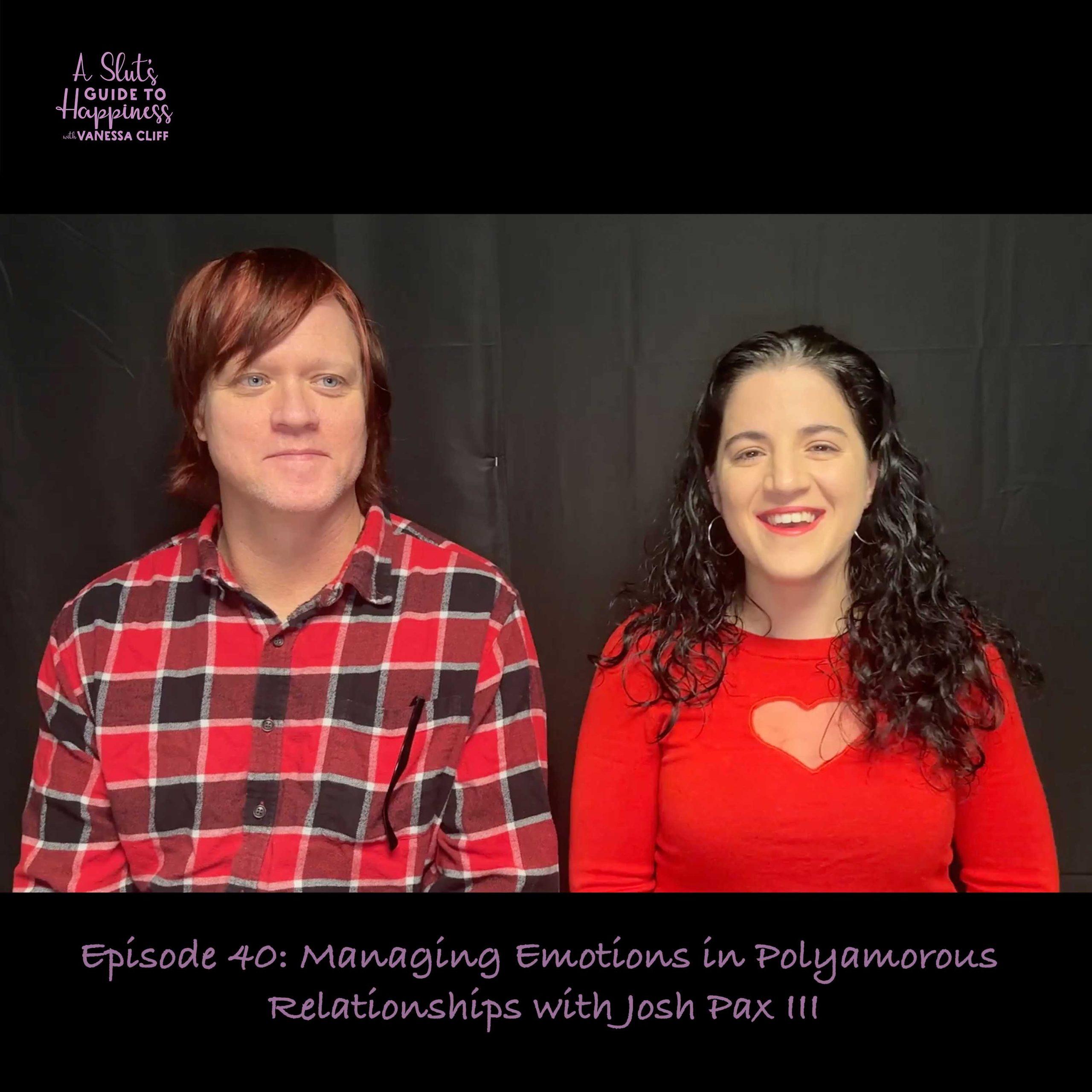
In addition to the many joys of authentic relating and abundant love, polyamorous relationships can also bring up challenging feelings, like jealousy, insecurity and fear of missing out. There are as many ways of dealing with these feelings as there are relationships, including a range of relationship hierarchies, rules, communication strategies, or preferences, and the underpinning of all effective strategies including honest, open, non-judgemental communication.
In this episode, Josh talks about a component of managing jealousy that’s less often discussed, perhaps because it’s less comfortable for the jealous partner. He takes us through steps he’s taken to manage his own emotions and grow into confidence, secure attachment and healthy interdependence. His reflections range from big picture questions of self-worth to day-to-day strategies of distraction.
The idea that we are all responsible for our own happiness can be understood as a source of liberation: we have the keys to unlock the kingdom for ourselves. Although communication in a relationship is of course important, learning and developing strength as an individual is also a critical part of making polyamory a more life-giving experience.
Welcome back to A Slut’s Guide to Happiness, where your body is perfectly imperfect and it’s safe to be as sexual, kinky, queer, or slutty as you want.
Today we’re going to be talking again with Josh Pax III. Previously, he joined as Orion Pax and has now decided to be out in the world with his legal first name as he loses shame about the reality of who he is, even working in the porn industry, which I think is pretty fucking cool.
There he is with this Josh cup.
Previously we talked with him about the experience of coming out as a baby queer, and he’s no longer particularly a baby queer. He’s been out as queer for a while. He was sucking dick for 20 years, and talked about being in the underground world of gay sex and also loving slutty women. That piece is adjacent to our topic today, which is being in polyamorous relationships.
Specifically, we’re going to dive into the experience of emotional management in polyamorous relationships, which I think is a really big part of successful poly, because the more people you add, the more relationships and dynamics and emotions and communication you have to manage.
It is not a strategy to make your relationship easier. As a lot of people in the poly world say, it ain’t going to save your relationship if your relationship isn’t already there on a stable ground. You’re not going to fix it by adding more people. More people, more problems.
But there are lots of people who choose polyamory for many reasons, and we’ll get into that, some of the reasons for Josh. We’ll talk about why, despite the fact that it may require more work, that it can also be very fulfilling for lots of people, and strategies to make it work.
Josh, thank you very much for joining us today. We’re going to go right in deep. I’d like to start with your personal history with non-monogamy. And I want to emphasize that there’s a difference between ethical non-monogamy, what people call ethical non-monogamy and what we might call unethical non-monogamy. Cheating is a form of non-monogamy, it’s just not communicating with your partner.
Josh:
It doesn’t have a cool acronym.
Vanessa:
Yeah, that’s right. ENM (Ethical Non-Monogamy) versus cheating.
So take us through when you first started interacting sexually and romantically with multiple people.
Josh:
Well, I think in my case, I had always been a cheater. And it wasn’t until I got older where I realized that there was a different way to do it. I was tired of cheating. I was tired of hating myself, which I think we’d covered in the podcast before, about that guilt and shame about cheating, what that does to somebody.
I met a tribe and it was swingers. That’s where I felt like I met people who were just like me. They were open about it. They just weren’t hiding behind it. It was very different for me to be so open. I was so used to hiding that part of me, having to hide somebody else that I was talking to.
It wasn’t until I met a group of swingers in the Seattle area that I felt like I had met people that were like me, that had also struggled with cheating and had similar stories, similar arcs.
That led to my first introduction to a poly relationship with a partner. I added a new partner and her husband. I think like most poly relationships, it was great at first, but then once you start to break down the different dynamics between the couples and what is expected or what this person expects, the calendar is something that you live and die by in relationships. I learned that the first time and, my first try with poly, it didn’t end great.
My struggle was that I had two partners who both wanted to be my primary partners. It was super hard to try to please people like that. It felt like an impossible task at that particular point in my life. And I think it was because I didn’t have the necessary tools or experience in managing it.
I also was a people pleaser, so I was trying to make this person happy, then that person happy. It just went back and forth and I lacked boundary setting. So I would let things go, even though they bothered me and I just didn’t speak up. That led me to some bad habits again.
I started talking to a person that my partner at the time hated. Instead of me saying, hey, I understand that you hate this person, but I want to be able to explore something here. I think there might be something here. I didn’t do that because I was a people pleaser. I wanted to make this partner not feel so insecure about this person.
So I hid it. I had a secret relationship with another person for two years, which then imploded the whole thing. I now know that if I had good boundary-setting and worked on not being a people pleaser, working on my own needs, that I probably could have ended it completely differently. It would have been a completely different relationship. But I chalk that up to learning one of life’s lessons.
Vanessa:
As we’re talking about these going forward, I want to make sure that we can keep them clear. Let’s give them fake names. So you were in a relationship with Jane, and you also had honest communication about your relationship with Georgia. And then after that, you started secret cheating again with Sarah. And then, when Jane found out about Sarah, everything exploded.
So that poly experience, neither of those sound like they worked out particularly well for, but there were lessons learned in each one of those?
Josh:
Yeah, I learned a lot about myself. It helped me grow. It helped me not want to experience that again. Knowing what I do now, I know I don’t want to go down that road. I’m on a different path now. I’m open to all things going forward in my life.
Vanessa:
What happened in your next relationship? Did you decide to stick to monogamy or try polyamory again?
Josh:
There’s no way I could do monogamy, so it was definitely going to be poly or open or ENM something. I was willing to give it another shot because I think there are benefits to it that I see that I enjoy.
But like most relationships, it takes work. It takes learning a lot about yourself and kind of growing as well. Finding those growing edges. Sometimes you find those edges and those are the rough parts. I think at first, the idea of another poly relationship kind of scared me because of my first experience. But I didn’t want that to be a deterrent.
Just because it didn’t work that one time doesn’t mean it can’t work or won’t work the next time. Or even if this one fails, it doesn’t mean that the next one won’t work.
I’m on this journey of life, figuring this shit out as I go. So, I’m willing to grow and work at things to be a better partner for my partner. I’ve found that when my partner is happy, it makes life a lot happier for me.
Vanessa:
What is your relationship situation with other partners right now?
Josh:
My partner has a partner that’s relatively new, maybe six months. I don’t have any other partners. Too busy here at Cliff Media to worry about that.
I’m on this journey with myself where I get to have the luxury of figuring out what I want. I don’t have time for another partner right now, and I’m fine with that. But the future may change. We’ll see.
My partner currently has a new partner and I like my partner’s partner, which I think is helpful, but I also know that I am somebody who gets along with pretty much anybody, and I don’t usually have problems with most people.
One of the things that I like is that I trust my partner enough that if she is choosing a new partner, then they have to be pretty extraordinary because not to toot my own horn, but I feel like I’m pretty awesome sometimes. So if my partner is choosing another partner, I know from experience that she’s going to choose somebody that’s a certain caliber or has certain traits that will benefit the relationship.
Vanessa:
That’s trust in your partner.
Josh:
Yeah. That when my partner chooses a partner, it’s going to be a quality partner, just because I know how she operates.
Vanessa:
One of the things I’m hearing that feels really important to underscore is that a huge part of why you trust your partner’s choice about other partners comes from your own confidence in the quality of who you are.
Josh:
Yeah, that’s a good point. I feel like my partner and I are good examples of poly in the community. And I enjoy being a good example of it because I think we need more positive examples of it in the world.
Vanessa:
Can you tell me more about what you mean by positive example? What are some of the characteristics of the relationship that feel positive for you?
Josh:
I think it feels like a family and that’s what I enjoy. There’s no weirdness. Here’s a key to the house. Come and go how you want, spend the night, it’s not a big deal. You can use this room, I can sleep somewhere else. Life integration. We help each other out. Like when a friend needs a ride, we can just call. It feels like family, like being able to share resources or kitchen duties. It feels like you have somebody else there to rely on for help in the relationship. Whether that’s household chores or a shoulder to cry on.
Vanessa:
The last thing you just said, that feels really powerful. You have been able to be emotionally vulnerable with your partner’s partner.
Josh:
I have been, yeah. Because one of the things that I was experiencing was not feeling queer enough, having kind of imposter syndrome. I had a very vulnerable and personal conversation with my partner’s partner. I’m getting kind of emotional now thinking about it because I came at it very vulnerable and I was kind of crying because it was scary to share.
What she said was a beautiful response. It felt affirming. It really did. And the hug afterwards felt so good. I think it was one of those times where I told my partner, I could see why she loved her. I could see it.
Vanessa:
What gave you the courage to have that emotional, vulnerable conversation with your metamour?
Josh:
I think, again, it goes to trusting. My partner is very emotional and vulnerable. And she brings that out in people. It felt safe. It felt like a safe person to confide in and to show them that I’m vulnerable as well to them. Show them my soft underbelly, to let them know that I’m talking to them about something that is very personal, emotional to me. Their advice to me was really beautiful and great and kind of reaffirming, it was a very good exchange.
Vanessa:
That’s beautiful. So we’re talking about this beautiful, honest, communicative family-like current poly dynamic that you’re in right now where everything is super open, life integrated. I want to go back, go to a super contrast. So let’s rewind the clock 15 years.
You’re in a relationship but you’re cheating. That includes the underground world of gay sex that we talked about before. And then also occasionally some relationships that were hidden while you were in open relationships. Can you talk about why you were cheating at the time? Why not just be poly? And then later, why did you choose to be poly instead of just continuing to cheat?
Josh:
I’ll answer the second question first because it’s easier. I had had my life implode so many times and had to rebuild everything from the ground up that I got sick of it. I got sick of hearing from my dad in particular that something was wrong with me.
Vanessa:
Why did he say something was wrong with you?
Josh:
Probably because he’s had to help me move a couple of times and it’s always been. “Hey, can you come help me move my shit out of this house and help me take it to storage?” When I was moving out of exes places, it was never a positive experience. Asking my dad to help and feeling that gaze of shame, like there’s something wrong with me, that didn’t feel good.
I guess I didn’t know there was another way until I met other sluts, other people in this sex-positive community. Only then did I realize there are other people like me. I’m not alone. That’s how I felt.
I’d always been in monogamous relationships and I’d always wanted to try open relationships or have my partner fuck other people. Not every partner was into that. Some partners would look at me like I was weird or, like, that doesn’t seem normal.
I had expressed a desire to have those kinds of relationships with a couple partners, and it was met with disgust. And so it led me down that path of secrecy. I would go behind my partner’s back because expressing those desires would have been the end of the relationship.
Because of my life situation, I didn’t want to move. I didn’t want to get out of this relationship. There were still some benefits that I enjoyed from it.
It was that monogamous trap, feeling stuck in those relationships, wanting more, but being shut down from that partner. And then that just led to having my own desires privately, which then would lead to another explosion.
Vanessa:
You said something previously about that experience where you were with Jane. You were living together and financially entangled. That can be complicated. Then you had another person, Sarah, that you wanted to date. Jane doesn’t like that.
One thing you could have done that it sounds like you didn’t do was tell Jane “I want to be with Sarah. What are you going to do about that? How can we make that work?” At the time, what was holding you back to not do that?
Josh:
People pleasing and I guess not wanting to hurt Jane and not wanting to have that relationship end. I didn’t have the confidence in myself to know that if I could have been assertive and said, this is what I want. I think in hindsight, I could have made it work.
Vanessa:
One thing I’m noticing as you’re talking about this is that now you know that you are an awesome partner and you have reasons why your partner wants to be with you. But at the time, you were scared that if you expressed your boundaries, Jane would leave you. You were afraid you weren’t awesome enough to be wanted after expressing your boundaries.
Josh:
Yeah. Jane could have been upset about it, but then ultimately accepted it, and it could have been a negotiation about, What does this look like then, if this is what we’re going to do? But we didn’t have those conversations. It was me trying to make Jane feel more important and giving up my needs for Jane’s security.
Vanessa:
So I hear that your self-confidence was really important in transitioning how you did polyamory. Another piece I heard is overcoming people pleasing habits. What did you do to overcome people pleasing and be confident and comfortable with setting boundaries?
Josh:
Well ironically, one of my current partners is a great coach and kind of leads by example. I wanted to see how she did it and I wanted to do it like that. I think she’s helped me a lot. I also think therapy helps. Counseling helped with boundary setting and people pleasing. Those two things helped me drastically.
Vanessa:
One of the quotes that I love related to people pleasing is something to the gist of “People pleasing is not kindness. It’s not rooted in love. It’s rooted in fear.”
What happened in your previous life that resulted in fear leading to people pleasing?
Josh:
I think for me personally, it was probably not feeling like I was seen as a child and not feeling worthy. I felt almost like my needs and desires didn’t matter to my parents.
That kind of childhood trauma follows you as you get older. You deal with it in relationships where it doesn’t feel like my needs matter. I need to worry about other people’s needs and not mine, because caring about my own needs is selfish. I don’t want to be labeled selfish. One of the people I have a child with uses that term all the time, she calls me “selfish”. So it became a trigger word for me.
Vanessa:
I love the linguistic transition from talking about selfish to “self-full”. Actually practicing expressing your boundaries and asking for your needs in a way is really positive.
One of the themes that I’m hearing is that when you were a child, it was communicated to you that you were not worthy of love, and so you had to please the people around you in order to keep them loving you. Then you replicated that in your future relationships.
Josh:
Yeah, that’s how it works. It’s interesting how as I’ve gotten older, breaking those habits and growing and moving through those insecurities and fears. That’s something that I would never have done in the past. Before I was too scared to push through the fear.
I have a lot more confidence now and I have more experience. I know that I grow by pushing through the fear and those difficult conversations, the things that are scary. That’s the only way that I grow.
Vanessa:
You’ve described a variety of ways that your attempts with poly or non-monogamy, whether that’s cheating or in more honest dynamics, were challenging during times when you’re not expressing your boundaries and you’re stuck in trying to please everyone.
I want to go to your current relationship. I know your partner has had various other partners throughout the duration of your relationship. I want to dive into how you make it work, recognizing that even in this more functional iteration of non-monogamy, poly is still hard. It’s not like you realize that, fuck, I’m awesome. And all of a sudden everything’s great.
What are some of the things that come up for you that are still hard, that still require communication and navigation and maybe your own personal emotional management?
Josh:
I still have insecurities. I sometimes have feelings like, fuck this, this partner doesn’t want me anymore, now I gotta find my next relationship. Fight or flight feeling, I guess. And, and I know that I know that’s fear-based.
I have jealousy, but it’s not sexual jealousy. It’s emotional jealousy. It’s interesting watching your partner fall in love with somebody else when you’re with them.
I hadn’t really experienced that. It always felt like I had one partner here and the other partner over there, separate. But in this relationship that I currently have, I’m in love with my partner and she’s in love with me, and I’m watching her fall in love with somebody else. It’s hard. It’s super hard and uncomfortable.
I had to keep reassuring myself that she still loves me. She still wants me. Nothing has changed. All these crappy, shitty emotions that are showing up, none of it is true. She’s not saying she doesn’t want to be with you.
That was one of the things that I was struggling with is feeling like, because she’s found somebody else, now she doesn’t want me. But I think that’s a callback to my past and cheating. Feeling like, oh, this person now has that person, I better go find my next person. I’m out.
When I thought, “now I’m out”, I would get frustrated and angry because I would feel like she doesn’t love me anymore. She doesn’t love me as much. She’s not in love with me anymore. She’s in love with the next person. I can feel it. I know that she doesn’t want to tell me that.
I had a lot of those kind of emotions. There was a lot of ups and downs. I’d think, everything’s fine, then no, it’s not now. It hurts. I don’t want to do this anymore.
I know for myself, “I don’t want to do this anymore” is me being scared and dishonest with myself. I do want to do this. I do like this person. I’m not ready to get with this person. And she’s not wanting to be done with me. She’s not saying she doesn’t doesn’t want to be with me.
I had to learn it’s not me OR this partner. It’s me and this partner. It’s an addition. That was my roller coaster in a nutshell. Does that make sense?
Vanessa:
Yeah. There are a few things to break down there. The really important one is that when you are feeling insecurity or jealousy, you identified that it was trauma-based. I think a lot of people will name it as insecurity or jealousy caused by my partner doing something negative.
But you were able to name – and I imagine it was a process that you got to the point – that your insecurity was not based on your partner doing something wrong necessarily, or your partner wanting to leave you or your relationship actually ending. It was based on something that came from previous traumas in childhood and other experiences in adulthood that creates stories in your mind about your worthiness and the permanence of relationships.
Where did that trauma come from and how was it related to that insecurity?
Josh:
I think it’s rooted in not not feeling worthy of love. I wasn’t worthy of great things. That goes back to a little bit of childhood trauma, but also my past relationship traumas where it feels that it felt like every fucking relationship ends this way. I’m not worthy of great things.
I had to change that narrative and know that I am worthy of great things, I feel like I’m a pretty awesome partner. I’m pretty awesome to be with, in my opinion. I say that with full confidence because I hear that echoed back to me.
Sometimes when I see my partner’s partner’s partner have their own insecurities they’re dealing with, I feel like me and my partner are great examples to other people, the way we’re able to navigate certain situations feels like a good example for other people.
Vanessa:
I’m hearing that your worthiness is a huge part of getting over your trauma and insecurity, which is a process that only you can do yourself. But you also said that the journey of becoming more confident, more successful at polyamory and managing your insecurities, that in itself became a self-fulfilling cycle, leading to increasing security and belief in your worthiness as a quality partner.
Josh:
I’ve found that when I’m insecure, I’m not a great partner, and my partner can feel that insecurity and it makes my partner not want to kind of engage with it. She doesn’t have to deal with it. It’s not her junk. It’s my junk.
But when I am feeling secure and confident, I see the difference in the relationship. I see that when I’m secure and confident, it makes her feel like our relationship is secure and confident, and she can relax and she can feel like we’re okay. She knows I got her, we’re each other’s ride or die bitches.
When I’m feeling those self-destructive lows, like, “Shit, I don’t like this, I don’t like the way this makes me feel.” Then my energy is off. She can feel that. I have to remember, it’s not her junk. It’s my junk. It’s my responsibility to deal with my junk.
Vanessa:
There is a woman whose work I love, she has a blog called “Overcoming Monogamy Hangover”. She talks a lot about the culture of monogamy, how as we are seeking polyamory, many of us have to go through a process of undoing cultural norms around monogamy. Those norms are really deeply embedded in our media and in the way that we talk about relationships.
There’s this idea that there’s one true person, you can have one deep love, and then everything else shouldn’t be as intense as that. If it is, it means that you’re not as worthy or valuable, or that one relationship replaces the next. The process of undoing that really encoded social narrative is very hard.
How do you do that? How do you move beyond that cultural belief that one relationship, if it’s strong enough, is going to replace a previous relationship?
Josh:
It’s hard. It’s really hard. I think having some self-awareness that it’s rooted in monogamy helps. When you have that self-awareness, I will sometimes fall back on that, when I think about a situation, like okay, that’s that’s rooted in monogamy. That’s not here. I’m not on that monogamy boat. I’m on the poly boat.
It’s societal norms, it’s all around us. I’m always aware of it and trying to be like, no, that’s over there when I’m over here. I think that is something that if you’re doing poly that you will struggle with. We’re so used to what it’s supposed to be like or what you’re supposed to do or what society says you’re supposed to do.
A lot of times I feel like poly is going against the current. It’s not the norm. We live in a world not really built for polyamory, in so many aspects, when it comes to health care or childcare. When it comes to so many things, it really always seems to be rooted in monogamy.
I think it takes self-awareness and knowing that if you want a poly relationship, it’s something that you’re going to be up against all the time. You may not be able to change society, but you can enjoy your own life and fuck that monogamy framework.
Part of the process is recognizing which of your beliefs are coming from dogma and trying to consistently remember that that’s actually not what you’re doing.
Vanessa:
I also heard that you have a lot of insecurities and jealousy that come up sometimes, which I think is pretty universal. I think if people are not experiencing that on some level, they’re probably not being honest with themselves.
One of the things that I know that a lot of poly couples do as an attempt to navigate that, to mitigate insecurity or jealousy, is to establish hierarchy or rules in the relationship. That could be something like, you only have unprotected sex with me. The wild one, the one I don’t understand how is even possible, is that you can only have sex but don’t fall in love. Or don’t sleep at your partner’s other house, or I’m primary and it’s important to me that when we’re doing family things you bring me instead of your other partners.
So there’s a lot of different iterations. I’ve also heard one couple who said that this particular body part can only be touched by your primary partner and another who said no kissing on the lips. I dated someone who was like that. They said that they were slutty with their dick, but monogamous with their mouth. That one was hard to navigate.
So I want to know, in your current relationship, how do you navigate that in terms of hierarchy, rules or agreements?
Josh:
I think, for me, rules kind of feel like limitations in a way. Fuck rules. Some general boundaries, yes, but none of those sexual rules because I’m my own person. I can do what I want and you can love me or not.
That’s the framing in my current relationship. I like that because that’s how I want to live. I don’t want to be limited. I also don’t want to be told what to do. I’m too old for that shit.
I like being able to have this sort of freedom and not have these weird hangups or boundaries. You have to come here. You can’t stay the night at this person’s house. I guess it’s like relationship anarchy in a way. And that’s what feels very true to me, especially knowing my past, that this is how I will be able to survive and thrive.
I think as far as higher hierarchy, I haven’t seen very many poly relationships that have no hierarchy. It feels like most of them are like that, like this is my primary and this is my secondary. And I hear those terms all the time, but that’s not how we live. In my current relationship, I live with my partner and I guess that would be “nesting partner”. But you know, at the same time, her other partner is more than welcome to come over whenever to stay the night. They’re still working on if they can ever see her at the partner’s house.
But yeah, that’s how I want to live. It is absolute freedom. I think my partner is the exact same way. It works for us.
Vanessa:
You mentioned that there are some boundaries. What does that look like? What are some of the boundaries that you discuss so that feel important to you?
Josh:
Let me think here. I think communication. My current partner and I, we talk about so many things that I’m trying to figure out what what would be a boundary. It’s not like we can’t fall in love with whoever. If you want, we can. We can be friends with who we want.
I don’t know, I guess I’m not sure what my current boundaries are with my partner. I guess it’s a relationship that I’m currently in feels pretty goddamn great that we’ve never really had a boundary-setting conversation that said, you can’t do this. She’s way more communicative than most people I’ve ever met. I don’t know, I can’t really think of a certain boundary that me and my partner have.
Vanessa:
You mentioned communication. If you read any book on polyamory, that’s like chapter 1 or 2, it’s right up there. If you ask people what is what makes me a healthy poly – I recently asked that in interviews with some folks that were coming to Cliff Media events – and the most common response by far was communication.
How do you and your partner communicate? And what are some of the things that work and don’t work for you in communication?
Josh:
Well, I think I’ve been with my partner long enough that we always say “voluntold” as in, like she has blanket consent to kind of just tell me we’re doing something. I’m fine with it. I don’t give a shit. It’s on the calendar. I think that’s what we currently use. It’s on the calendar. We didn’t even have a conversation about it, this is just what we’re doing on Tuesday. I kind of enjoy that because I trust my partner. We have a pretty full life.
Without that calendar, it’d be very fucking hard. So I kind of just enjoy our “voluntold” dynamic. In a certain way, so there’s some comfort in knowing that the thing is going to happen, regardless of how you feel about it. Then you navigate your feelings to get on board with that thing.
I think she knows me well enough to know that if it was something that needed to be discussed beforehand, she would have a conversation. But most of the time, when she has those conversations, I’m yeah, just put me on it. I’m very easygoing, very easy.
Vanessa:
How did you get to that place? Because a lot of people in relationships want to have a conversation first. I guess maybe those conversations have happened throughout the relationship before you got to that point,
Josh:
I think trust. Yeah, I think trust takes time to develop in most relationships. In his relationship, it developed very, very fast. It helped me feel a lot more secure with this partner. Because of that trust building, it led to a kind of free use dynamic on both sides. I whore her out and on the flip side, I tell her, just put me in coach, I trust you. I trust you as a partner. The partner has shown that they are very good at scheduling so it works. It works for me. It works for my relationship.
It might not work for a great relationship, but I think, like you said, communication, having those conversations, put it on the calendar, and then I know this is what I’m doing. This is what you’re doing.
One of the things also that I have heard in terms of communication is feeling like it’s possible to have those safe emotional containers to talk about things like insecurity and jealousy. I know that there’s a difference between saying, you did this thing that was wrong for a relationship versus, knowing that together you can figure out what caused those feelings. What is the root of those feelings? How can you solve it together?
Vanessa:
So how have you been able to have those conversations, and what have they looked like over the course of the relationship?
Josh:
For me, my partner will say, “give me ‘I’ statements”. And I think those are important. For example, instead of saying, “you made me feel this way”, “I” statements made me realize that I’m feeling this way because of my past and it usually is. I’m insecure. I’m feeling insecure in this particular vulnerable spot and I don’t like it.
It’s not beneficial to the relationship when I do that. It makes me realize that I do have insecurities. I do get jealous. I do have those things that I don’t like. I don’t want to be jealous. I’m not really a jealous person at all. And my partner can attest to that
I love spending time with my partner. So with a new partner now, my time is being shared with somebody else. And then, as the relationship goes, I’m not getting as much as I used to because now there’s somebody else in the picture. Managing that feeling like, now I need to go find somebody to go do this with because she has somebody else.
I don’t want to do that. I’m not doing that because that feels reactionary. That’s not what I want to do. That helps me feel able to manage it, knowing that my insecurities are what is what drives my jealousy. That’s self-awareness. Sometimes this conversation with my partner where she won’t even mention it to me, it’s like you’re not doing anything wrong. I’m scared, I’m insecure. This is why I’m feeling this way.
Vanessa:
So you mentioned that you have less time with your partner when your partner’s having sex with the other partner or hanging out with her other partner. During those times, do emotions come up for you? And if so, what do you do to manage your emotions and take care of your own needs?
Josh:
What I’ve been doing lately is going to the gym. I recognize that I’m feeling jealous and insecure so I go to the gym and run it out. I’m taking time to be by myself and run on the treadmill. I’ll listen to music, go get some coffee.
That helps. That’s been helping me quite a bit, actually. It’s something that I kind of enjoy now. The gym I go to is open 24/7. So it doesn’t matter when I want to go, it’s there, it’s available to me. That to me feels like a healthy alternative compared to being in another bedroom, being frustrated that I’m not sleeping next to my partner, I’m sleeping alone.
It seems like a healthy habit, going to the gym or going for a walk. I enjoy the neighborhood that I live in, and I enjoy going for walks and I also know that my partner doesn’t get a lot of time with that partner. So the reason that I will sometimes go to the gym or go for a walk or go run some errands is to give that alone time that I know that she doesn’t get.
That kind of makes me feel good in a way where I know, I know that my partner loves me, and I know that she loves this other partner. I get a lot of time with her. She doesn’t get nearly as much time with that partner. So there’s a little bit of a sacrifice that I feel like I can let go.
I am my own person. I can go for a walk to the coffee shop, give them some alone time. So that’s what I do.
Vanessa:
It seems like one of the things in there is that you’re intentionally being kind to your partner and that reinforces the narrative that you are an awesome partner, which reinforces your confidence. It makes her want to be with you and therefore reduces your insecurity because of the security of the relationship.
It’s interesting how making an effort to care for your partner’s partner contributes to the quality of your own relationship.
Josh:
Yeah, I’ve noticed that when my partner is happy, I feel that happiness and then that makes me happy. So it’s weird, when things feel good, things are good. It’s all a connected network.There’s shared emotions, not codependence per se but interdependence. Everyone rises together when everyone’s happy. Everyone’s happy.
Vanessa:
I want to talk about times when you felt like your needs were not being met. That could be sexual needs, emotional needs, or social needs, whatever comes up for you. How do you address that?
I know that sometimes that could lead to insecurity or jealousy. Sometimes that can bring up other emotions of unworthiness or just frustration. How do you deal with those things, and how have you learned to confidently ask for your needs to be met?
Josh:
I have come to the conclusion, and I think this is right, that my sexual needs are not my partner’s responsibility. They’re my responsibility. I have every opportunity in my relationship to have those met with my partner or with other people.
I think at first I was feeling insecure because my partner has a new partner. There’s that new relationship energy that’s going on there. I feel that draw away from me to this new partner and that that new relationship energy is more exciting. Sex is over here and I’m feeling left out.
But I realize that I have my own social life, I can take care of myself, masturbation or with other people, hookups on apps, whatever. And I also reconnect with my partner after they’re done with their other partner.
So my sexual desires and needs are my responsibility. I can’t put that on my partner. That’s one of the things that I’ve felt works in my relationship right now. That’s a lot of pressure to put on one person, for my partner to meet all my social needs or make it their responsibility. It’s not fair because they have their own sexual desires and needs. That’s one of the things that I manage my current relationship with those sexual needs and desires.
Vanessa:
Are there ever times when you express your needs and ask for what you need?
Josh:
Yeah, I think it took a little bit of time in the current relationship after the new partner to say those kinds of things, to say, I kind of missed this aspect of the relationship. Then my partner and I reconnected, and that feels right. I think she was receptive to that conversation.
Vanessa:
All right, well I have more questions, but we’ll wrap it up there and reconnect about this topic another time. I want to end it with a love note to other people in poly relationships, who may be struggling with that insecurity that we talked about a lot. What would you offer to people who are going through that?
Josh:
I would say you know yourself. You know you have limitations. You know what you want and if you want to be in a poly relationship, it’s going to take work. It’s going to take learning about yourself.
It’s going to take realizing that some of your shit comes from your trauma. You have to deal with that shit because I think in a poly relationship, once you get all that shit out of the way, it feels very fulfilling. It feels like I’m surrounded by love. I feel like I have a loving family when I came from one that didn’t feel that way. I feel lucky.
Vanessa:
Thank you for sharing all your perspectives and experiences with us.
This has been another episode of A Slut’s Guide to Happiness with your host, Vanessa Cliff, and our guests today, Josh, who is the Chief Visual Officer at Cliff media.
If you are over the age of 18, you can check out work samples on Pornhub and support our work and see full videos on our website, cliffmediaproductions.com.
Our full-length videos include a lot of exploration on what it looks like to have healthy polyamorous relationships.
Please help us share the message of inclusive, sex-positive slut life by downloading, liking or sharing this podcast on Spotify or Apple or wherever you get your podcasts.
And most of all, I invite you to join us in the pleasure of being awkwardly human, naked, and without pretense.
Let’s get free.


















Materials found in this section may be sexually explicit in nature. To view materials on the site, you must affirm all of the following:
I am at least 18 years of age (21 in some localities). Any sexually explicit material I am viewing is for my own personal use and I will not expose minors to the material under any circumstances. I do not find images of nude adults, adults engaged in sex, or other sexual material to be offensive or objectionable and I desire to receive and view sexually explicit material.
The viewing, reading and downloading of sexually explicit materials does not violate the standards of my community, town, city, state or country. I am solely responsible for any false disclosures or legal ramifications of viewing, reading or downloading any material on this site.
This website and its affiliates shall not be held responsible for any legal ramifications arising from fraudulent entry into or use of this website. This warning page constitutes a legal agreement between this website and you.
All models, actresses and actors whose images appear on this site are over the age of 18. Bookmarking to a page on this site whereby this warning page and/or terms and conditions are by-passed shall constitute an implicit acceptance of the terms and conditions herein.