

Beautiful social movements have seen the growth of positive social spaces for both queer and swinger or polyamorous communities. While many lesbian, gay, bisexual, transgender and queer spaces are sexually open, not all sex-positive swinger or polyamorous spaces feel safe and welcoming to queer participants.
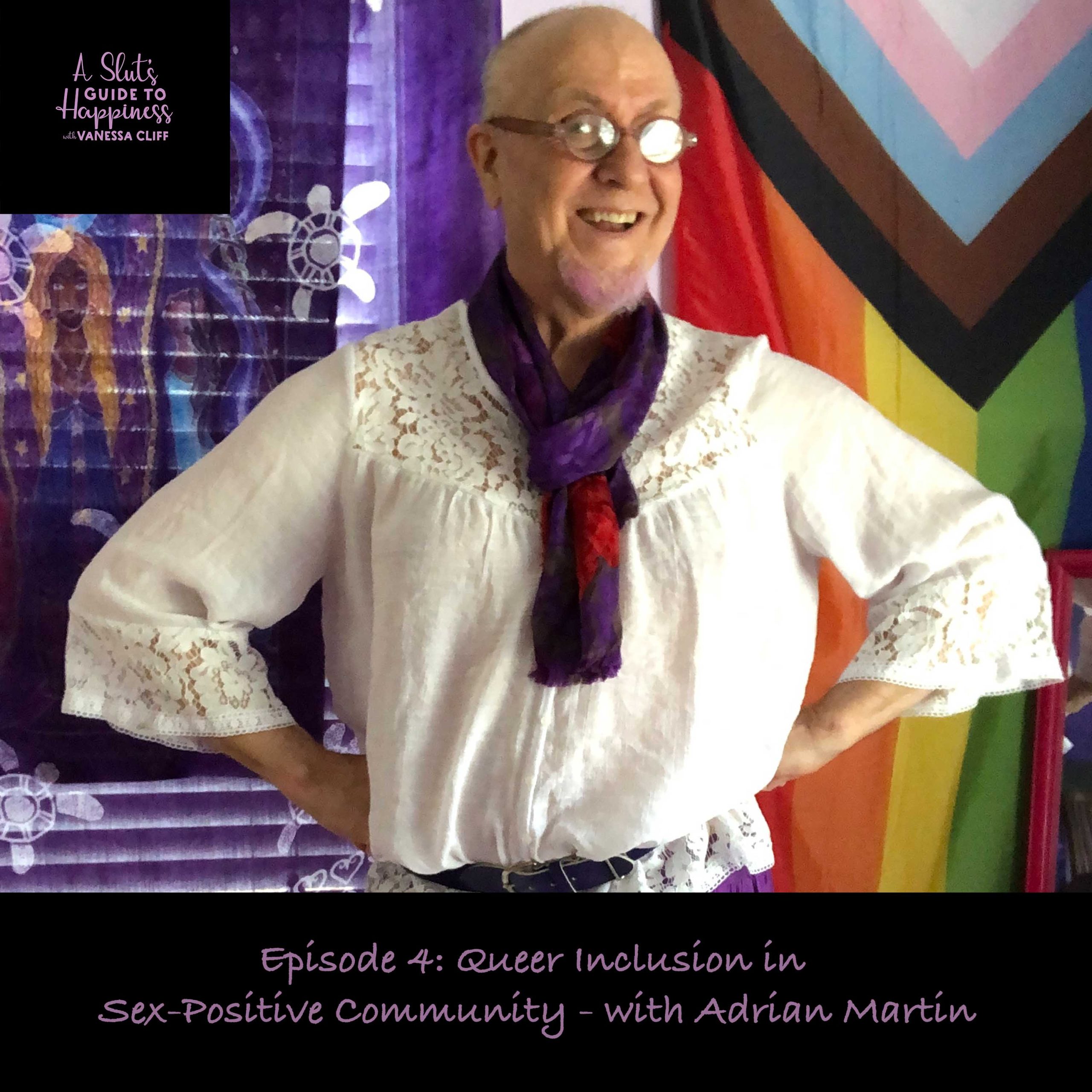
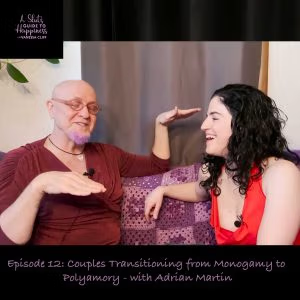
In this episode, Adrian Martin, a long-time community organizer with a foot in both worlds, explores how sex-positive community organizations and social groups can create a more inclusive environment for queer and trans participants. Adrian describes dynamics they have seen play out preventing queer and trans people from feeling supported in sex-positive spaces. They delve into examples of spaces where beautiful choices were made to create environments that were more inclusive of diverse genders and sexual orientations.
Today I will be talking with a dear friend and our Consent Educator and Sound Director at Cliff Media. Adrian is a pansexual queer person who has been engaged in queer and sex-positive organizing in different capacities for a long time.
We’ll be talking about a question that tickles my heart. I spend a lot of time dreaming about and trying to figure this out because it’s such a source of joy and meaning, and it’s worth it.
The question at hand: What does it look like to build inclusive, sex-positive community?
I want to start by prefacing that there is no perfect path to community building. If you’re here looking for the exact perfect model, we don’t have it. It’s all messy and imperfect.
I think a lot of times it’s easy for us to get critical of how organizers or organizations build spaces for people to connect. But we have an opportunity to be positive and learn from each other, to be humble, to recognize that we’re all coming from different positions, whoever we are, whatever our life experiences are.
We’re going to make mistakes and we can stay together. It’s worth trying from whatever place we’re in, from that growth mindset to learn together.
There are also a lot of vectors of inclusivity. What does inclusivity mean? We can talk about race, physical ability, neurodiversity, body size, age, so many things, and we’ll explore lots of that in different episodes of A Slut’s Guide to Happiness as we imagine building the beautiful future of an inclusive, sex-positive world.
We’re going to take that piece by piece. So today we’ll talk to Adrian about one specific part of inclusivity around gender identity and sexual orientation.
Adrian, I am so grateful you’re joining us today.
Adrian:
I’m super happy to be here Vanessa.
Vanessa:
It’s great that we get to hear from a person who has been organizing in the community in so many different ways for quite a long time.
I want to start with a conversation that you shared with me. You were talking with a local organizer, who was asking you about how they can make their space a more queer, inclusive space.
So I’d love to know first, what kind of work they do in the community. And then, what was that conversation like? What were you exploring there and what was your advice to them?
Adrian:
Well, it was about the organization called Sex Positive Portland (SPP) and these conversations happened many times over the years. I joined that organization in 2014. And many times throughout there, people have noticed that there isn’t quite the queer representation that we would like to have.
I don’t know why they keep coming to me. But they asked me. Something about the purple beard? Must be. Theyhave asked me, what can we do to increase the queer representation in our group?
Part of it, I think, is a matter of timing. This organization started in 2009, and I call that the age of the poly population explosion, especially in places like here in Portland and the Pacific Northwest. It coincides with several books, like The Ethical Slut and More Than Two, and other popular media about polyamory coming out.
So there was a lot of interest in poly. There were a lot of poly people that showed up. Some were queer, some not. But that was it just seemed like the organization came up at the same time that that population was just becoming aware of itself.
At that time in history, there were certain queer spaces. And gay male spaces in particular were pretty abundant. There are lots of gay bars. There’s lots of organizations and hiking clubs and things like that. There were also, definitely not so many, but there were already existing lesbian spaces too.
So I think that what was happening was, our organization looked interesting to people who kind of were looking for a home. And some queer people kind of already had a home and weren’t sure about SPP.
Now, since then, SPP has definitely increased the queer population of our little group. Part of that I think is just queer people making themselves visible. When I go to events, I try to be myself and really lean in to my authentic gender expression. If I can, I will push the femme side a little bit harder just to try to make the people coming to the event feel like maybe they see someone, a representation of their own selves.
Vanessa:
By opening up yourself and identifying yourself and maybe a vulnerable way of being a little bit more queer, you are creating space for other people to feel comfortable there.
Adrian:
In the same way that in media, there’s so many more queer characters in music, in movies right now than when I was growing up. And, growing up, I had no role model, no safe identification for who I am.
So I have tried to work on that a little bit. Our group has also tried, making subgroups. There is a queer subgroup within Sex-Positive Portland. And that it takes a lot of leadership and a lot of time on people. We have to find people with enough time to put that on their plate as well.
Vanessa:
Yes, organizing is a lot of emotional energy. There are a lot of different pieces that you talked about that I’d like to pull out. First, just knowing that people use different words and come from all different places. And I think one piece of inclusivity is making things as accessible as possible, that the words are just kind of trying to capture something that is an abstract social experience, but we want them to be helpful.
So, you know, I’ve been a lesbian for a long time, then I was bisexual, then realized there are lots of people of different genders which helped me come to recognize my sexual orientation as pansexual. And in regard to gender identity, I know a lot of people who identify as trans or genderqueer in the community. So I’m wondering if you can talk us through this word that some people use in this community. And maybe in different parts of the country it isn’t used as much. What does queer mean to you? What all is in that umbrella when you’re talking about that?
Adrian:
I am going to refer to my notes that I made on this because it is complicated and, as much as I live it, it’s still a question, what is this? People come up with various ways of thinking about this too. There’s all sorts of ways to approach this.
To me, queer just means it ain’t normal. Then you have the problem of what is “normal”. We can think about this in terms of orientation, gender, and relationships.
Sexual orientation is who you find attractive. It’s outside of yourself, looking at other people.
Gender is how do you identify yourself.
And relationships is about the way you best relate to other people and how you define the relationship.
And so the normal of those three would be straight, cisgender and monogamous.
Vanessa:
And for our viewers, can you tell us what does cisgender mean?
Adrian:
Yeah, cisgender means you identify as the gender you were assigned to birth. Thank you. Some words become normal when it’s within your own community but then it can be lost talking across communities.
So for example, if I was assigned male at birth and if I identified as a male, that’s what I would see as cisgender. That’s what our current society would think of as “normal”. When I think about normal, it’s really the most widely accepted identity. Right.
So then the most common orientation would be known as straight. If I was a cisgender man attracted to cisgender women, that would be seen as sexual attraction to the opposite sex, what society would think of as straight.
And then if you prefer to have only one partner and only have sex and intimacy with one other person, that is what we would think of as monogamous.
And all of these things are good. As are other ways of being. In community, we just want all the people to feel loved.
Vanessa:
So you talked about cisgender. Can you talk about what are some other genders that exist?
Adrian:
Sure. So if I’m assigned male at birth and I feel like I’m not actually a man, I’m actually a woman, then that’s transgender. The opposite can happen, too – female to male.
There’s some ambiguity about also using the word “transgender” in other contexts. For example, I consider myself agender. I don’t really stick with one or the other. Another word for that is sometimes genderfluid, because it can lean back and forth.
So a person might refer to that as understanding that I’m transitioning from male to agender. Or it could be described as genderqueer, gender fluid, or non-binary, Those words all have subtle meanings that differentiate from one person to the next.
Vanessa:
Yeah, that’s beautiful nuance. I think one of the things that I’m hearing is the plethora of identities and desires and life experience in there. Queer community is not a monolith, queer people don’t all feel one particular way. There are so many different backgrounds, ways of identifying, ways of interpreting words. There are many different ways people enter the experience of what might be called queerness.
Adrian:
Yeah, absolutely. And that’s just the gender identity part of it we’ve talked about. When you get into orientation, meaning who am I attracted to, then there’s a whole other spectrum. There’s gay, lesbian, bi and bi-plus.
Vanessa:
I don’t think I’ve heard that one. What is bi-plus?
Adrian:
It’s sort of the same as pansexual. The word bi has been around so long and so many people use that as their identifier. But they are also open to not just male and female, which would be the binary, but also the people in between, people who are transgender, genderqueer, non-binary, or other genders. People like me.
If you go deep, thre are tons of other identifiers. For example, gynosexual meaning, I’m attracted to femininity. Skoliosexual meaning attracted to trans or genderqueer people.
Vanessa:
Interesting. So I came out when I was 14. I’m 33 now. I’ve been in the queer community for that long, and still you’re sharing words that I never heard before.
It feels like one of the things that is helpful is this mindset of learning. No matter how many gay people or trans people or whatever you’ve encountered, you are going to find people with different experiences. And asking people about how they identify their body parts or their gender or their sexual desire is maybe a way to allow us to connect with people in the queer community.
Adrian:
Yeah, we have to learn this stuff, because we’re figuring it out as we go along. That’s the problem with being out of the monogamous, straight, cisgender norm. As soon as someone says they’re different from the norm, outside the normative template, people often want a word for it.
I know a lot of people also push back against labels. But I look at it as language that is helping us to organize our thoughts, feelings and desires. To me that is really important. And it ain’t easy.
Vanessa:
Yeah, clear communication is often complicated. We’re using these words to try to bridge understanding across different life experiences and desires. We’re trying to communicate what’s going on inside of us.
I think one of the things that feels beautiful about what you were talking about in this experience with Sex Positive Portland and queer community, is that there are two different kind of social movements of people who are learning to think in a different way.
Poly people were realizing a monogamous structure and an escalator to marriage maybe isn’t the only way. Realizing there’s a lot more freedom then seeking out other people who see how this world is free.
And then at the same time, there’s the LGBTQ movement that’s exploring identity and community, advocating for changes, creating the gay bars and lesbian bars and the pride movements in all these spaces, and also figuring out like, oh, we could be any orientation or gender that feels true for us. We can we can fuck and love whoever we want to do.
And so there’s these openings of freedom and questioning the prescribed norm, but it sounds like they’re happening in parallel.
Adrian:
Absolutely.
Vanessa:
So how do you bring those things into conversation with one another? I imagine that there is a lot of overlap, but there’s kind of different movements and leadership and representation there.
Adrian:
Yeah. I mean no one person is any one thing, even people way to the far edges. A lot of times we’ll have to eventually admit that, you know that. Yeah, I’m totally queer and I’m active in that community. But at the same time, it seems I’m polyamorous as well.
And, and so to certain people, one thing might seem more important, socially and politically. But also there’s, there’s both movements or, and other ones, you know, that are all happening at the same time.
Especially in this political climate that we find ourselves in now, where books are being banned and, in some parts of the country, people can’t use the word queer. So these movements, and others, are really important. I kind of look at it the same as if you’re a queer, polyamorous person, global warming is still important to me.
It’s not like I’m just an environmentalist. I’m a whole person, a full person living in a complex world.
So there’s a lot of overlap. If there’s a Venn Diagram, the overlap between non-monogamous people and LGBTQ people is quite large.
But there are people who maybe opened up their traditional monogamous relationship, realizing they can have multiple straight relationships. And they’re support of LGBTQ+ people, but they don’t have the life experience to realize ways that they’re not creating a space that is driven by, welcoming to and desiring of queer people.
Vanessa:
I’m wondering if you can talk about some of the experience like that, moments where you saw spaces that may have been disempowering for queer or trans folks, or driven them away?
Adrian:
Sure. One example we can use is around pronouns. One thing that I experience in a lot of sex-positive spaces that want to be inclusive is an opening circle at an event that includes people saying their name and pronouns.
The first time I was ever at an event and said “they / them are my pronouns now”, several people when going around the circle said “I don’t care about pronouns”. It’s easy to not care about pronouns if you’re cisgender. You have the privilege of not caring because people will likely call you how you identify, based on your appearance. You don’t have that struggle.
To me, it felt demeaning for someone to say I don’t really care. II understand that some people are open to using pronouns and that quite often they think that it’s, being supportive by saying if you want to call me they/them, that’s fine. I support that. But this when someone says, I don’t care, then I don’t feel good about that, because I do want to be cared about, you know?
Vanessa:
Yeah, it does matter to you because pronouns help identify a part of your being in the world. I think everybody wants to be seen and loved for who they are. And if that’s a part of who you are, that’s an important conversation to have.
Adrian:
When we get together, we will include people of all different orientations, genders and relationship styles. And it’s important to recognize that difference.
Saying something in general about kinky people, swingers, or a whole group of people can be hurtful because it erases some people’s identity and experience. We all have our different individual life experiences, regardless of what words we’re using to try to communicate about our life experience.
Vanessa:
I think one of the added layers of sex-positive spaces is the added factor of sexual interactions. For example, in Cliff Media, we shoot porn which of course involves sex. We practice enthusiastic consent, which means people are making choices about their personal desire. So there’s some similarity in that to sex clubs, sex parties or orgies hosted at SPP events.
People may come with good intentions and desire to support queer or trans people, but then in practice, during the scene, there may not be the same attention given to queer or trans people as cisgender people.
The same is true of other factors people associate with normative attractiveness, like body or dick size, disability, age, race, and so on. Without really intentional work within an organization, some people end up more desired and receive more sexual interaction than others.
Have you seen that play out in SPP? Is that a thing that has impacted you or other people around you? How do you deal with that?
Adrian:
Oh my gosh, yes. I’ve been to many sex parties where cisgender, mostly straight men, are interacting with lots of people and I might be interacting with just one person.
When the assumptions of straightness are taken out, it can be harder to identify if someone wants to interact. You have to use your words and ask. Sometimes it can be harder to identify if someone who looks straight or cisgender presenting is interested in engaging with you and queer sex.
So even in non-sexual settings, the onus cannot be completely on us. I consider myself an educator. I’ve been a music teacher for 40 years and I love when people ask me questions and I get a chance to talk to them.
But not all queer people do. It can be exhausting. And sometimes the kind of questions that people ask are just ridiculous. Like, they’ll ask you, have you had surgery on your dick? It’s a little personal. Maybe that’s not a question that somebody wants to be asked.
So putting things out there is like, we exist, we are worthwhile people. You, we are going to interact with culture and society. And there are materials you can read. There are podcasts as a matter of fact. There’s all sorts of resources.
Another thing that I definitely run into with people in my community is that there’s also this kind of this ageist situation where some people feel like they’re too old to learn that. People are saying they’re too old to interact with this new fangled “queer thing”.
Like “yeah, I know the young people tell me I need to figure out their pronouns, but I’m 50 years old. I can’t do that.” I’m absolutely 100% sure that you can use “they” instead of “him”. I am 100% sure you got that command of the language.
Sometimes asking queer people to be the ones to have those conversations can be exhausting. Sometimes it’s beautiful if people who are not queer are taking the initiative to ask open-ended conversations, like “How would you like your body parts referred to?” Or, “How would you like me to interact with your body parts in a way that’s not making assumptions?”
Also I think having queer and trans people in leadership is important. It’s more likely to help make queer and trans people feel comfortable in that space. To the extent that cisgender or straight people are in leadership as well, part of what they can do is educate themselves and be people who are putting in the work to create space for queer and trans people.
Vanessa:
One of the things I also want to talk to you about is some of the experiences that you have seen of it really working. We’ve talked about some examples of actions that have driven queer people away. I’m wondering about organizations, spaces or even moments where you have seen really positive things that worked for helping to create more queer inclusivity.
Adrian:
There is a poly discussion group that I’ve been in and out of leadership since 2015. I try, when I can, to present myself as a little bit more obviously queer in the way I dress and show up. I stand up there and I tell people this is what I am, this is where I come from, this is what you see. And kind of queer taking up space.
So when people see something that they can relate to that looks a little bit like what they think they are, then they’re a lot more apt to walk in the door. Which takes bravery, willingness to release any shame society tries to attach to gender diversity. You’re implying in your presence, I’m here and I’m happy and I’m proud of myself.
Vanessa:
I think it’s beautiful that you do that and that people are able to support you and follow your leadership or the leadership of other queer people who are in those kinds of spaces.
If there are listeners who are already involved in communities, whether it’s a sex positive, formal organization or they’re getting together with their friends for orgies or swinger parties or poly groups, what would you recommend around how they can think about creating more space for queer and trans people?
Adrian:
Put it out there. Just just say the words: queer people are allowed here. Queer people are encouraged to come here. And like what you just said, to put queer people in leadership or in some place where they can be seen. Queer and trans people who have the spoons for that, people that can.
I recognize my own privilege in that I don’t have to be closeted. I’m not going to lose my job. I’m not going to lose my family. Not everyone’s in that position.
So if you can do that, then, maybe reach out and join a group who is going to benefit from just the presence of your body and identity being in that space.
And, if people are on the other side of that, looking for, safe space, then, take that first step. You just have to start putting one foot in front of the other.
Vanessa:
You also mentioned something to me the other day that was really good advice also for this. When cisgender or straight people are already in spaces, even if they’re not yet interacting sexually with queer or trans people, they can still help create an environment that is welcoming and affirming.
Adrian:
Yes, someone who’s not in the queer community can reach out and say something like, that is a beautiful dress. Affirmation matters. People can also say things like, I would like to know more about you. Smile. If it’s a space where sexuality or touch are encouraged, you might ask if the person would like to hold your hand.
You’re just making people feel more at home, wanted. Just go up and say hello, or offer a hug if that person wants it.
In sexual play, if it’s something you’re considering, like if you’re bi-ish, bi-curious, ask. Take the brave step of saying, hey society, it’s actually beautiful when when everyone is engaged and seen in their bodies.
Vanessa:
That’s really important, the value of being the first one to step out of your comfort zone, outside straight sex, and be the first one to connect and ask. Ask someone who is in the queer community that you might not normally interact with.
Adrian:
Yeah, exactly.
Vanessa:
I’m a big fan of Brené Brown. Her book called “Daring Greatly” talks about stepping into the arena. Especially if you are the one that has the comfortable space, the support of all of our society and culture, especially if you’re a heterosexual, cisgender white person, and you’ve got all that privilege going for you, use some of that power to walk up and tell someone they are cared about. Show them that you are not afraid of them. They don’t need to be afraid of you.
Step up. Dare greatly. There’s a phrase that I frequently tell myself whenever I am nervous walking into a space I don’t know, you know, different phrases, useful for different people. But one thing I say is I am open to giving and receiving love unconditionally and worthy of being loved, myself and others.
It helps me remember that other people are going through the difficult experience of walking in vulnerability. A queer person might walk into a space not knowing whether they’re going to be accepted in this space. I can say thank you for being here. You’re so beautiful.
If we’re focused on building beautiful things together, even if I say the wrong pronoun, or I say a thing that names your body part in a way that doesn’t feel good, then hopefully there’s some possibility of you providing feedback.
I’m grateful for information like that from people, when people have the spoons for it. It communicates what helps people feel wanted and loved and cared for in that space.
So thank you so much for working together and figuring out this long, ongoing journey of how we can create spaces where queer and trans people are seen and wanted.
I really enjoy talking with you, and I look forward to more conversations. And listeners, thank you so much for joining us.
This has been another edition of A Slut’s Guide to Happiness with your host, Vanessa Cliff and our fantastic guest, Adrian Martin.
You can find us wherever you get your podcasts, including Apple, Spotify, as well as on our website, cliffmediaproductions.com. I encourage you to like and share this podcast. Please help us get the word out there, spread the message of freedom and joy.
Stay tuned for more deep dives into this beautiful, messy, fun water of life. If you’re over 18, you can also check out our video content on our site, cliffmediaproductions.com.
And most of all, I invite you to join us in the pleasure of being awkward, human, naked, and without pretense.
Let’s get free.


Materials found in this section may be sexually explicit in nature. To view materials on the site, you must affirm all of the following:
I am at least 18 years of age (21 in some localities). Any sexually explicit material I am viewing is for my own personal use and I will not expose minors to the material under any circumstances. I do not find images of nude adults, adults engaged in sex, or other sexual material to be offensive or objectionable and I desire to receive and view sexually explicit material.
The viewing, reading and downloading of sexually explicit materials does not violate the standards of my community, town, city, state or country. I am solely responsible for any false disclosures or legal ramifications of viewing, reading or downloading any material on this site.
This website and its affiliates shall not be held responsible for any legal ramifications arising from fraudulent entry into or use of this website. This warning page constitutes a legal agreement between this website and you.
All models, actresses and actors whose images appear on this site are over the age of 18. Bookmarking to a page on this site whereby this warning page and/or terms and conditions are by-passed shall constitute an implicit acceptance of the terms and conditions herein.