
Feeling comfortable in your own body and experiencing a sense of connection and belonging to others is a nearly universal connection to happiness. For people with a visible physical disability, trauma, exclusion, and discrimination contributes to higher rates of mental health problems and substance use disorders.
When you have a visible physical disability, other people’s ignorance, even when well-meaning, can make you feel different, misunderstood or excluded.
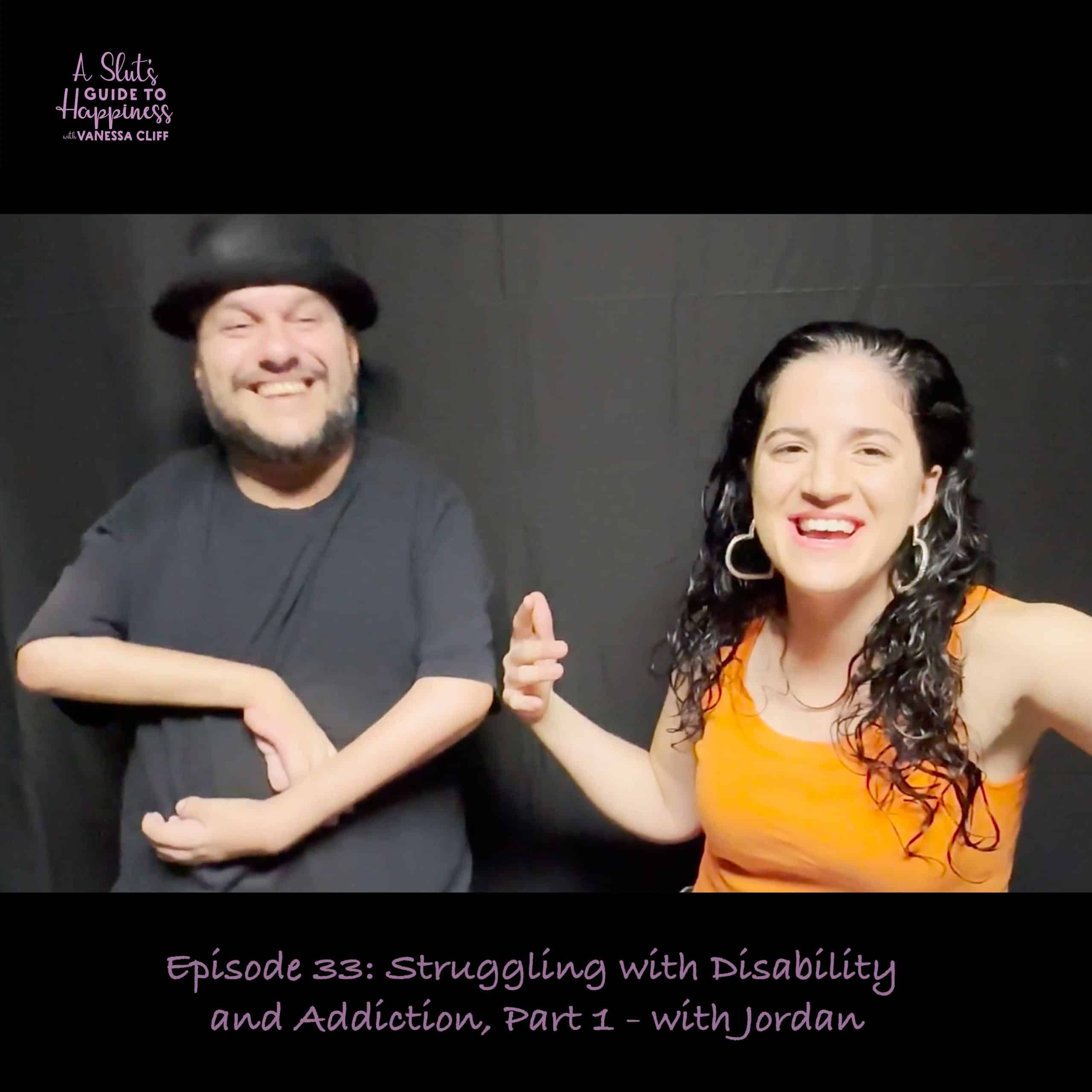
In this podcast, Jordan talks about the relationship between his life as a person with a visible permanent physical disability and his experience of addiction. The difficulty caused by exclusions in school, and other people’s ignorance, even when well-meaning, led to him feeling different.
In high school, substance use gave Jordan access to what otherwise felt like unachievable inclusion. Increasing use of substances, in the hustle to experience belonging, led to a life-impairing addiction. Although Jordan has since overcome his addiction and now leads a life full of positivity and meaning, the addiction took a toll on his early adulthood.
Like many common human experiences, including sexual desire, masturbation, queerness and mental illness, addiction is often suffered in secret shame. Jordan’s story models incredible vulnerability.
Welcome back to A Slut’s Guide to Happiness, where your body is perfectly imperfect and it’s safe to be as sexual, kinky, queer, or slutty as you want.
I’m going to preface by saying that my voice may sound a little different today, because my body is doing all kinds of things. But people like Jordan, who is hanging out around the Cliff House today, has said very sweet things like take time to take care of yourself, which I deeply appreciate.
So if my voice sounds different, that’s all that’s going on.
But today we’re going to be talking with a new guest. He’s new to A Slut’s Guide to Happiness podcast, but definitely not to the Cliff Media universe. He is currently a resident of the Cliff House, as some people roll through this beautiful community space, which I love.
He has been sharing with people that his office is open, which is at the kitchen table, and I love walking through and seeing him set up there. Sometimes working on building up the new website, cliffmediapproductions.com, sometimes helping other members of Cliff Media build up their work and as sex workers build up their power in the world.
So it’s exciting and lucky that we have to be able to collaborate with Jordan here at the community-driven porn production company that we are running.
Today we have the pleasure of talking with Jordan about the relationship between physical mobility, disability and addiction.
A little bit of background. According to the Centers for Disease Control, 64% of people with disabilities in the US reported either adverse mental health symptoms or substance use, and specifically, substance use disorders were 2 to 4 times as common among people with disabilities as among the general population.
There are many possible explanations for this, the reasons of which almost certainly vary depending on people’s disabilities. Exposure to trauma, to pain, or their social environment. But at least one thing we know for sure there’s a strong correlation here.
Today, we’ll be exploring Jordan’s perspective based on his personal experience, and I think it will become self-evident as he talks about why this is so relevant to happiness. Of course, not always, but addiction often originates from underlying emotional concerns like sadness, depression or isolation.
So finding ways that we collectively connect, whether that’s in loving community or happy relationships or hot sex or all of the above, is a huge component of building lasting happiness, which is one of the core subjects we talked about and potentially a counter to addiction.
I will note that this perspective that I’m providing is from someone who neither has a physical or mobility disability, nor have I done the incredible and challenging work of overcoming the illness of addiction. As always, it’s important we turn to people who are experts and no one is better equipped to help us understand an issue than the people with direct lived experience.
So I’m grateful to be able to dive into this conversation with someone who is an expert, and for Jordan’s willingness to share his personal experience. Jordan, thanks for joining us.
Jordan:
Absolutely. My pleasure. I love to share. I love to empower others through my own experiences. And I love to hang out with you. This is our community.
Vanessa:
I know there may be moments throughout this that feel traumatic or hard, so please feel free to say you don’t want to go to that moment. But let’s start at the beginning of your relationship with drugs. How old were you? When did it start? What was going on in your life at the time?
Jordan:
So it all started for me in high school, I would say mid-high school. So probably between the ages of like 14 to 17.
In that time, high school was a bit of a drastic change for me, because in elementary school I was very guarded and very protected. Because of liabilities and all those kinds of fun things. Rather than allow me to really grow as an individual, it was more convenient for them to secure me and keep me away from certain things in order to protect their liabilities and whatnot.
Vanessa:
So for our viewers and listeners, can you help them understand why what’s going on with your life or your body that required concerns about liability?
Jordan:
As a youngster growing up in Toronto, Canada, the school board system, obviously to protect their legal liabilities in terms of students getting hurt or any types of injuries or anything like that, they went the extra mile in ensuring that, for example, it was winter out or icy out, they wouldn’t let me out or there was certain activities and gym participation that I wasn’t allowed to do certain trips.
I wasn’t allowed to go on because of my physical disability. Because of my physical disability, I was more likely to fall and hurt myself in doing these things than not. Which I mean statistically, probably correct because my balance is less sturdy than than most. So it’s valid. But I felt like there probably could have been better ways to handle it.
Due to my physical disability, they were worried that in certain scenarios I was more likely to hurt myself than the “average student”. That was used to kind of isolate me in certain ways and in a lot of activities, in a lot of fashions.
Circling back to the original question, once I got into high school, that was all gone. It was a new school. It was a new start. It was a fresh start. So for me, that fresh start was really important. I took advantage of it, to the extent where I felt comfortable making friends and being free and just doing whatever I wanted.
At the time, the culture was cannabis first and foremost. That was something I started early, maybe before I got to high school. I’ve been smoking cannabis longer than I haven’t at this point.
So that’s kind of how things started. I wouldn’t necessarily call it a gateway, because even now that I’ve been sober from hard drugs, I still enjoy cannabis. So for me, I never connected the two.
But that’s how I guess I was maybe not feeling anxious to try things or me maybe at least like the attitude, like weed isn’t so bad, so I’m not too afraid to try other things. So maybe in that sense it’s kind of gateway-ish.
Once I was able to get established with the potheads and the stoners, then I felt like I’m part of a little clique, and then that clique started smoking pot and drinking beers on the weekends. Then it went from beers to cocaine and mushrooms and ecstasy and all those others, like MDMA and all those designer hard drugs that were available in the early 2000s, I mean are still available now.
It’s interesting that even amongst my travels and living in different areas, the one constant is like if you are somebody who is looking for drugs, you will find it in every city. That’s one thing I can say from experience is a fact of life. It really just became part of a way to keep myself included. Saying no felt like a step in the wrong direction.
So it started off like cannabis was cool and I enjoyed it. And it didn’t necessarily interfere with my everyday life or my ability to think critically, my ability to do well in school, or my ability to socialize.
But then I got so drawn into that clique, that group of people that it was hard to feel like the odd man out or go against kind of what the group was doing. Like if they said, let’s go drive around, do something stupid, I’ll jump in the back seat or the front seat and say let’s go.
Like if it was a New Year’s party, and somebody got a little baggie of something, and they’re handing it out a little bit to everybody, are you going to be the one guy that says no? Probably not. I wasn’t at first. That was probably inexperience and poor judgment. I think some of it also has to do with ignorance, not knowing what I was actually getting into either.
Everyone grows up getting told that drugs are bad. You always have that. And you also see other people, older brothers or friends that you have taken wrong paths, and they’re like 5 or 6 years older. You see these things, so you kind of know, like this is generally not a good thing to do.
But again, like you’re standing in a circle, it’s New Year’s Eve. And this is a true story. This is how it started. It was New Year’s Eve standing in a circle, passing around a joint. Somebody had a bag with a little key. Everyone was doing it, and it was my first time. And I was like, I could be the one guy that says no. But I didn’t.
There was that moment. Absolutely. The moment was, I’m looking around at everyone else saying yes. I decided I’m not going to be the one guy to say no today. Even if it was in other cases, I might have dodged bullets and danced around it, saying I’m not feeling well today or I gotta wake up early tomorrow.
But it was New Year’s Eve. Everyone’s partying. I felt like, you have to step up and be part of the crew and just say yes. Nobody externally was pressuring me, but I felt like that it might be the difference between having friends today and not having them tomorrow. Or maybe they think I’m too good for them or their perception of me is that he’s not down. Maybe we’ll just stop inviting him because he’s a downer or not cool enough to hang.
So all these thoughts go through your head and it’s like, all right, well, against my better judgment, I’m just going to do it and hope for the best.
It started that New Year’s Eve.
Vanessa:
Do you remember how old were you that night?
Jordan:
I remember it was mid-high school, like grade ten.
Vanessa:
That’s when you were jumping into cocaine?
Jordan:
Yeah. That was the first time that I had tried it. Again, the cannabis was pretty regular. It was very controlled and responsibly used, never during school or never during work, just very responsible casual usage.
And then that was the first time I had been exposed to cocaine in the past and had seen older brothers and friends hanging around there doing it. They looked cool. They were having a good laugh. They know that we’re maybe too young or shouldn’t be doing it.
So they get a kick out of doing it in front of us and not giving us any and just having a good laugh about it. But then it’s like that exposure, you see a bunch of other people doing it and then it becomes normalized.
You think they’re having a good chuckle about it. Then once when it’s brought around you think, well they had a good time. And these people are saying yes and having a good time. So I guess I’ll just ride that bus.
Vanessa:
One of the things that I’m hearing as a theme of what you’re talking about is this desire for a sense of belonging. You wanted to stay part of this clique. You wanted to not be that odd one out that says no. And I think that’s kind of a common thing that people talk about when using drugs.
I’m thinking in the back of my mind about that statistic about people with disabilities being much more likely to get connected to substance use disorder. I’m wondering if there are parts of your childhood related to your disability that contributed to that moment, those experiences in high school where you were saying yes to drugs.
Jordan:
I think I touched a little bit on it earlier, but like the extra mile like that the elementary school that I went to went to ensure that I didn’t hurt myself or get hurt while under the care of them or whatever the case may be. It turned into a lot of very isolated feelings.
When the world treats you differently, it’s hard for you not to naturally start to feel that you are different because everyone around you is treating you differently. It’s hard for you not to feel different because it’s there and it’s obvious and it’s actively being thrown in everyone’s face, like hey everyone, go do this activity, everyone except that guy.
You feel like you’re the guy standing in the corner by yourself with a light shining on you. So for me, I grew up just understanding or accepting or like or not even accepting, actually, that’s the wrong word, but frustrated and that turned into isolation. And then it was deep, anger and frustration, like “why me?” anger and frustration.
A lot of “why me” anger and frustration or anger at having a disability or both. Yeah I was angry at having a disability. Why me? Why am I different? Why was this set up this way?
A lot of questioning religion and faith. Has a God that has done this to me? Is it genetics? Is it science? Am I cursed? Am I blessed? I don’t know.
I have all these thought processes in my head. I’m being treated differently. I’m being isolated and sequestered. I don’t know how to process my feelings. So I was just angry. I was a very angry adolescent.
Growing up, before getting into high school, it was a lot of difficulty even getting into that. The 2 or 3 years before getting into high school, you’re kind of just discovering your body and how you feel about other people.It’s really like a crucial time. So isolation makes it even worse because you feel like while everyone else in the class is starting at a level playing field, I’m starting at like -100 when everyone else is at zero.
I felt like that feeling of isolation just kept perpetually growing, like the hole figuratively keeps getting bigger, and you feel like you’re getting deeper and deeper into that hole.
That was kind of like how I grew up, feeling and being treated differently. It just hurt and it sucked, and I hated it. It caused a lot of hardship for me.
So in the second that I had an opportunity to not feel that I was different, I jumped on it right away. This is fantastic. This is what I’ve wanted. We’re all doing drugs. We’re all the same. Let’s go smoke a giant drag. Let’s go drive around, grab some beer. Let’s go do this and that.
Then after the first time, it was like, on the weekend, let’s go have a beer. I suppose “Who’s got 20 bucks? Let’s go grab a little baggie.” Okay, cool. That’s fine. All right, now it’s 4 a.m.. 5 a.m.. All right. If somebody has 40 bucks here, let’s go get another one. And that’s just it starts like where it’s like you’re in party mode and everything feels great.
Then it kind of just cycles into more of a habit. A lot of it did, I think, and I don’t hold any ill will against any of it.
I had a specific caretaker in elementary school that was assigned to me, which also felt very isolating and made me feel even more different. I had somebody follow me basically every day, all the time, making sure that it didn’t break my neck. Nobody else had that. It was just me sitting beside an assistant teacher while everyone else was doing their thing.
For a period of time, they required that I wore a hockey helmet when I went outside. It was so fucking big and exaggerated the visibility of my disability. That makes it even worse. And the whole activity. Everyone’s going out. Well, now you have to go do this prep instead of just running outside with everybody else. And then it becomes, all of these compound into an identity of being different.
You are treated differently. You are different. And that’s just the way it is. So that’s really the deep root of that need to belong or being in a group and be part of a crew was just deep seeded from not wanting to feel different anymore.
Vanessa:
One more clarifying question on that. You’ve talked a lot about the perhaps well-meaning, but really profoundly negative impact that the liability and the schools’ procedures, the caretaking and keeping you out of physical education had on you. I’m wondering if you also had any peer experiences during that time that impacted you.
Jordan:
Yeah. I sort of touched based on that, I didn’t really finish that thought. I don’t hold any ill will because in elementary school, I was the only person with a disability. So maybe there’s a lot of ignorance there.
It was the early 90s and there wasn’t a lot of education on that, yes from a medical standpoint, but not a sociological or psychological standpoint, where people can understand all of these things and how it would impact people.
I don’t think anyone was thinking about that one bit. They were just making sure that I didn’t break my neck. That was their main concern. So once you exclude all of those other factors, then you know it’s left to the person’s devices to figure it out themselves, whether it be positive or negative.
Peer wise, it also threw in another wrench because they would assign people to help me with things, like walking up and down stairs or have a helper or to do things. I was assigned another student to help me to do things.
Vanessa:
So you became a responsibility instead of a friend?
Jordan:
Yeah, to certain people. I did have my friends, I also have a twin brother. That helped a lot because he is not disabled, that relationship, he folded me into what he was doing, and he was very protective of me that way to make sure that I was included with everybody else.
So that did help a lot.
But, for the most part, I had a bunch of friends but then I was one person’s responsibility and it shifted. They were nice enough to choose different people every so often. So that just made it better. And that also threw a wrench because it’s like I’m trying to socially develop with other kids, but now it’s like you’re are you you’re my nurse.
You’re my helper, I don’t what is this dynamic? Can I just be your friend? It’s very difficult to navigate that type of scenario. I found at least with peer-to-peer responsibility and asking people if they want to help, anyone who volunteered. In some situations, they nded up being like some of my best friends that I still have to this day.
So it wasn’t all terrible. And there were some good outcomes from it, of course. But I think it was rare and it wasn’t easy and it was probably just luck of the draw. Like two people just get along together.
Probably under normal circumstances, we wouldn’t have been best friends. But it just so happened that the call was made, “Does anyone want to volunteer to help?” Somebody said yes, and we ended up either being best of friends or like having very awkward futures together. Like in high school and other places, it was just weird to say, hey, remember six years ago and he was helping do this.
Vanessa:
I love that story where it’s all about perspective, people can be asked to help and that can be a source of connection and friendship or that can be a source of that person thinking about you in a different kind of way. It’s just how they approached it.
I also wanted to underscore something I think you said that was really important. At that time, there wasn’t as much emotional, psychological, understanding of disability and inclusion. And so I imagine that there wasn’t as much emotional and social learning that was happening in the classroom to help children understand how to be inclusive.
Jordan:
Yeah, emotional support was close to zero to be honest. That’s not to be critical of people or the system that it was placed in, but psychological and emotional support didn’t exist in that world at that time.
Even just having honest and transparent discussions with other people in the class about me and what it means to be around somebody with a disability or how to ask questions about things, or how to open up and offer assistance if they look like they need it. Some of these little social politeness that regular people kind of have with each other. For me, it was challenging because it’s a bit of a different dynamic.
It would have been a lot easier for me if there was more discussion on how we can all get along together. I think it would have helped in maybe even breaking down those barriers of isolation and feeling different.
Then I think even now in general, those kinds of discussions should be had because 25% of the world identifies with the disability. That’s just a fact.
So web accessibility and physical accessibility are so important because if you neglect to think about that stuff, then you’re only really catering to 75% of the population, which may be fine for some, but I think 100% is better.
Vanessa:
When I think back to the overarching themes we often talk about, and I think about sex-positive community or healthy relationships, non-monogamy or kink, not contemplating that 25% seems absurd that if we are talking about 1 in 4, how can we have inclusive community or talk about healthy relationships without touching on that huge population?
I also really appreciate your ability to share about your childhood, because I do think a lot of our ideas about relating to other humans are so often formed during those early years, and of course, compounded by things in society, ideas that encourage us to feel shame about who we are to prevent ourselves from having those deep connections.
Being able to share vulnerability to the extent that feels comfortable, going back to those early years can be really helpful as we learn to get free collectively.
Now I want to jump back to being a teenager. You were describing that initially you’re using drugs recreationally and then it became regular on the weekends. Then you were going through all the night and then at some point it became an addiction. What was that transition? At what point did you know that it was an addiction?
Jordan:
So it went from trying to keep up to then overcompensating. I needed to be like either the craziest or the baddest badass guy in the room. And so it went from just being casual about it to, now I’ve got to be the guy that drank the most this night in the room. Now I got to be the guy that started the most lines tonight in the room.
So it quickly went from just trying to fit in to now being like top of the heap. That was me just trying to hyperdrive or speed up the process of moving from the bottom to being at the top. I wanted to walk into the room and hear people say, you remember that guy from last week? You fucking drank a bottle of Jack Daniels? What a nutcase. That guy’s cool. Let’s go hang out with them.
And that shit just drove me. I was like, okay, I want to be the story for the next week. And so it went from, I’ll do a little bit to like, give me the whole thing right now. I’m going to do it all. I’m gonna do it right in front of you and show you how it’s done.
I was bragging about it, braggadocious off the chain, just trying to be over the top about it. But that wasn’t helpful because now I’m just being reckless about it, and I’m not considering how much is getting done and what the long term effects of continuing and overuse of things like cocaine especially would do.
Vanessa:
That feels really significant that you were wanting that value in the group. What was your emotional craving that was driving you to want to have popularity?
Jordan:
I wanted to be the most popular guy in the room. I wanted to be liked. I think I slowly developed this attitude that if I’m going to walk into a room and people are going to look at me, I’m going to give them fucking something to look at, and it’s going to be something nobody’s expecting that they’re going to talk about, or it’s going to just be like, the last guy standing at the party that just drank everybody under the table, or did the most drugs or did something crazy.
Anything that I could do to be over the top, to be that guy that people wanted to continue to invite to parties, be was the guy that people talked about at the next one.
Vanessa:
That sense of belonging, you are valued. You are seen as important. People talk about you. You’re included.
Jordan:
Yeah. It felt like, once I was eased in and the acceptance was there, Jordan’s down. He’s cool for that shit, then that wasn’t enough. That was just the spark.
Then I was like, I can go further, accepting to be the guy at the back of the line wasn’t good enough for me. I needed to be amongst the top of the heap, the popular guy. I needed to be more than the isolated guy in the background.
That was just ingrained in that transition. I was just trying to be accepted now. I’m the life of the fucking party. Yeah.
Vanessa:
That psychological swing that is talked about so much when you’re struggling with something, you go black to white. You were not accepted, you were isolated through a lot of your experiences. And then you’re like, I’m going to go all the way in all directions.
Jordan:
Absolutely. I was all in. If I was going to be the party guy, then I was going to be the party guy. And I did. I played that part very well, much to my own physical and mental detriment at the end of the day.
It went from that kind of mentality to a little bit more dependent. It got to the point where if I went out for a drink, then I would automatically crave more cocaine, drugs, weed, whatever it was. That was very difficult to navigate.
Maybe it’s like a Wednesday night and I just want to go for a pint, but I can’t because one pint leads to three pints and three pints leads to a bag of cocaine. Then Wednesday turns to Friday. Then all of a sudden it’s like, you’ve just killed your week or you missed the day of school or you didn’t go to work that day.
It turned into this appetite that was very difficult to control because of that gratification and that adrenaline rush, especially from cocaine. For anyone who has done it, it’s very much a stimulant. It gets your adrenaline running. You feel like you can run a mile in a minute.
That rush is instantly gratifying. You know why it’s so very addictive is because instant gratification is very hard after a while to produce naturally. You become dependent on that rush. There’s a drop afterwards. The more you do, the harder the drop is. And that’s why the perpetual need for it becomes important.
Once you hit the drop, what you do to cure the drop is by more. And once you hit the drop, the only way to cure the bigger drop is to buy even more. And then if you really want to kill that drop, you buy even more. That’s when it becomes an addiction, is when it’s the drop is so unbearable that more is the only answer.
So I had that appetite for it. Then it became, to the point where I was doing it when I was bored. If there was nothing else to do that day, by myself, it was just a Friday night or a Thursday night, and I was just bored playing video games, that would seem like a good enough excuse to buy a bag and go for it.
I would and I would do it by myself alone. Then it would be like, all right, then maybe it’s like a Friday, Saturday, Sunday, kind of situation. Then it becomes a lot more being alone and doing drugs by myself and being on sex chat. Watching a lot of pornography or being on chat, interacting with cam girls. That even kind of perpetuated it because my love of porn and erotic material just compounded with the drugs.
So the two eventually became married. I found that if I really wanted to get into the porn now, I had to go buy some drugs.
Vanessa:
At first the drugs were attached to the feeling of belonging and then eventually became attached also to the positive experience of porn and arousal.
Jordan:
Yeah. And it’s interesting because it started as a way to belong, and then it became the utmost form of isolation again, because I was finding that I was spending more time alone. The social aspect, when it got really bad, was completely gone. I wasn’t doing it with anyone at all. It was always by myself at a certain point.
Vanessa:
What was the reason you weren’t going to parties to use cocaine anymore?
Jordan:
I think it was just that marriage of pornography and cocaine made it like, I can’t go do that at a club or at a party. Once that marriage happened, then it was like all isolation, staying up all night chatting and buying tokens on Chaturbate.
I don’t have a problem with doing that stuff clean and sober and the problem is not doing that. The problem was the marriage of the two, which became very dangerous and very isolating and made it more like a normal thing.
It was every weekend and then it turned into like four times a week, and then it’s like 5 or 6 days a week. It’s like you don’t even know that. You’ve just spent all your time by yourself, in the dark. You haven’t showered, you haven’t eaten, you haven’t hydrated.
You’re a mess and your emotions are, all over the place. The drop is starting to hit and all you can think about is, how can I get back to the happy state of porn and drugs?
Sso that’s when it became the moment it switched from the social fun type of stuff to staying at home by myself. That to me was the crossover from the casual to the addict in my opinion.
That’s not based on any science or any study. That’s just my opinion. That to me is when I felt in my heart that it was no longer a party drug. This was a lifestyle. This was a dependency. This was what I needed in order to, what I perceived to be happy, which is really not happiness. The drugs were miserable, and I was just always high. So that’s not happiness, that’s addiction.
Vanessa:
I think about that in the sense that I’m bipolar disorder and one of the characteristics in the DSM manual regarding psychological disorders of bipolar disorder is hyper-sexuality, sometimes described as sex addiction.
And for me I am hypersexual. But I don’t describe it as an addiction because it doesn’t negatively impact my life. It provides a lot of happiness and connection for my life. So when I think about addiction, this is on a personal level, not scientific or medical perspective, it is a connection to an activity causing detriment to your happiness or to your employment or your social relationships or other aspects of your life.
It sounds like that was your moment. I’m wondering if you’re telling us a retrospective analysis or if you also knew at that moment that you had an addiction.
Vanessa:
No, this is completely retrospective. Absolutely. At the time it was completely fine. It was you know, I, I, you know, and normalized to the fact where I knew of other people who were in the same boat.
Interestingly enough, if we want to kind of backpedal to that original crew, half of them ended up with families and wives and children, and the other half ended up addicts like me. I knew of others that struggled the same way and that were doing the exact same things. We’re facing the same kind of demons. So it became almost like, this can’t be that bad if I know 3 or 4 other guys doing the same shit.
So it really didn’t feel like I didn’t feel like an addict at the time. Absolutely. No. I’m like, this is just what people do. It’s all right. I’m in control. I can stop anytime or I don’t need this or all of the things addicts do for themselves to convince themselves that they’re not addicts.
That absolutely was the case. I was not self-aware enough to know that that was a problem. But at the same time, the signs were there because holding down a job was very difficult. I’d last 3 or 4 weeks. When it came the time to choose between addiction and work, addiction always won. Jobs would always suffer.
Relationships were very difficult. In high school, I had my first relationship. It was with a girl and we had a couple of years together. I was transparent about my addiction and hoping that I was going to get support. Instead, I got left behind. She decided that that wasn’t something she was comfortable with. She decided to move along.
At the time, I was very hurt. Now I have the utmost respect for that and for her.
What I did at the time, felt super alone and I was really depending on that as a support option. I was hoping that it would be received with more love and less abandonment. It did hurt a lot and it didn’t help the addiction. It probably actually made it worse if I’m going to be more retrospective about it.
That was less reason to stop because it’s like people are already given up on me. So then, you know, there’s nothing for me to want to stop because all these things are gone now. So what’s the point?
Vanessa:
It reminds me that even though we can choose and we can control the narratives about our lives, and realizing that we can is really powerful throughout our lives and in general, the stories that people make up about us seep into us.
Like when other people were perceiving you as different, that became your internal narrative of being different. And when your girlfriend in high school abandoned you and you weren’t going to have that kind of relationship, then you just decided that became your narrative, that you were isolated and you leaned into that.
It makes me think about how important it is, the way that we choose to relate to each other in the narratives that we put on each other’s lives, in case they become internalized.
Jordan:
Yeah, absolutely. I think it’s a tough thing to understand, a tough thing to see at the moment. It has a lot to do with when you’re put in a situation where you have two choices, and those two choices are based on how other people perceive you or how you want other people to perceive you. Then it becomes less about a choice that’s for you, and it becomes a choice about what’s for others.
So I think that there’s a lot of that too involved in sort of addiction, because a lot of it is selfish. When you are neglectful of things or when you purposely choose addiction over other responsibilities or other people, you then have to accept those consequences.
So if me being an addict affected my relationship with that person to the point where they weren’t willing to help me, then that was less about them and all about me.
Now I can sit back and realize that it wasn’t that person abandoning me. They were protecting themselves. And I respect that they took care of themselves before trying to do anything for me. And they made the decision that that wasn’t a situation they were comfortable with. At the end of the day, I respect the hell out of that.
However, at the time, those feelings are like, you start to compound them. Like I’m not capable of holding down a job or having a relationship. You start to feel more and more that you’ve dug yourself into the hole of being this addict or junkie or whatever people want to call it, to where you just accept it. That’s who I am, I guess, and there’s really nothing else.
That’s how you define yourself. I’m alone. I’m by myself. I’m unemployed, and I spend a lot of time doing drugs by myself. That life really becomes your identity. That’s who I am. That’s what people know me as eventually.
That was another aspect of the addiction was that you walk around thinking nobody notices when everybody does. It’s a really sad appearance to have where you can be high as a kite, thinking that I look normal, nobody will ever notice. And everybody does. That became a thing too. I’d go to bars, I think I’m tippity top and everybody in the freaking room knows what’s going on.
So then you start building that reputation. That happened to me, as well, as the addiction progressed. Then it became, in the smaller circles of the bars that I would hang out, it would be known that that’s the kind of stuff I do. And it would be very obvious that that’s the kind of stuff I did.
That really did start to become my identity. Some people didn’t mind it. Some people fucking hated it. And that’s just who I was for a long time. It became really difficult to not be that because I didn’t know how not to be that. Yeah, that’s who I was.
Vanessa:
Thank you so much Jordan. We’ll dive into the rest of this story in part two of this episode.
Thank you, listeners and viewers for joining us.
This has been another edition of A Sluts Guide to Happiness with their host, Vanessa Cliff, and our amazing guest today, Jordan.
You can find us wherever you get your podcasts, including Apple and Spotify, as well as on cliffmediaprodcutions.com.
Please help us out by liking, sharing this podcast and stay tuned for more deep dives in the beautiful, messy waters.
If you’re over the age of 18, you can check out our video content on our website, including this fabulous person, on cliffmediaproductions.com
And most of all, I invite you to join us in the pleasure of being awkwardly human, naked, and without pretense.
Let’s get free! Woo!









Materials found in this section may be sexually explicit in nature. To view materials on the site, you must affirm all of the following:
I am at least 18 years of age (21 in some localities). Any sexually explicit material I am viewing is for my own personal use and I will not expose minors to the material under any circumstances. I do not find images of nude adults, adults engaged in sex, or other sexual material to be offensive or objectionable and I desire to receive and view sexually explicit material.
The viewing, reading and downloading of sexually explicit materials does not violate the standards of my community, town, city, state or country. I am solely responsible for any false disclosures or legal ramifications of viewing, reading or downloading any material on this site.
This website and its affiliates shall not be held responsible for any legal ramifications arising from fraudulent entry into or use of this website. This warning page constitutes a legal agreement between this website and you.
All models, actresses and actors whose images appear on this site are over the age of 18. Bookmarking to a page on this site whereby this warning page and/or terms and conditions are by-passed shall constitute an implicit acceptance of the terms and conditions herein.