

Coming out as lesbian, gay, bisexual, transgender or queer was a lot harder several decades ago. Many people coped with the fear of unsafety by staying in the closet, resulting in the less often discussed experience of coming out in middle age or later in life.
While there’s more acceptance and support of queer lives today that makes it a little easier and safer for young people to come out, there are still many parts of the country where being LGBTQ is hard or even dangerous.
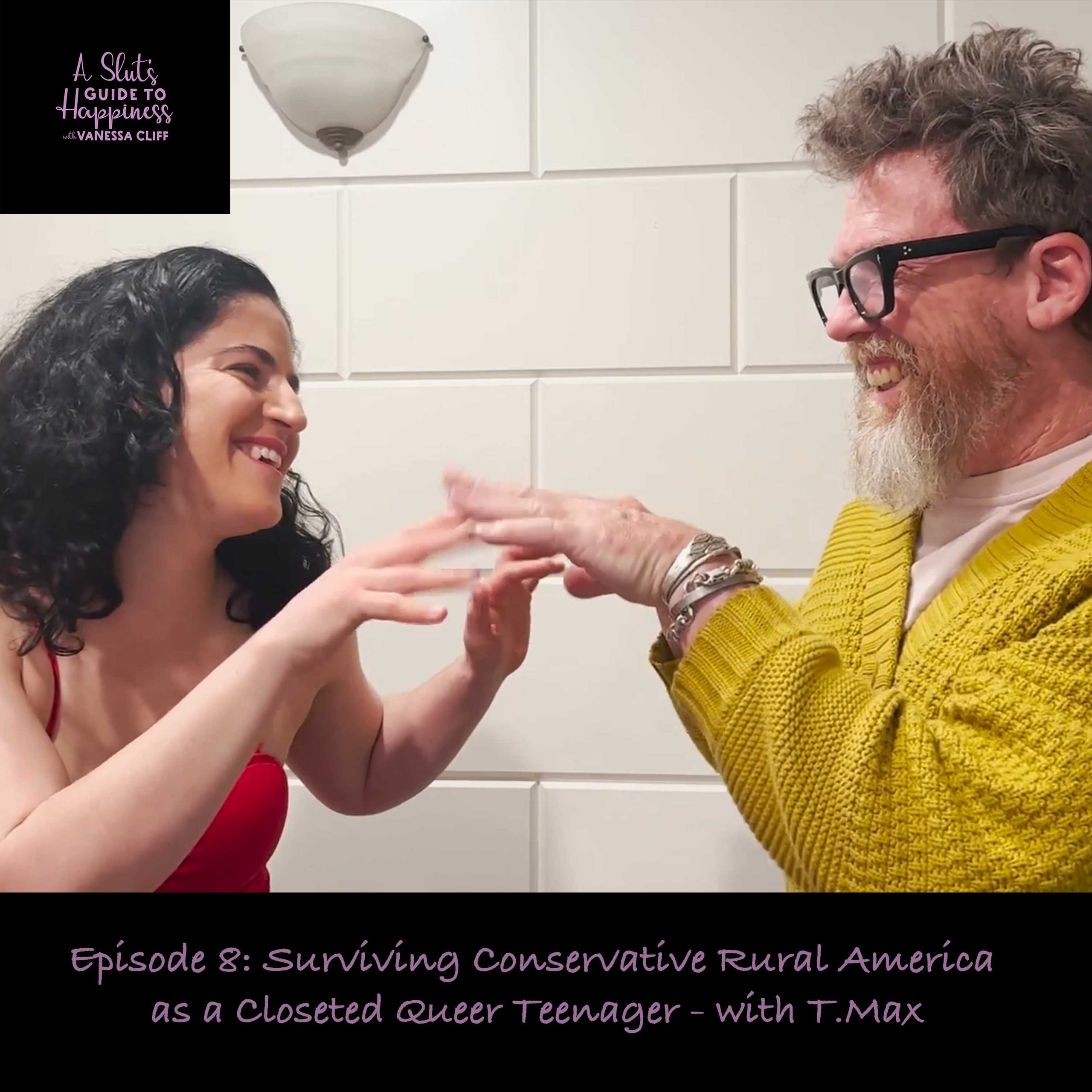
Local queer community leader, T.Max, came of age in conservative rural America in the 1980s where they coped with bullying and physical assault for perceived queerness by staying in the closet. Their story of survival and their choice to come out decades later at age 50 is relatable for young queer people struggling to survive today, as well as older adults exploring what T.Max refers to as a “second adolescence”.
Welcome to A Slut’s Guide to Happiness, where your body is perfectly imperfect, and it’s safe to be as sexual, kinky, queer or slutty as you want.
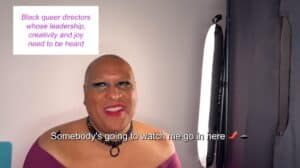
Today I will be talking with T.Max, a queer community leader and wonderful friend who is a lighthearted ball of giggling energy.
I want to show you their eyebrows. I walked in today and saw them, and they’re just a perfect example of their beautiful energy. It shows what a mom I am, that when I saw them, I thought they had been playing with a little one that was touching their face. But no, it’s just their beautiful, fabulous makeup.
These days T.Max has that free-flowing glitter eyebrow, Jewish grandma energy. But that wasn’t always the case, as with a lot of people who are on the winding journey of finding themselves.
Today we’re going to be talking about the specific, tough but common experience of growing up as a closeted teenager in a religious family and conservative part of rural America. This had a big impact on T.Max’s life. Like a lot of people and social environments, socializing us to straightness and compulsory monogamy, it required a journey to learn through.
We’re also going to be talking about how T.Max survived, how they finally navigated to where they are today, in their fabulousness, as well as recommendations for folks who are similarly exploring their queerness for the first time in a second chapter of their lives.
So T.Max, thank you for joining us.
I’d like to go to a transition moment in your life. You were telling me about a realization that you had when you were in counseling five years ago. What was it that you discovered?
T.Max:
I had a traumatic brain injury, skateboarding and, afterwards, I made several changes in my life. On paper, things should have been fucking awesome. And they just weren’t still.
So in June of 2017, I decided that I needed to go to therapy and started to put in the work to get in touch with myself, in touch with how my brain was functioning or not functioning. That little journey kicked off real revelations.
One of those first things I had to come to grips with was recalling a moment in my teenager years. When I was 14 or 15, I discovered punk rock, I discovered skateboarding, and I realized I was queer all within about three months of each other. And I grew up in a part of Minnesota that was not welcoming to that. We were just far enough away from Minneapolis that it was a little bit backwards.
I learned pretty quickly that one of those might be okay, but all three things were trouble, and one of them could be life-threatening. So for a variety of reasons, the queer part of me went right back into the closet, never to see the light of day. Basically for that early chapter in my therapy process, I had to reckon with that.
Vanessa:
Five years ago you were having this conversation with your counselor. How old were you at the time?
T.Max:
Late 40s.
Vanessa:
Okay, so in your late 40s, you’re thinking back on a moment of loss, of the possibility of your identity as a queer teenager when you were 14 or 15. And you’re realizing for the first time that maybe you didn’t need to stomach that?
T.Max:
Yeah, it was a non-decision at 14. It was just not something you could be. It’s a little dark, but in my high school experience, even without the layer of queerness, it was very violent. The word fag was used all the time, but in my high school in the corn fields of Minnesota, it was better to be a skater fag or a punk fag than to actually be a fag fag because the beatings were a little different.
And I say that with a smile just because that’s how uncomfortable it is to me still. It was the decision I made at that moment.
Vanessa:
So when you say it was life-threatening, you don’t say that in a simple way.
T.Max:
Oh yeah, the violence was real.
Vanessa:
I want to come back to that in a minute, because that’s deep and powerful. I’d like to first go back a little bit earlier in your life, because I know that by the time you got to age 14, a lot of this need to suppress yourself was also ingrained from other processes in your life. I think that’s true for a lot of people for different reasons, when the whole environment is telling you that you have to hide your authentic self early in your life.
What was it like growing up in a religious household? What lessons were taught about how you had to be? How were those lessons communicated or enforced?
T.Max:
I grew up in a deeply Catholic household. To the point where my parents were put out that the church didn’t conduct mass in Latin anymore. They were that entrenched.
The other key ingredient is that I was adopted. It wasn’t hidden from me. My parents were actually very cool in that respect. But there were those two things, heavily religion and the knowledge that I was not actually theirs.
I think it was best that they were open about it, but I did come away with the feeling that I was just an outsider. They set up this dynamic where they brought me in so I better want to stay here. I need them for safety and shelter, but in this house is the expectation of the religion they follow. So it turned into a very performative sort of exercise.
In order to have the housing, stability and emotional support that they were offering, the expectation that was stated or implied was that I conform to the religious practices of the family. I think I had it in my head that because I came from the outside, they could return me. It was never threatened or implied, but maybe I was told I was adopted a little too young.
So that was the set-up. And it was super challenging. I was a very free child. As a child in the 70s, I didn’t like wearing clothes. So things haven’t changed so much, I’ve gone full circle on that.
Vanessa:
I want to pause to clarify on that, when you say full circle you mean, you initially didn’t like wearing clothes, then you were socially forced or expected to wear clothes, then had to come back to the realization that it was okay to not wear clothes?
T.Max:
Yeah. It was just cute at first, and then it wasn’t. In the flip of a switch. And I didn’t understand why. I guess I was only a little kid, 4 or 5 then. And they said, just all of a sudden, don’t be naked anymore, it’s bad, you need to cover up. It was hot out and I liked my body and wanted to run around outside. But I had to learn to take a piece of me and put it in a little container.
Vanessa:
So you learned at age four to begin the process of compartmentalizing pieces of yourself, to hide pieces of yourself until you’re in an environment where it’s safe.
T.Max:
Yeah.
Vanessa:
But that environment was often not your home environment, not with your family.
T.Max:
Yeah. So shortly after, we lived just outside the suburbs of Minneapolis when I was in early elementary school. It was basically where the suburbs end in a little subdivision. My backyard was cornfields from there as far as the eye could see. So kids were just allowed to walk out the back door and then come home by dinner.
So I had a lot of time to myself and I would go off into the cornfield and find a little open patch, strip down and lay in the sun. I felt like I could breathe. Also if you’re not in the house, you can’t get in trouble. Out there it was a mini-paradise.
I got in trouble a couple of times because some of the neighbor kids came with me, and then the shame got to them and they squealed to the adults.
In the Catholic religion, the main implement was shame. How dare you do this? Who are you? It was unfortunate. It also came with a bit of physical punishment. But the toughest of the punishment was the shame. You were just meant to be shown that you were wrong, that you should feel bad about your body and how you enjoy body.
Vanessa:
Right, shame then becomes an internalized narrative about yourself and you begin to reign in your own behaviors without anyone else telling you to. That pocket of freedom you created for yourself in the cornfields, once you feel that internalized shame, even though the cornfields are still there, you can’t access the same freedom.
T.Max:
Right.
Vanessa:
How did you deal with this environment in your childhood, where you’re taught to accept these shaming narratives about yourself? How did that impact your development as a child?
T.Max:
Well, I have a real problem with authority. It taught me to keep a closer circle, to be a more crafty weirdo. I think the little group of neighborhood kids just condensed down to me and a couple people. It helped me build early trust circles.
But on the other side, I did still feel shame. Because I knew I was going back to a place where, even though I was having a really good time, I had to go home. I can’t go in too smiley because if they ask me what I did, I don’t want to lie.
It was really almost like, you know how they say, you go to prison and learn how to be a better criminal. Doesn’t do anybody any good.
Vanessa:
You’re finding this little group of friends that help you to play and enjoy, to try to be yourself and explore this world, but then you have to go back to the contrast of your family at home each night. It sounds like that’s one of the survival strategies that you’ve had throughout your life, finding your little group of people.
When you were that age, what were some of the messages you were receiving from your childhood environment about what wasn’t okay with your body, gender or way of being in the world? You mentioned nudity as one. What else?
T.Max:
Yeah, that was back in the elementary school years. Later, in middle and high school, after discovering punk rock, going to the used clothing store and buying old army things, shredding them up, that’s when it got pretty ugly.
I definitely wasn’t fitting the social construct. Even though I didn’t have the words for it at the time, I definitely dressed fairly androgynous early. I had longish hair; I had a mohawk for a while.
So it just got tough real quick. That’s when we started to butt heads. That’s another one of the factors, when these things showed up for me and that queer side of me had to go very far away.
Vanessa:
So returning to that life-threatening environment that you were talking about before, I imagine it is an unfortunately common experience for many teenagers in rural America.
T.Max:
Yeah. It was in the 1970s, 80s when I was 14. So I think that things have gotten better, but I know there are still spaces in the country where it is unsafe.
Vanessa:
I remember being called a faggot when I was that age. I was kissing my girlfriend with the windows rolled down at a red light and someone in the next car shouted that at us. That was a really early core shame moment. But I’ve never had the experience of feeling like my life was threatened in a homophobic encounter. So this conversation reminds me of what a big diversity of culture and spaces of safety or unsafety for LGBTQ folks across the U.S.
I want to know more, if you feel able to share, about what some of the experiences were like when you felt unsafe coming out as queer. Who were the people that scared you? What messages were you receiving from others about queerness or why it was bad?
T.Max:
First of all, the “f slur” [fag] was pervasive in the mid-80s. So everything that didn’t fit the football jock norm had an “f slur” attached to it.
In one particular experience, I went to a very large high school. Even though I lived in a rural area, people came from far away for the school. So there were 1200 people in our high school.
I was in the marching band and I had just gotten back from California because I was in a tournament as a marching band member. While I was in California, I had purchased some skateboard pants called Jimmy Z. They were so cool. They were linen, they had a Velcro belt, and they had a lot of room in them to skate. I was so happy, because you couldn’t get those in Minnesota.
There was a little tag on the pants that said “Jimmy Z”. So almost immediately there was a group that started to follow me around in the mornings and call me “Jimmy Z Fag”.
Vanessa:
Wow. Do you think that wearing the pants made you read to them as queer?
T.Max:
Or just as different. Too different, the worst thing to be at that time.
Of course it eventually morphed into “skater f-slur” [fag] – I still have a hard time saying it because it was part of my everyday landscape for months.
Eventually I turned around one day and I was like “Look, I know that you guys follow me around every day. And I know that you have a pet name for me, but actually, that’s not my name. My name is Tom.”
I went to shake hands with them and they all backed up, except for one. That didn’t turn out so well.
Vanessa:
What was the result?
T.Max:
A huge fight.
Vanessa:
A physical fight?
T.Max:
Yeah. When I turned to shake their hand, the biggest one who didn’t step back, said “Don’t touch me, fag. Don’t fucking touch me, faggot.” Then a fight ensued. I kicked the shit out of him. And then he threatened to stab me in the principal’s office afterwards.
Vanessa:
In front of the principal?
T.Max:
Yeah.
Vanessa:
I hear what you’re saying about him not being particularly smart. I’m really sorry that happened to you. That’s heavy.
T.Max:
Yeah. That’s an example, that kind of thing happened often.
Vanessa:
I just want to name how incredibly beautiful and brave it was that you turned around to those people who were following you. And you state clearly what your boundary was and offered your hand. That’s amazing. Even though it was received in a terrible way and threatened your life afterwards.
T.Max:
Yeah, it was weird, I’m also very snarky, but I did offer my hand. It was genuine. That’s an example of what I mean by a violent middle school and high school, what I mean by truly not feeling safe.
Vanessa:
Did you parents know about this happening?
T.Max:
Yeah, but they were just like, “You know, boys will fight.” It was an accepted thing that fighting was part of being a boy. I didn’t throw the first punch. So there wasn’t any extra punishment on the home side. I don’t remember if I told them the boys called me fag or not.
Vanessa:
I’m so glad you survived. We can laugh about it now, because you’re here and made it, and also what you’re describing is heavy, it sounds like you could have died. And I know that there are a lot of queer and trans people, even today, who do die as a result of bullying. So you made it.
T.Max:
Yeah. It was not a pleasant high school experience. But yeah, at least I made it. I want to share my story so that other people can hopefully have a different experience.
Vanessa:
There are all kinds of ways we cope, and we can’t judge each other for the choices we make to survive impossible situations. From my understanding, one of the ways you survived that impossible situation was by going into the closet.
You decided that queerness was not an option for you right now. You had learned monogamy from your religious family, learned that monogamy was the expectation. Specifically, gay marriage was the exception and straight marriage was the expectation. So for a while, you leaned into fitting into expectations and then things started going differently as you realized, maybe this isn’t what I want. Can you tell us about that?
T.Max:
Yeah. Going back to that dynamic early in my therapy experience. I came to grips with that realization, discovering those three things as a teenager and putting one of them super far away. It was absolutely a survival technique.
I didn’t like it. I had life structured in a certain way. And these realizations ran contrary to it because of how deeply I had put that into the proverbial closet. But at some point, it just hurt too much not to be me. Once I had that realization, I couldn’t unlearn it.
I just really wanted to be myself. Finally.
Vanessa:
And that was in your late 40s.
T.Max:
47ish, yeah.
Vanessa:
So from 14 when you stepped away from queerness until 47, you did your best you could to fit within the box of what was safe. Then something bubbled over at 47 and you realized, oh actually I want to be myself. So what happened when you were 47, redefining your life for the world?
T.Max:
Well a lot of it was still internalized and I had to keep it hidden for a variety of reasons. But in March of last year, I separated from my ex and I’ve been able to really lean in since then and explore.
Vanessa:
You just recently left your ex-wife of how many years?
T.Max:
Over 20 years.
Vanessa:
Wow. So for two decades, you were living a married life that looks like how normative society says we’re supposed to be doing it. And then you embarked on this whole other journey. What was it like coming out as a baby queer?
T.Max:
Yeah, baby queer at 50. It’s been overwhelmingly positive.
One of the most interesting things for me is that there were years and years of therapy that went into this decision and a lot of work. But when I got up in the morning, I always used to have really poor body image, and now when I wake up in the morning and brush my teeth, I actually like the person I see in the mirror, which is bizarre.
I’ve always had issues with my body, how I looked, like trying diets, running. There were stretches where I looked a little different but I’m just kind of a chunk dude at its root and that likes pretty things and gets to be me every day.
Vanessa:
Something about unlearning the internalized shame that you are not allowed to be queer also transferred over to the internalized shame about your body. So that you can now look at yourself in the mirror and feel good about who you are. That’s incredible.
T.Max:
Because of those early experiences running around naked in the corfield and having to feel so much shame, and the fact I’ve always been fairly athletic, through snowboarding and snow sports, but I’ve always kind of had moobs.
Vanessa:
What was that word?
T.Max:
Moobs, or man boobs.
Vanessa:
Oh, got it.
T.Max:
As a little kid, I was really self-conscious about it. And then after leaning into being more gender fluid, non-binary, guess what?
Vanessa:
It’s kind of lovely, I’m already starting to have these things (boobs) that I want.
T.Max:
Yeah! Little titties. So since coming out, being on my own, and being able to really truly explore these places, it’s just this domino effect. And it’s absolutely wonderful.
Vanessa:
I really love that what you’re describing about your body is that your chest didn’t change, what changed was how you looked at it. You were given the space to explore, what are the different things that this could mean? What does this mean for me? What do I think about this? Rather than forcing your mind and desires to fit inside the box you’re told your thoughts and feelings should fit inside.
In order to get to the place of freedom from the shame you were raised with, you had to give yourself permission to write your own story about your body.
T.Max:
Yeah. That’s a lot of work. I am very fortunate, like I have access to health care, mental health care, counseling and medication for mental health treatment. And so there are certainly some layers of privilege woven into all of this progress. But at the same time, you’re right, it wasn’t something that just happened overnight. It happened over the course of 5 or 6 years.
Vanessa:
Sometimes in counseling, have you ever felt that little kid in you come back up, hear the pain and vulnerability and desire to be accepted or desire to be yourself, and having to re-parent yourself to feel that it’s safe? I think about this especially that you were talking about how you were literally unsafe; your life was threatened.
How do you teach the little kid in you that this is a different world and it’s safe?
T.Max:
THere is this interesting thing that happens in almost every adolescence process. So there are moments where I go, okay, I get to go do this thing. I tell myself, you live in a major metropolitan West Coast city that’s fairly liberal. You can try on that dress or cute bra that you saw and you can wear it to the coffee shop this morning. It’s okay, you will be okay.
That’s your internal narrative. That’s you telling yourself, reminding yourself it’s okay. You’ll be okay. You can wear this today. And if it doesn’t work, it can be undone. It doesn’t have to be forever. None of this is forever, which is true of so many things.
Vanessa:
Giving yourself permission.
T.Max:
Yeah. Give yourself permission to remind yourself that you can try this on and it really will be okay. It’s okay to make mistakes. It can get messy and weird and all those things are part of the process.
Vanessa:
If you could write a love note back to yourself as a young adult – or to young adults that today are living in really conservative households or in conversations parts of rural America – to offer support to people who are in spaces where it’s very difficult to be free and authentic, what are some of the things you put into your love note?
T.Max:
You are okay. There’s nothing wrong with you. This is very difficult and just be patient. You are okay and loved. Your tribe is out there and it will happen with time. It doesn’t have to be solved overnight. Trust it.
Vanessa:
I love that. I feel that so hard every time I find the courage to be a little more open about some scary part of myself, I realize there’s a bunch of people over there saying, hey me too. You find your people. There’s a whole bunch of little corners of the world that you didn’t realize existed.
Come dance in joy. Come to the cornfield naked with us.
Thank you T.Max.
This has been another edition of A Slut’s Guide to Happiness with your host, Vanessa Cliff, and our guest today, T.Max.
You can find us wherever you get your podcasts, including Apple and Spotify, as well as on cliffmediaproductions.com.
If you’re over the age of 18, you can also check out our video content on our website, cliffmediaproductions.com
And most of all, I invite you to join us in the pleasure of being awkwardly human, naked, and without pretend.
Let’s get free.





Materials found in this section may be sexually explicit in nature. To view materials on the site, you must affirm all of the following:
I am at least 18 years of age (21 in some localities). Any sexually explicit material I am viewing is for my own personal use and I will not expose minors to the material under any circumstances. I do not find images of nude adults, adults engaged in sex, or other sexual material to be offensive or objectionable and I desire to receive and view sexually explicit material.
The viewing, reading and downloading of sexually explicit materials does not violate the standards of my community, town, city, state or country. I am solely responsible for any false disclosures or legal ramifications of viewing, reading or downloading any material on this site.
This website and its affiliates shall not be held responsible for any legal ramifications arising from fraudulent entry into or use of this website. This warning page constitutes a legal agreement between this website and you.
All models, actresses and actors whose images appear on this site are over the age of 18. Bookmarking to a page on this site whereby this warning page and/or terms and conditions are by-passed shall constitute an implicit acceptance of the terms and conditions herein.