

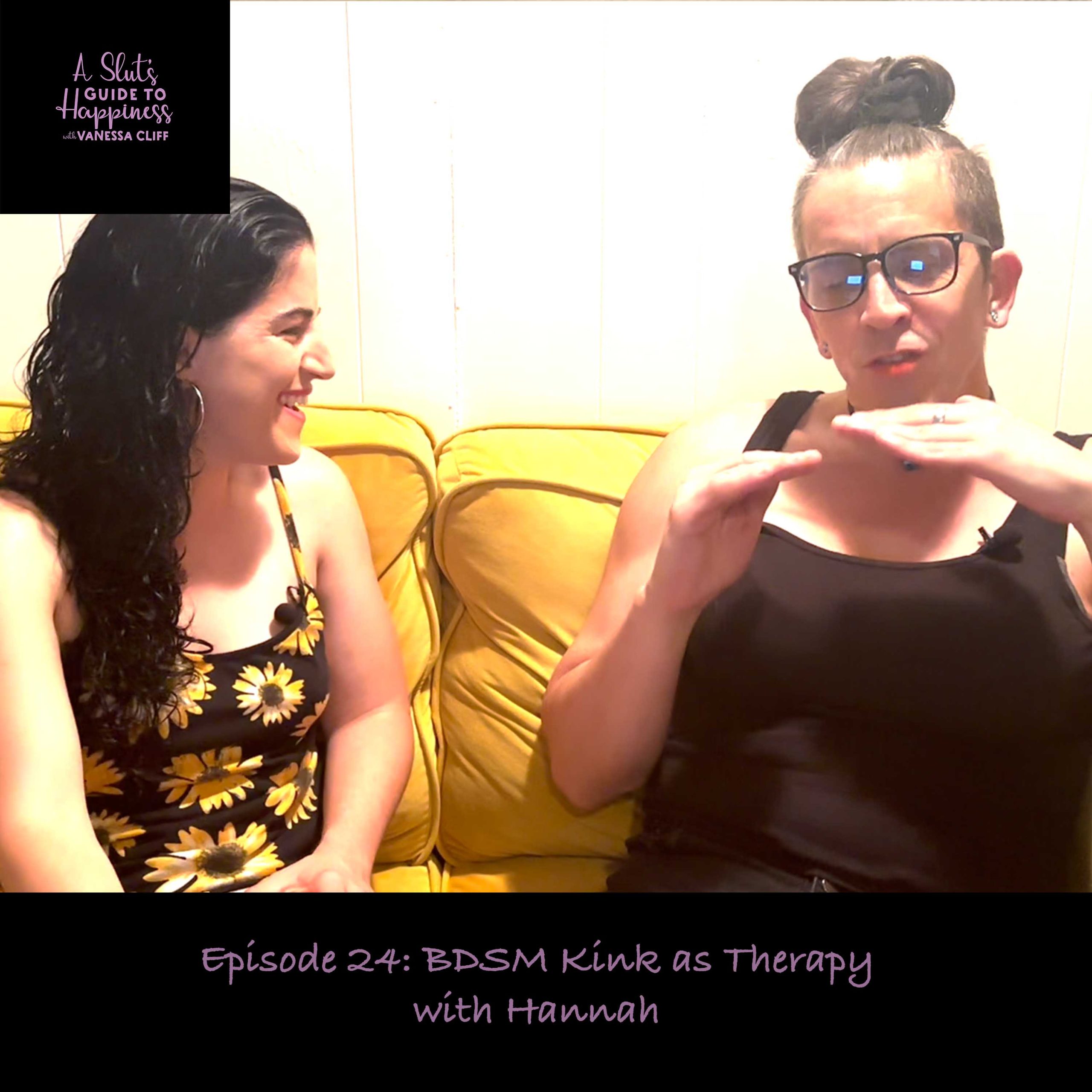
Kink or BDSM (bondage, discipline, dominance, submission, sadism and masochism) is not just leather and dark dungeons. It’s also a way of relating to sexuality and other people, an opportunity to play with power, consensual pain, energy and roles. In this episode, Hannah shares the way kinks can not only heal specific traumas and fears, but also transform how you think about yourself and what is possible in your life.
As you push your boundaries in kink, allowing yourself to open up to new experiences, release societal expectations, and practice expressing your desires and boundaries, you gain a sense of personal power. As Hannah describes, feeling empowered becomes addicting. Once realizing that you can own your desires and boundaries in kink, you discover the ability to do so in other aspects of your non-sexual life, in your personal relationships, work environment, and way you walk in the world.
Hannah invites listeners into their personal journey of self-discovery through kink, outlines ways people can explore kink themselves, and become a bigger, stronger version of themselves.
Hannah:
It’s really embarrassing because my mother is an incredible seamstress and makes quilts, and I can’t even, sewing machines are way too complicated. It might as well be the space shuttle. I can’t handle it.
Vanessa:
I feel that way about a lot of technology.
Friends, welcome back to A Slut’s Guide to Happiness, where your body is perfectly imperfect and it’s safe to be as sexual, kinky, queer, or slutty as you want.
Today, I’m excited to be joined by a person that I’ve seen to be wicked smart, spiritually grounded, and a self-confident weirdo. I am very grateful that they are now part of the Cliff Media leadership team and community.
They’ve done a little bit of gangbang fucking, a little bit of big picture strategizing, and I’m excited about what we are continuing to build together, both in the X-rated point that we do and the SafeForWork educational materials, rooted in inclusivity, body positivity, enthusiastic consent and joy.
On a personal note, Hannah has had non-monogamous relationships and queer and kinky sex for a hot minute.
Recently, they’ve been working on a book that I am so excited to read one day related to the role of BDSM Kink as Therapy. Woof! Beautiful big topic that we’re going to dive into today.
They have some profound ideas about how participation in kinky sex and kink spaces can impact so much more than just your sex life. I absolutely relate to this on a personal level, and it’s a subject we’ve danced around in previous episodes.
For example, the podcast episode called “Eroticizing Trauma, Fear and Jealousy” explores how kink, cuckold role plays and consensual non consent can be used to help people heal through fears of abandonment and the aftermath of sexual assault.
Today, Hannah is going to be taking this a step further, describing how kinks can not only heal specific traumas and fears, but also transform how you think about yourself and what is possible in your life.
So, Hannah, thank you so much for joining us today. I want to start with the first moment that you discovered BDSM. As a producer of visual media, I was kind of excited to hear you say that it was visual arts that first inspired you, and then you and your ex started exploring the real world.
Can you share what was going on in your relationship then, what you watched and where you went after that? What were you thinking and feeling in that first foray?
Hannah:
Well, it’s amazing to go from humble beginnings to gangbangs and big picture stuff being the top two items on my resumé now, which I feel pretty good about.
I think it’s important to preface that my exposure, my introduction to BDSM was like a lot of people. The biggest weakness that people have is lack of access to knowledge, to information. I grew up in white, middle class suburbia as an acculturated male person.
So therefore I had zero access to any kind of counterculture, or what would be considered counterculture. I didn’t have a name for anything. There were ideas that I had seen pictured in movies and TV shows, but they were all caricatures of reality that give you kind of a skewed perception of what things really are.
This really manifested itself mostly in my gender journey. In the 80s and early 90s, there were undoubtedly thousands or millions, maybe even, of people who knew something didn’t fit right but didn’t have a name for it. They didn’t know what it was. So they just sort of carried it as this weight.
I’m not a fan of labels, but an identity is different from a label. A label is something somebody else gives to you, and identity is something you give to yourself.
So, it took me until my 30s, until actually my very first exposure to BDSM to start learning those identities. And then from there it was a rocket ship.
I was sitting, as people do after they get off work, they’re tired so they don’t have any energy to do anything other than eat Taco Bell and watch television. I was sitting with my wife at the time.
We had followed the progression of a lot of monogamous relationships, and we had been together for several years. Lots of tensions build, minor resentments and things. And you go through bed death. You hang out together and stuff, but the intimacy is more or less done.
Being a hyper touch-focused individual that I am, that was agonizing because I wanted to reconnect. The only way that I knew how to do that was through touch. Touch wasn’t on offer. So I was just there, sitting watching TV and this show came on and I believe it was called “Our America”.
There was a journalist who was traveling through the United States, shedding light on things that most mainstream stories won’t cover. A lot of counterculture stuff, ballroom and things like that.
One of the episodes that she did was on BDSM. In the beginning of the episode, it was all the cliche things that you expect to see, gimp outfits and people hanging from the ceiling and all that stuff.
But then, true to a decent journalist, their mission dug deeper into it and gave more information. We were sitting there kind of more and more engrossed and fascinated in this, in this whole world that we didn’t really know existed. My wife turned and looked at me and said, I want to do that.
That must have been such an exciting moment. I was just like, okay, let’s do that. I was so excited because it meant this is a pathway to intimacy, to rekindle that intimacy. And if this takes these things, let’s go. And, it was amazing how big a role pure, naked serendipity can play in your life.
Who knows how much longer it would have taken me to make the million and one discoveries that I’ve made since then, had I not been sitting and watching that episode of that show on that day.
Because my circle, my life hadn’t changed. I was still presenting male everywhere that I went, trying desperately to fit into that space culturally. But we saw it and it just exploded from there. I don’t do anything and half measure.
So I believe we were at SheBop in about 15 minutes.
Vanessa:
What is SheBop?
Hannah:
SheBop is a sex toy store in Portland.
Vanessa:
You were sitting watching TV, and then you literally peaced out the door.
Hannah:
That day, yeah, we went down and started trying to find things that looked fun to play with. And two people completely in their novitiate, as far as any of this stuff is concerned. We had no idea what’s going on.
Most of those things ended up collecting dust because they were not our jam. But we’re like, ooh, this looks cool.
You know what I have to say, though? There’s one thing that must be said. BDSM gear is prohibitively expensive. Like $35 for a ball gag. So you get pretty creative inventing things and making them for yourself. Ball gags are easy to make, by the way. Don’t let anybody tell you different.
Yeah, so that was the introduction. It’s very simple. Beginnings. Humble. And then both of us, I believe, were looking for a different kind of release or escapism. This one avenue provided that that road and the benefits of it can’t possibly be overstated.
Kink as a it’s not a singular thing, but the benefits of it can’t be encapsulated into this one through line. All of the butterfly effect of the million and one things that you learn about yourself and other people that are related ultimately tied back to this.
For example, my gender journey never would have even started. So it was very, very transformative.
Vanessa:
Yeah. That’s amazing. It sounds like it was a spark that it perhaps could have started anywhere, but it just led to this.
It makes me think of the concept of “keystone habit”. If you change one thing, if it’s related to a bunch of different pieces in your life, that just unlocks all the keys.
Hannah:
For sure. It’s like having a volcano and then kink poked a hole in the top of it. It was already there, all this potential energy, just waiting to find a direction to go. All of this frustration and confusion and sadness and anger and all of these feelings that were tied up ultimately in the pretense that we are forced to oblige every day that we go about our lives.
I don’t think enough people really understand the amount of internal tension that it causes. You open your door and as soon as you step out into the free air, you’re pretending from moment to moment, until you get home. Maintaining the charade is exhausting.
Vanessa:
Absolutely, yes. The freedom that comes from being able to be your authentic self, just a physical release, I know is similar to that physical release of being pushed in a kink way.
So I want to go to that moment, because I think of something that’s very familiar to a lot of people, when you crossed the line in your understanding of kink.
Previously, you saw kink in the way that it’s presented in a lot of mainstream vanilla culture. It’s this one specific thing, maybe stigmatized. Then all of a sudden you and your partner are exploring it. You said “hell yes” to kink.
Were you nervous? Confused? What were you feeling at that time?
Hannah:
My only nerves about it at the time was that she would change her mind and back out. Because I hit the ground running and had found a pursuit that I truly resonated with.
The physicality of things, the inherent intimacy in most kink-related activities, and honestly, just the pure carnal or prurient interest of kink pursuits really appealed to me. It’s very emotionally raw and uncomplicated, which I appreciated.
I struggle with the pageantry of people pretending and the manipulations of emotions and things that can happen. I struggle to connect with people on that level.
But there’s such a purity, to things like subspace and power dynamics, the roles and activities that people engage with in kink. There’s a purity to it that is simple to understand, and I believe it’s much closer to the base of what we are as an animal. It was easier for me to connect with people on that level.
It’s funny I mentioned that because my biggest nerves were that she would back out and that that possible avenue to connecting with her would go away because time proved that right. She backed out.
Eventually, ultimately, it ended up trailing off, which a lot of things do when people take up hobbies or whatever, and they just lose interest in it. But I continued and forged forward and have made a myriad of discoveries long since we separated.
I continue to learn more and more, primarily about myself. I think that’s where the real power lies. Yes, you can gain a better understanding of other people, but you do so through the lens of yourself and what you’ve learned about you.
I’ve never I’ve never experienced a greater teacher than a lot of the kink spaces that I’ve been involved in and my own journey into those spaces, which is almost a whole different saga.
Vanessa:
You were talking about subspace as being a different kind of space. It makes me think of a video that I made for one of my partners. We had just been having a kink exchange. They left and I made a video that was not at all performative in the way that a lot of my porn work is. I was still in that raw subspace.
And I look at it now and it’s hard for me to recognize. It’s not my performative self, even when I am being most authentic. Subspace is something different. It takes us into a raw, animalistic space.
Hannah:
It’s almost impossible to completely abandon that pretense. People are always being performative. Always. All the time, constantly. I would say that it’s in our nature to do so.
There is very little, in my opinion, I’m not a professional psychiatrist or psychologist so this is all supposition based on my observations, but I think there are very few ways in which people are purely and authentically themselves. Almost everything that we do on a daily basis is programmed and coded.
One of the ways that you can kind of crack that facade and get into that softer center, that “you” part, is through the inherent vulnerability in most kink activities and communities. You will not benefit to the degree that you could unless you allow yourself to be vulnerable in those spaces because you’re defeating the entire purpose.
The purpose is to be vulnerable. The purpose is to do the thing that makes you nervous or scared. But at the same time, you love that cold sweat. You’re like, I need to know what’s on the other side of this barrier. You do it, and you find like-minded people who want to do it with you.
You learn about enthusiastic consent, and you start to demand that in your life and in arenas outside of kink. The lessons that you learn about just being a good and decent person are invaluable.
It’s not to say that there aren’t plenty of bad stories and people who’ve had bad experiences in kink and BDSM. Certainly there are lots of them. But as an overarching umbrella, I think it’s generally a pretty safe place to be.
Vanessa:
Yeah, I completely agree with what you said about enthusiastic consent. You’re in those conversations about what’s going to happen before a scene, you’re continually talking about what you actually want, even if it’s taboo, even if it’s scary to say, perhaps especially if it’s scary, because that is the source of intimacy, vulnerability and power.
And then you take that experience of expressing what you want and you realize you can also say, hell yes, I want this relationship, or hell yes, I want this job. All those other practices of enthusiastic consent.
Hannah:
And maybe even more important than that, you can say, hell no, I don’t want that. Which is a type of empowerment most people don’t allow themselves because saying no is almost a prohibited thing.
So it’s one of those ways that we can begin to heal ourselves through engaging with community and kink spaces. In those conversations about consent, in those negotiations about boundaries and expressing safe words and all the things that we do, you’re building a framework inside the way that you think about life.
That absolutely bleeds out into the next time you have an interaction with a person who you’ve always had disagreements with, where you’re able to say, you know what, I’m going to try a thing that I did last night, right before I had a dildo in my ass. This is going to be nearly as much fun. But no, I don’t like that. Stop doing that. I’m not going to allow that in my space.
And then you wait, paralyzed. What’s going to happen now? The big fear of the consequences of saying no, and 99 times out of 100, nothing happens. They’re just like, fine. And then you realize, oh my God, I’m alive.
I said, no, and I’m not doing the thing I didn’t want to do. I didn’t make that sacrifice. And that that kernel grows and your power grows. You start to realize you can speak up for yourself.
People who come from backgrounds, like a lot of folks do, of being spoken for or not being able to set their own rules, whether that’s familial or relationships or whatever, anybody who is in a kink space that is doing so in a healthy way, in a communicative and loving way, is going to insist that you talk about your boundaries with them.
Almost like an unwitting mentor, they’re telling you now, I’m going to need consent from you, and I need to know that you know what that means. So let’s talk about it.
You start getting practice in talking about your limits and your boundaries and boundary-setting.
Vanessa:
It’s so empowering when you start realizing that you can do that in other aspects of your life. I love that. You remember, oh, I’m still alive, perhaps even more alive than I was before, because now I’m choosing my life rather than being drawn along by other people.
I’m wondering if you can take us into some of your specific experiences with kink today. Because, like you were talking about, kink is this huge umbrella. So what are you particularly drawn to? Why? How does that relate to your emotional development and what it means for you?
Hannah:
So it’s kind of odd actually, that we would be having this particular conversation about this particular subject because as it turned out, over the course of many years of exploration and playing around, I ended up being pretty vanilla.
But not for lack of desire to try things. My introductions, like a lot of folks, I’m a tremendously socially anxious person. If there’s going to be more than ten people there, I have to try to come up with some excuse not to go.
The very first lesson that kink taught me was to push that boundary, to try to push against this idea that being around other people is scary because those people may judge you.
You might not fit in, you might not be as cool, you might not be as pretty, you might not be as in shape, you might not be. All of these things, these limiters that are programmed into us so that we believe that they matter when they’ve been irrelevant all along. But we’re so inured to believe that this is important. It taught me to challenge those things. And just to go.
I think what is important to remember about saying yes to things and having these new experiences – like I did in the beginning, there were lots of things that I tried, like golden shower stuff and a lot of pain, sadomasochism and stuff like that, turns out not my bag – but taking the chance to do them and try them and learn that is a growth experience, in and of itself.
You’re reprogramming or rewiring your brain to desire new experiences to know before you think you know. It’s easy to say, oh, no, no, thanks. I don’t want you to pee on my face. It’s easy to say that, and then somebody does and you’re like, yep, I was right, I don’t like when people go on my face. Or you realize, okay, that was actually pretty awesome. But you can’t know until you have some of these experiences.
Now, this is not to say that people’s boundaries are their limits, rather, are not valid. They absolutely are and should be respected 150%. But every once in a while, it’s important to pull that file out of the Rolodex and look at your limits and say, do I have these? Why do I have these? What are the reasons and should I challenge any of these today?
That’s what I ended up doing. So in the beginning, I was very closeted in my sexual desire for masculine-appearing folks. These kink spaces allowed me the liberty to be able to explore that with anonymity, but also with the support of other people around me who were like, yeah, you should do that. You should try that. People who would also play those kinds of things with me.
Vanessa:
These were kink dungeons and sex clubs?
Hannah:
Yeah. Most of the beginning activity for myself and my wife at the time started off with, I can’t remember the name, there was a spot on Foster Road here in Portland that was owned by somebody that we met through FetLife – FetLife profiles, by the way, happened instantly – That was a dominatrix that owned the place.
So all of it really happened in these kinds of clubs, munches or gatherings at other people’s houses, settings where we were kind of the odd people out. I struggled a lot with it in the beginning because there are other factors that end up playing a role that shouldn’t but do at the time.
I was just another dude. At least that’s how it felt. Just another dude in the room before.
Vanessa:
This was before you came out as trans.
Hannah:
Yeah. They’re everywhere. I’m looking around and there’s just a sea of dudes.
So what happens a lot in the beginning, especially in poly – and poly, by the way, in my opinion is kink. Anything unconventional that helps you expand and broaden yourself is kink. So we separate ourselves from the 50 Shades of Grey definition of what that is and understand that it’s this beautiful, amorphous fog of wonderful things. It encompasses all of these different challenges to your preconceived notions and embracing what you love.
But we all go to these spaces and my ex is an extremely attractive cis woman and would garner enormous amounts of attention. So that was hard in the beginning, just trying to set myself up as my own person, as my own entity in the room, separate from that, but together at the same time. It’s a difficult balance.
Vanessa:
Somehow you pushed yourself through that?
Hannah:
Yeah.
Vanessa:
Because you were choosing to. Not because someone was pushing you to do that, which would have been a violation of your boundaries. But you wanted to explore that new thing in your life?
Hannah:
And I push myself to get past them. There’s always going to be an element of peer pressure involved in pushing yourself. But the peer pressure is indirect. It’s passive.
It’s because you’re watching other people enjoy the shit themselves and you’re like, why am I not that. What’s stopping me from doing that? Where is this self-judgment and this self-hate coming from that I’m holding myself back?
We do so much more than that. We do so much more than have this negative inner view of ourselves. But we then push that outwards and make assumptions about how other people are going to look at us too. It’s so destructive.
Kink, in my experience, has taught me to stop doing that. There’s so much general body-positivity and sex-positivity and inclusivity in a lot of these kink communities that teach you to overcome that boundary within yourself, to just stop and get in the pool. It’s okay.
Vanessa:
You don’t have to wait until you’ve finished your diet or whatever it is that you’re beating yourself up for to get naked and enjoy the hot tub.
Hannah:
You also don’t have to wait for people to shoot flares into the air to alert you that it’s okay. The attitude of the environment is telling you this is acceptable. You’ve already clarified that whatever it is that you want to do is okay to do. And then the hard part comes. You have to do it.
And for me, in the infancy of that, in the beginning, that was the hardest part. I knew all this stuff already. I knew it was true. I knew I was the only force holding myself back from doing these things that I really wanted to try.
And then you just do once, or the baby step, or stick your toe in the water and it gets easier and easier and easier, and pretty soon, for most people that I’ve known, anyway, it becomes a runaway train. All of a sudden, they’re seeking that kind of personal validation from the entire world at large, and not just in dimly lit places.
So that’s what it did for me. It slowly but surely built confidence that I was okay as I was in that moment, and I was accepted as I was in that moment, to where when I left those spaces and I would go, like sit on the bus, I still felt it. I wasn’t there anymore. I was here, but I still felt it. That aura that radiates, that comes off of you.
Maybe it wears off after a while, but then you go back. And the next time it takes a little longer to wear off, and pretty soon it just becomes a thing that is part of you.
Vanessa:
Yeah. Rewiring your brain.
Hannah:
Yeah, absolutely. One little thing at a time.
I’ve always maintained that negative self-talk and all those things that we do, those are habits. They’re maladaptive defense mechanisms. Somehow our lizard brain is telling us that that keeps you safe.
It is impossible to quit a bad habit. You can’t do it. All you can do is replace a bad habit with a better one. Your brain abhors a vacuum. It needs to fill that space.
So slowly, one little bit at a time, you start taking one piece away and putting this new, better or warmer, kinder you in its place. And pretty soon you’ve got a new habit.
Vanessa:
I love the idea that you are giving yourself permission to do it. Who told me that I could come to a club and have someone pee on my face? Nobody. But I chose that. That’s what I want to do.
Hannah:
You know who told me? The invitation that said, come to this club and have somebody be on your face. That’s who told me. When you walk in the door and it’s right there, it’s on a big sign. This way to get your face peed on, and you’re still questioning whether it’s okay for you to be there and have somebody pee on your face.
Yes, absolutely. See? It’s right there. It’s all lit up. Permission has been given. Now you just have to allow yourself to do it.
I think there’s a lot of different experiences and traumas that people have coming into their first interaction with kink spaces that are all rooted in a lot of the same kinds of stimuli. These are things like emotionally abusive situations or neglect that inform us that we are not good enough, that we’re, we’re not attractive enough. We’re not fit enough.
Our entire culture is built around the idea that you are not enough. That’s the engine that drives capitalism. It always has been.
Vanessa:
You have to hustle for worthiness.
Hannah:
Absolutely. And if you’re not producing, you have no value. And that’s absolute horseshit. It’s always been horseshit. And they know it’s horseshit. It’s a tissue thin veneer that holds it all together. It does not take very much to poke a hole through it and go, wait a minute. This is horseshit.
That’s where I’ve made probably my most valuable discoveries. Kink was the catalyst for that, because these spaces were people who were challenging all of that. And they were having a fucking blast doing it.
They weren’t wringing their hands and nervous about what people think. If I challenge social norms, will lightning bolts come down from the sky? They were just having a good time and maybe they went home.
Immediately before they even got to the car, all the buckles and belts came off and they were back in their pantsuits, and they were back to pretending the next day at 8 o’clock in the morning. But they weren’t the same, right? They might have been pretending, but they knew they were fucking pretending.
Vanessa:
It’s that play you were talking about. Capitalism tells us we have to produce. There’s nothing productive about kink. It’s play. It’s like the adult version of kindergarten.
There was something that you were sharing with me earlier that really stuck with me and I want to share with you listeners because this phrase has been in my mind since Hannah and I were talking about this podcast. So here’s the phrase: “Empowerment is addictive”.
I love this because I know that our minds are wired for addiction. On a biological level, we want to hang onto things, and so why not harness that for good.
I think about that in my journey with porn. The first time I stepped into it, I felt that I definitely should not be doing this. This is terrifying. I did it. Then I was like, ooh, that was really fun. And then I did a foursome. Oh, that was fun. Then I went and performed with other companies and then started doing my own content and started organizing big group shoots with queer folks, and then left my day job.
It just became more and more of a realization that I could do this. Nobody told me I could, but it feels good, I’ll just let myself do this. Empowerment becomes delicious.
So I wanted to hear more about that. How has this shown up in your life? You mentioned polyamory and different forms of sexuality. And how is kink kind of starting this addiction for you?
Hannah:
Well the empowerment addiction thing is our brains are simple little machines. Everything that we do is to feel safe. Even people who hate, because something rewards their little lizard brain and says, okay, you’re safe now, you’re safe if you go on the offensive.
We’re always looking to feel that sense of safety. And empowerment is addictive, because all you’re doing is telling that little asshole part of your brain, this is way more fun, and you’re safe and you’re enjoying yourself. So you slowly, with that little re-programming, start to say, oh, there’s no danger here.
Then your brain says, okay, well, then you can do this and you can feel great doing it. And I’m not going to give you all of the anxiety and bullshit that goes with it to make you stop, because it’s safe.
So you’re slowly training that danger sensor in your brain that you’re not in danger. The more you do that, the more you fill up that vessel with that feeling. Why would you ever turn back to hiding and self-loathing and all of that? Because it doesn’t feel good. Now you’re getting the endorphin release and all of these wonderful brain chemicals that also go along with feeling safe, and you’re having a lot of fun doing it.
You’re establishing rock solid boundaries so you never fall into the same traps that you used to. It’s addicting because – I absolutely assure anybody listening to this or anybody who comes to these conclusions on their own – the rewards are 1 million times worth the discomfort of pushing through those initial boundaries.
For me, the most important thing for me to abandon was shame. Shame is one of the greatest motivators in the world for keeping people in whatever place that they’re in. And once you step around shame, and you start looking on the other side of it, the colors and the light and the beauty in the work. That’s right on the other side of that shame and shame is ultimately just fear, like everything else. So taking little bites out of that.
It’s really important to note that everybody’s journey is different. Everybody is starting from a different square one. I’ve always been a very cavalier individual, very forward and out and open and socially anxious, yes, but completely uncompromising.
So it was very easy for me, probably due to my upbringing, partly due to being not a physically small person, it’s easy for me and that is a factor, believe me. It’s easier for me to walk around just bumping into shit with my shoulders.
But I still had shame, deep seated, carried it with me, that I had to get around. Most of that came from the gender journey, which is thankfully for me, anyway, no longer a work in progress. I’ve arrived.
That feeling that something wasn’t quite right. And then as soon as I saw other people, and this is what kink spaces gave me, a gift that is priceless, as far as transforming who I am. Going into kink spaces and seeing other people within the infinite spectrum of gender presentation and representation that exists in the world that is just on the other side of that red-felted door or whatever.
They were there and they were bold and they were themselves and they were unashamed and they were uncompromising.
I liken it to, I don’t know, did you see The Matrix in the theater? Everybody that went and saw The Matrix in the theater came out of that movie and felt like they could do the Trinity? They just hoped that there were ninjas everywhere that they could go out and just fight.
You obviously can’t float in the air and do come kicks, but the feeling is the same.
I came out of those experiences a little bit closer to that every time until it was just like, all right, well, now I have a name. I have an identity. I have a path. I have a path that has been forged by people far braver than I that came before me. I’m taking this ball and running with it.
So it taught me that for myself, the way to go about making these declarations in your life was like a cannonball. Just do it and be that. And then if that changes to something else tomorrow, so be it. It’s your prerogative to do what you want.
Vanessa:
I love that. So there are two things in particular that I was inspired by in what you were talking about. One is the idea that part of the process of empowerment is doing the scary thing and then realizing, okay, I’m safe.
It makes me think of the analogy of stretching. I do a lot of things like yoga. When you’re learning to do the splits, you’re not actually changing the tissue of the body so much as teaching your brain signals that you’ll be okay when you spread your legs.
So you’re describing this on an emotional level. When you’re pushing yourself, despite the fact that we are wired for connection, you will still be socially accepted and still be socially safe when you do scary things. That feels like a really powerful reminder to keep learning through kink or through boundary pushing in other parts of your life.
The other thing you were talking about, this connection between kink and your gender journey, that’s really significant to me because some people who are derisive of kink will say, people are there because they have been assaulted, because they’ve been through trauma, and they’re only there to deal with that. When that is true, I actually think that’s a really beautiful thing, but it’s not the only reason.
We can also extend that from the “big T” Traumas of sexual assault to also the “little t” traumas of dealing with life in a society that is unequal and unfree.
You’re describing that kink was connected to your gender journey. Was there ever a time in kink where you were explicitly playing with it? Or you were just seeing other people who were genderqueer in those spaces?
Hannah:
I feel like that, for myself, and I can pretty confidently extrapolate that out to a lot of other people of the same age, growing up in the era that I did, there was no representation of this in my life. So you feel a thing, you know it to be true.
But you can’t do anything with it until you can name it. It’s just this kind of amorphous feeling that you have, you can’t quite reach out and grab. I feel different, I feel weird, I feel strange, I feel like I don’t fit in this space I’m trying to cram myself into.
I was angry all the time because of trying to be a dude bro. That’s what I was supposed to be, how I was socialized. You wear blue, you get toy guns. But there were signs. I was having a discussion with my parents looking back, and there were definitely plenty of signs that something wasn’t quite stirring the Kool-Aid as far as being a boy.
But what kink spaces did for me was providing me with the information that I needed, the exposure that I needed to understand what I was feeling, what I already knew but couldn’t verbalize, including verbalizing to myself.
Then on top of that, empowering that idea, turbocharging it because these weren’t people who were skulking in shadows, these weren’t people who were hiding under eaves in the rain. These were people out there.
You would ask them about themselves and they would tell you with pride about their gender identities and their relationship models that they lived with. All of these things were a total enigma to somebody who grew up in the spaces that I did.
Like poly, isn’t that just cheating? Come on. You have to have these things explained to you in a way that your own light bulb comes on. Kink did that for me, those spaces and the wonderful, incredible people that were willing and embracing to take this wide-eyed, dukes up, “don’t touch my butthole” person, walking in the door, with all these preconceived notions about it.
I will be eternally grateful for that, more so than traditional models of therapy, where we would sit down and we would talk through things. What kink provides for myself and I believe a lot of other people is an active, kinetic form of that kind of therapy.
Vanessa:
It’s outside language.
Hannah:
Right, it’s more than just processing how it feels. It’s challenging how it feels. It’s challenging it physically. It’s being in that space. It’s being in the space where you’re surrounded by the thing you fear and realizing that the ice cold you feel in the beginning gets warmer and warmer by the second.
You are going to be okay and there’s 20 other people in this room who know what you’ve been through, who’ve been there, who have walked this road. Even though everybody’s road is a little bit different, the destination is pretty similar. They can tell you too, I’ve there and I’ve been all the points along to right here. And I’m telling you you’re going to be okay.
That kind of support is not just intrinsic to the kink community. It is. But it’s also necessary for that particular community to thrive because of the vulnerability of people who are in it. Your intramural softball team or whatever, it doesn’t have quite the same cohesion. There’s no necessity for that kind of faith and trust in each other.
That’s healing all by itself. Just to be steeped in that is healing. I have seen it work, and I have used the idea of kink and introduction to kink spaces to help friends and family members heal from trauma, overcome body image issues, overcome things that they were struggling with their self-confidence, their gender expressions, their own sexuality.
I just kind of coached them in this general direction. I want to show you something. I want to see what you think. And universally, to the one, they’ve all just been like, yeah, amazing.
Culture loves to paint still to this day, which I have no idea why it’s still a thing, the kink community is this dirty kind of underground thing that people are ashamed of. They hide in basements. They call them dungeons after all.
I can guarantee you that one of two things is happening. Either one, those people have never been in kink spaces. Or they’re in king spaces all the time and they’re compelled to lie about it because they have to pretend, which is unfortunate.
I found them to be nothing but warm and inviting.
Vanessa:
I really relate to what you’re talking about there, that community connection and transformative moments.
I think, for example, about when I am fully tied up. All of my limbs are tied, even in suspensions, where I am now completely at the whim of whoever this person is. Sometimes it’s someone I just met. But even without talking, without sharing details about our background, because of the trust involved in that moment, there’s an intimacy. There’s a connection that’s formed there.
Hannah:
If it was just randomly happening in the woods, you’d be terrified.
Vanessa:
Absolutely.
Hannah:
Yes, if it was someone you didn’t know, like the outside of those spaces, that would not be something that you would do. But there’s something to be said for the fact that there’s a level of accountability and trust and disclosure and consent and all of that that happens in order to make healthy kink spaces operate.
The fact that that exists is a huge part of convincing that shitty little part of your brain that tells you everything is scary, that it’s not. Wait a minute. No, there’s room for people. Everybody’s watching what’s going on? Everybody’s paying attention. If you catch wind that consent wasn’t given 100%, they’re on it.
That helped me a lot in the beginning. Especially the hyper protective part of myself when I was still married and we were going into these kink spaces, it was difficult for me. With all of the kind of semi-dangerous activities, rope and restraints, that protective sort of vibe came out of me, and I had to relax and convince myself of the same thing. Like, it’s okay. You go off by yourself into your own thing. Have fun. It’s going to be fine.
Again, it’s important to note the caveat that unsafe things or violations do happen.
Vanessa:
Which community it is and what the values are matters.
Hannah:
Right. But I believe that it to be comparatively rare. And I think that some negative experiences with elements of kink that aren’t within that community, that it’s worthwhile to maneuver back in around, vet people if you need to. Protect yourself always and understand that this takes time.
If the first 20 times you go to a munch or you go to a dungeon, you only make it to the front door and you turn around because you’re just too scared, you don’t want to go in, awesome. Pat yourself on the back. You won that day. It’s a little victory. You got all the way to the door. That is amazing. And the next time, maybe you go through the door and you’ll stand in the vestibule and watch people. And then maybe next time you’ll get ten feet in the door.
But in my experience with it, I think it’s similar to a lot of other people’s, you will hit an exponential curve. You’ll find this spot, you’ll tip this scale, you convince your brain you’re not in any danger. The 107th time you go, you’ll be wall-to-floor latex.
It really is so explosively liberating that I would encourage anybody to explore it to whatever level they’re ultimately comfortable exploring it.
Vanessa:
I love changing the self-talk where you can go as slow as you want. What you’re describing, it feels like every piece of it becomes a lesson for other parts of your life.
While you’re preparing to go talk to a family member you’ve never talked to before and you have a difficult conversation, maybe you’re making that phone call for the first time and you just say hello, you’re taking a little piece by piece in the same way that you’re allowing yourself to slowly explore kink. You’re allowing yourself to slowly do scary things in other aspects of your life where you’ve practiced a kinder self-talk.
Hannah:
Right, because you can bristle at external things that come in. You can set that bulwark and hold your line while still maintaining internal softness. That’s the whole trick. That’s where the real empowerment comes from. I’m giving myself a great big hug in here, and I got 47 middle fingers pointed out in different directions.
The ability to be able to walk through your life, not with blindness. There are hazards in the world. They’re there. Prudence is necessary.
But to be able to take up the space that you get, which is as much as you need, to be able to breathe and laugh and be you and be authentic and be out, amongst the people doing these things, ended up becoming something now that I just expect. I expect it when I walk out my door and I’m surprised when it doesn’t happen. Surprised, but not shaken.
One of the things that really helped me get past, and this is also again due to some of the inroads I made, you have to have conversations with yourself. You have to open up to the learning experience of kink, not just the physical experience of it.
You have to ask yourself hard questions and have those conversations and go for walks by yourself and think. Dig into those parts of you that are feeling that doubt and feeling that fear. Through those explorations, for me anyway, is what led to me being able to walk around with the confidence that I have now.
What I realized is that it’s the it’s the ministry of absurdity, is that, other people, which is really generally what we’re most afraid of, judgment and opinions or people not wanting to be around us anymore, like family or friends, if we’re authentic with ourselves, other people’s reasons for that are absurd. They just are.
Once you start seeing them as absurd, it becomes more and more laughable. You look at the reason. You do want to have compassion for them because they’re close to you. But absurd things, you can dismiss them as absurd. They become a thing that you can now hold and say here, get the fuck out of here.
That really helped me to not be to the point now where I walk around and walk through public settings and I don’t even notice the looks or the harsh words or whatever anything somebody says to me. Because I understand that it’s based on their fear.
In my own explorations of myself, I realized something in their little lizard brain is telling them that by making fun of me, they’re protecting themselves. There’s something within themselves that they need to hide from other people. If they say, oh, you’re a fag or whatever, and they call you a terrible name, then they can protect that part of themselves.
I give them a little bit of leeway for that. Honestly. I’m like, I get it. You’re afraid it means nothing to me that you think these things about me, but I really hope that someday I can talk you into going into a kink space and getting over that.
Vanessa:
I love the idea of healing transphobia and homophobia through kink.
So I like to end every episode with a love note to folks.
One of the things that you said that was really powerful to me was that when you’re talking about kink, you often use the phrase “kink spaces”, talking about community and how the people within that space keep each other safe. When you’re in a kink relationship, being connected to a community, whether that’s in-person in kink spaces, or online, whatever it is that helps you not be alone, can help to make it a really positive, empowering experience.
In general, one of the things that I just really take away is when you were saying, take up space. It’s like you’re walking out, you got your chest up, you got your chin up, you are embodying something different in your relationship to power.
I want to speak to people are beginning to come into it, especially if they are socially anxious or nervous or have heard stories and maybe they’re experiencing their bodies differently, maybe, shoulders hunched, heart pounding. I think it always goes back to things that we’re experiencing in our body, our experiences in our bodies are deeply connected to our emotions. How in that very closed body space, how do you begin that self-actualization process or even stepping into kink?
Hannah:
I mean, like any other skill, which I believe in empowerment as a security guard, self confidence is a skill that you earn. You start, you practice it by starting with little things. But it’s more than just starting with baby steps or whatever term people use.
The most important part is not about how much you accomplish. It’s what you say to yourself about how much you’ve accomplished, instead of condemnation that you’re not able to look in the mirror and convince yourself that you’re perfect just the way you are today.
Do you notice some small thing? I fucking nailed my hair today and you give yourself credit for those small victories. Life in general is all just an accumulation of little victories. The big ones are rare.
We were talking about trauma – big T and little t trauma – “little t” trauma is way more common for people to have experienced, the slow burn over time.
No quitting bad habits. You have to replace it with something else. So instead of this slow burn self-destruction, you start replacing it with one thing a day that you tell yourself you did great. You got up, brushed your teeth, good for you, dental hygiene. You win.
You are and will always be the love of your life. You are your own soulmate. It’s the big hallmark lie. It doesn’t exist out there. It’s always been in you. We were split in two. The big joke was that we were actually left together. There’s just a wall.
You’ve always been your own soulmate, so why on earth do people talk to themselves the way that they do? Your best friend on earth. You.
And remember that when you’re cursing yourself. What am I gaining by doing this? And give yourself that one little piece.
I had to do the same thing. I didn’t launch out of a cannon super confident and impervious to most things. It was little stuff, and I still fall into that even now.
Forgiving and complimenting and patting yourself on the back and hugging yourself, touching your body with appreciation and celebration. Taking the time to rest. Taking the time to do the things that are just for you. Never listening to anybody who tells you that the thing that you love is a waste of time because that’s bullshit capitalist lie anyway.
There is no prescription, something else that you will see replete in the kink community, there is no prescription on the proper way to be, the proper way to live. Just do you. But those little victories, the most important part, something small. It will become a ritual, I guarantee you.
Just this morning, in fact, the compliment I gave myself was that I got my coffee-to-creamer mixture precisely flawless. I took one sip of it and I was like, this is incredible, a celebration of coffee and creamer. I took the time to recognize this was a cool moment.
Vanessa:
Good job, Hannah.
Hannah:
Yeah, fist pump it.
So, those little things, that’s where the journey starts. And those little things turning the medium things turn into bigger things. And pretty soon, you’re unashamed. You just express yourself. It’s not always a cakewalk. Expressing is a minefield. But you learn to dance amongst them and stay you.
Vanessa:
Listeners, I hope that you can find five things to thank yourself for today, to praise yourself for today.
I can think of one. If you have made it through this conversation, that means you have supported us, you have taken time for yourself to maybe explore a new topic, or dig deeper, or connect with folks.So there’s one for you already.
All right, take another deep breath. And there is a second one, because you’re taking care of your body by giving yourself oxygen. Go you.
I hope that if you are looking to get into kink, you feel empowered to begin exploring that and to advocate for yourself both in kink and in the world outside of kink. You can continue practicing those enthusiastic consent and hell nos. You’re going to be okay. You’re going to be safe after you do it and it’s going to be exciting.
Hannah, thank you so much for sharing your perspectives and wisdom.
Listeners, thanks for being with us today.
This has been another edition of A Slut’s Guide to Happiness with your host, Vanessa Cliff, and our guest today, Hannah.
You can find us wherever you get your podcasts, including on Apple, Spotify, and Cliff Media’s website, cliffmediaproductions.com.
Please help us out by liking and sharing this podcast, and stay tuned for more deep dives into beautiful, messy waters.
If you’re over the age of 18, you can find our video content, including some of the stuff this one’s done, on our website, cliffmediaproductions.com.
And most of all, I invite you to join us in the pleasure of being awkward human, naked and without pretense.
Let’s get free.

Materials found in this section may be sexually explicit in nature. To view materials on the site, you must affirm all of the following:
I am at least 18 years of age (21 in some localities). Any sexually explicit material I am viewing is for my own personal use and I will not expose minors to the material under any circumstances. I do not find images of nude adults, adults engaged in sex, or other sexual material to be offensive or objectionable and I desire to receive and view sexually explicit material.
The viewing, reading and downloading of sexually explicit materials does not violate the standards of my community, town, city, state or country. I am solely responsible for any false disclosures or legal ramifications of viewing, reading or downloading any material on this site.
This website and its affiliates shall not be held responsible for any legal ramifications arising from fraudulent entry into or use of this website. This warning page constitutes a legal agreement between this website and you.
All models, actresses and actors whose images appear on this site are over the age of 18. Bookmarking to a page on this site whereby this warning page and/or terms and conditions are by-passed shall constitute an implicit acceptance of the terms and conditions herein.