

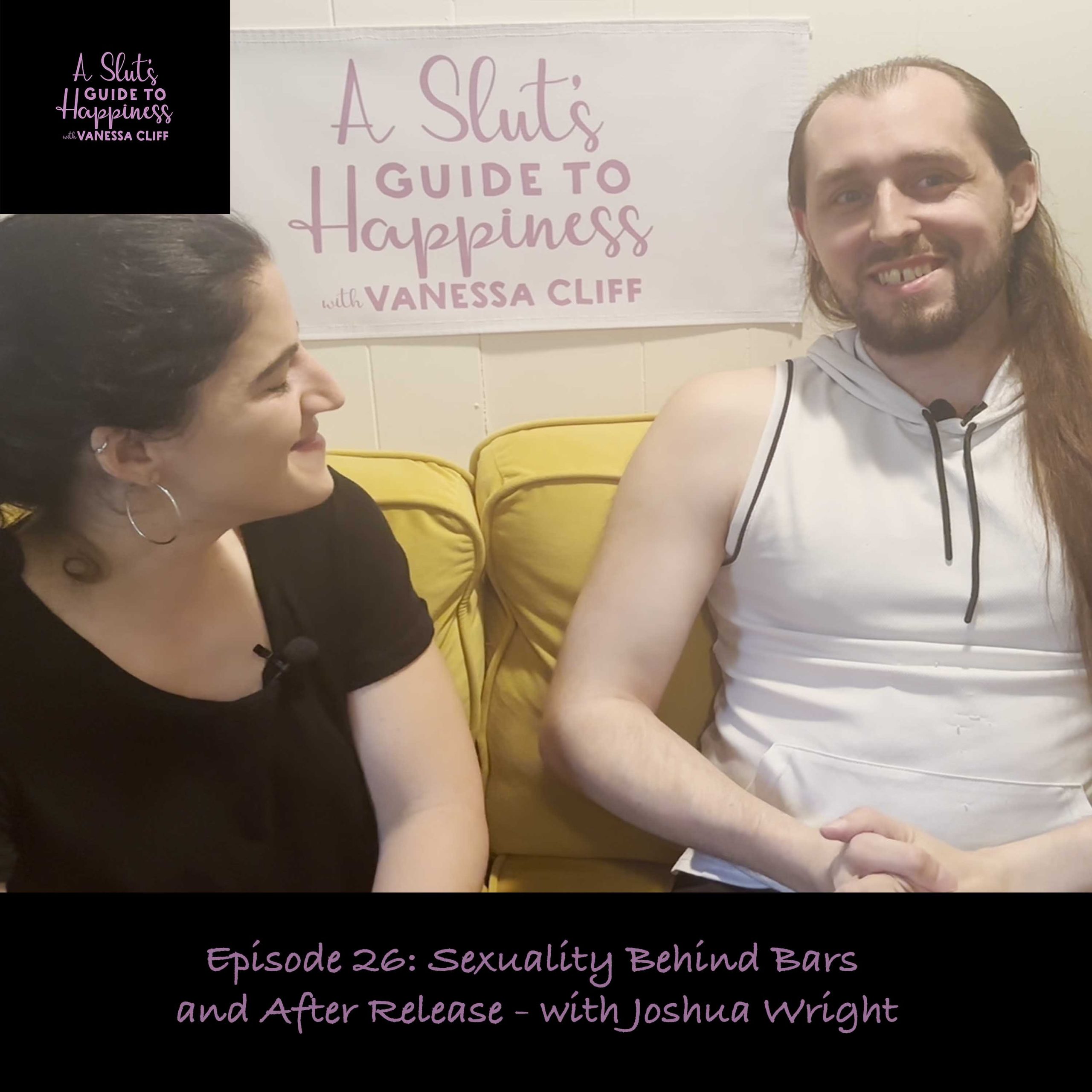
Sexuality is a basic human need, but in the dehumanizing environment of prison and jail, it is often prohibited, penalized or logistically impossible. After incarceration, a myriad of factors, including lack of experience, trauma from incarceration, and stigma associated with having been incarcerated can make it difficult for many formerly people to reconnect with their sexuality.
Although Joshua faced 4 years in prison, they are now a formerly incarcerated, openly genderqueer person, a community advocate for formerly incarcerated people, and a porn actor. In this episode, they describe their journey coping with the sexually repressed environment in prison and their journey figuring out how to be sexual after release.
During their period of incarceration, sex was never an option, access to flirting was almost never available, and procuring and using pornographic images became too much effort to bother. Eventually Joshua stopped masturbating and lost connection to their sexuality.
Nonetheless, during their period of incarceration, Joshua was able to work with Department of Corrections staff to develop a course on Gender and Sexuality taught to other people in the facility. The class was often academic in nature, but it still allowed people a space once a week to be a little more vulnerable and open about their desires and identity.
In prison, the only Joshua experienced touch was when faced with violence. They had to work through this trauma and their years of inexperience asking for dates and play partners, to find their way to trauma-sensitive and mutually consensual sex.
Driven by a racially discriminatory criminal justice system, 5% of the U.S. population has been incarcerated in their lifetimes and about 1 in 4 Black men have been incarcerated. This episode is a love note to these people and a window into the realities that people in prison face for anyone who knows, encounters, has sex with or loves a formerly incarcerated person.
Welcome back to A Slut’s Guide to Happiness, where your body is perfectly imperfect and it’s safe to be as sexual, kinky, queer, or slutty as you want.
Today, I have the privilege of talking with Joshua, a member of Cliff Media, a scene director and a fantastic, creative queer soul.
After a period of incarceration earlier in their life, Joshua found their way to some incredible work as an advocate and voice for people currently and formerly incarcerated. They serve on the board of the Metropolitan Alliance for Common Good.
They co-founded Liberation Literacy, co-created All Rise magazine and lead trainings for health care professionals on trauma-informed approaches to people who have been incarcerated. Joshua also has a podcast of their own.
Feel free to check it out, I found some really insightful episodes there, “The Exiled Voice”. They interview people who have been incarcerated about the true nature of mass incarceration in America.
Joshua’s community work started even before their release. While they were in prison, they founded the first gender and sexuality class in the Oregon Department of Corrections, and because it’s relevant to this topic, we’ll touch on that a little bit today as well.
Today we’re going to be talking about a really important subject that I don’t think is very often considered with humanity or care: the experience of reestablishing your sexuality after prison.
This may seem like a new subject to some folks listening. Maybe for some folks, maybe irrelevant to your lives. But unfortunately, mass incarceration impacts a lot more people than some might expect, especially given that it impacts people in different parts of the population more than others.
Let’s contextualize this a bit. I’m gonna go nerdy for a minute. Stay with me here.
About 0.7% of the US population is currently in a prison or jail system. Moreover, according to the US Bureau of Justice Statistics, about 5% of the population will be incarcerated in their lifetimes: five percent of us will be in jail or prison at some point in our lives.
In a racist criminal justice system, it’s no surprise that this experience is much more common for Black, Indigenous, and people of color. 16% of Black Americans and 9% of Latin Americans will be incarcerated at one point in their lifetime. On average, men are incarcerated more than women and Black men more than any other group.
About 1 in 4 Black men have been in prison or jail in their lifetimes. One in four Black men. So when we’re talking about sexuality for people, especially for Black men, but for lots of people, this is a significant experience to consider. Figuring out your sexuality after prison is an important conversation.
Joshua, thank you so much for joining us. I want to talk about something that you saw in a porn video. I don’t personally see a lot of people who are formerly incarcerated represented in porn. It could be that I’m looking in the wrong places. But you did encounter one example you shared with me. The reason I start here is because porn, like art in general, influences and to some extent imitates or reveals our collective sexual imaginations.
Can you tell us about the porn scene you saw, what was happening and how you felt about it?
Joshua:
Yeah, definitely. I was looking for something to watch on Pornhub. I specifically typed in “prison” because I wanted to see a scene that related to someone getting out and engaging in sexuality. The only one I found that was highly rated was a longer scene, I think it was like 30 minutes, where someone was getting out.
I think it was supposed to be step-mother type of porn, but it was very non-consensual. He just touched her and she clearly was guarded and defensive and uncomfortable. And I didn’t like that portrayal for multiple reasons.
For one, it makes us [formerly incarcerated people] seem like we just can’t help ourselves. We can’t control ourselves. We just need to touch people and kind of take advantage or take over their autonomy because we have been without for so long. That’s just not how it works.
I don’t appreciate that type of weird non-consent that eventually makes it to consent that is a common trope in a lot of porn. So I thought, what would that look like if it was an accurate scene?
Vanessa:
I’ve been thinking about this in general a lot lately. There’s a lot of porn in which it ‘s perceived as sexy to violate someone, and then it becomes okay. Actually, when someone asks me if they want to have sex with me, I feel like, wow, you want me? That’s really hot you just took that brave risk to tell me.
Then these representations of non-consent are compounded by the existing stigma about people who are formerly incarcerated.
This scene, one of the rare scenes representing formerly incarcerated people, was not empowering. But you also create some of your own porn, so you reimagined an alternative and we got a chance to act that out together. Can you describe what your vision was and why it was important to you?
Joshua:
Yeah. So the main thing that was different is obviously the consent piece. It was requested, it was asked, there was feedback, there was a back and forth, assurance on both sides.
That’s another thing that people don’t tend to think about is, when you get out of prison, touch does feel uncomfortable and overwhelming. It can feel not right to be touched, let alone anything involving sexuality and long, intimate, deep touching of someone else.
So, on both sides, you were checking in with me during the scene and that was something that I wanted to depict. When I got out, I didn’t know how to interact with people necessarily, because it had been so long.
Even some of the basics still felt foreign. Like trying to flirt and engage in sexual activities, to be intimate in any capacity, even to ask, hey can I kiss you? Things like that felt like, I don’t deserve that, I’m a criminal.
I wanted to incorporate that into the scene, to be more of how I felt when I was engaging in touch after release. I think a lot of people misunderstand us as ravenous animals or chaotic beasts. That’s usually how we’re portrayed. Or we’re calculated and methodical and kind of dangerous.
The reality is we’re usually just heavily traumatized from the experience of prison, and we don’t even know how to get to our next appointment, whether that’s a doctor or going to get groceries. That trauma is something I wanted to depict because I don’t think I’ve ever seen it in porn.
Vanessa:
Oh, there’s so much in what you just said. I think I’ve shared this poem on the podcast before because I just love it so much. The poem by Mary Oliver, “Wild Geese”. At the end, she says “You don’t have to walk on your knees through the desert for a thousand miles. You just have to let the soft animal of your body love what it loves.”
As you’re talking about people coming out of prison being deserving of expressing yourself and your boundaries and your needs. People coming out of prison are deserving of desire and love. Even if somebody was found guilty of something – which isn’t always true of people who are incarcerated – you don’t have to continue to be punished or continue punishing yourself. You are still worthy of love and soft, beautiful sexual connections.
The other perspective that stood out was that both parties are giving and receiving consent. There is this really beautiful moment in the scene where you paused the sexual interaction to say, “this is bringing up a lot of trauma for me”. That was intentional, on camera, written into the scenes. I imagine in prison, it’s often not very safe to express that level of emotional vulnerability. Does that feel true in your experience?
Joshua:
It does, yeah. In prison in general, but especially the prison I was at, it’s very toxically masculine. It’s very kind of stoic. You’re expected to just deal with stuff.
If you complain and especially if you’re vulnerable or you cry, you will be harmed in some way, whether that’s verbal or physical violence, because it’s seen as a weakness. It’s seen as feminine and undesirable.
So everyone’s putting on this false persona. It’s very mixed in with machismo. If you say you’re aggressive and violent, then people leave you alone. That’s kind of all we have in there. It’s kind of like animals in the wild, they puff up when they’re scared. So that’s what we do.
It manifests in very different ways and it’s usually just violence. If you wanted to express some type of vulnerability, you could try on the phone to your family maybe. But even then, you would have to be relatively quiet because there’s people right next to you having conversations.
Privacy is an illusion, so you can’t really be vulnerable. I remember crying twice over the four years I was in prison now and one of that was in the bathroom stall. And some bathrooms in some prisons don’t have stalls. You just go in there and use the bathroom. There’s no privacy even in that. But we had stalls. It was a minimum security prison, so there was a bit more amenities than other places.
The other place was in medical. I worked in medical. I helped people get the flu shots. I helped clean the place. I helped people kind of advocate for their health. That was one of the jobs I did. And I was able to go into an exam room after all the doctors had gone home and I cried, because a friend of mine was dealing with some severe health things and we couldn’t really help him.
Vulnerability and any type of intense thing is dangerous in prison to express.
Vanessa:
For intimate sexual connection, vulnerability is the heart of that. So I think we’ll get into this again. But I just, it’s hitting me already that you’re sharing all the different ways that it’s unsafe to be vulnerable in that environment. So I can just imagine the way that that can make sexuality after prison hard.
I’d like to ask more about your personal experiences. I cannot imagine a person locked away from their family and community, especially in the environment of incarceration, not experiencing some degree of trauma. So I do want to emphasize, if ever something feels too traumatic for you, feel free to express your boundaries in sharing. I also know that this is something you talk publicly quite a bit about.
Joshua:
Yeah, that’s what I do in my work.
Vanessa:
So can you start by telling us, you mentioned you were in prison for four years and where was this?
Joshua:
A little bit more than four years. It was 50 months total. It was mainly at Columbia River Correctional Institution, which is in North Portland. I think it was like 46 months out of the 50 I was there.
Vanessa:
Okay. We know that there are people who are asexual, a small percentage of the population. But even for people who are asexual, intimacy can be incredibly important. And for a lot of us, people who are not asexual, sexuality itself is an important part of our mental, emotional, and interpersonal health.
I’d like to know more about your relationship to sexuality when you’re in prison. For example, where are you having sex, thinking about it, sexting with anyone, watching porn, masturbating. How did you relate to your sexuality?
Joshua:
The first year I had a girlfriend on the outside, Megan. She was kind of there for me. She would be able to come visit once a month or so and take my phone calls, write me letters. The letters in particular were very sexual. The phone calls sometimes.
Sexual letters are not always able to get to you. That depends heavily on who’s working in the mailroom. That apparently got a lot worse after I was released. There was a change of people.
But when I was there, if it was just completely explicit all the way through, they wouldn’t give it to you or they would cut out parts of the letter. So you wouldn’t be able to read most of it. It’s just like a fragmented piece of paper, saying for example that they went to the library, but not that they want to suck your dick. So that that didn’t necessarily work.
But usually if you were not as explicit and used innuendos and euphemisms, they just glanced over it. If they see things like cock or pussy, they would take a better look at this. But if it was just neutral words and they didn’t see explicit words, they tend to just pass it through because they don’t have time.
So those letters at the beginning were helpful. Of course she was young, I was young I think I was 26, she was like 24 or 23. We had both been going to the University of Oregon at the time when I was arrested. She was there for me for a lot of it, but she wanted to get on with her life.
That was completely understandable to me. I couldn’t really tell her I love her and then say, you have to be with me. That’s not how love works.
So after that first year, the only thing I had was the small ways we could get porn in the prison. We had little clips from magazines, pieces of a hustler, for example, or Penthouse or Playboy.
People on the work crews that worked outside of the prison, some of them went to the airport, some of them went to camps and things and were ordered to clean. It’s without pay usually, or very minimal pay. And they sometimes had people drop things and then they smuggled them in.
Sometimes the officers allowed it, sometimes you had to do more intensive methods, like hiding it in parts of your body. Then you would sell it, you would sell these laminated or these rolled up magazines or whatever these pictures to other people.
I started out with my friends, I’m not going to name them, so he doesn’t get in trouble. He worked in the law library, and he had access to a printer, a copier and a laminator. I would be given or I would buy these pictures and then I would send them to my friend. He would copy them, he would laminate them and we would sell them.
Vanessa:
Community organizing for sexual liberation right there.
Joshua:
The problem with that is like you had to physically take it with you to a place that’s private, and the only place that’s private is a shower stall or a bathroom stall. Then if it’s not well laminated, it’s going to be destroyed the one time you use it.
It’s also still awkward because you’re carrying something to the bathroom which is considered contraband. Then getting in trouble if an officer sees and asks, hey, what are you doing? What are you holding? Yeah, what are you taking?
So you could not sit with this in your bed?
Joshua:
You could. It’s just the prison I was at, it was a dorm setting, so it was an 80 person unit there and the beds were very close together. You could stand with your shoulders in between the bunks, but you couldn’t extend your arms at all. That’s how close they were.
Vanessa:
How many bunks per room?
Joshua:
There were like 30 or 40 beds. Because it was 80 people and it was a bunk bed type of situation for most of it. So you’d have 30 or 40 people in one room.
Vanessa:
Yes, I love having sex in front of people and I really value my alone time to masturbate. That is not alone time.
Joshua.
No. And it’s consensual, when you’re having sex in front of people, they want to be there. They want to see you.
But I had a situation that I had to address when I got more what’s called “prison respect”, which usually just translates to fear.
My third year in prison, there was a person that had come in who had done multiple murders on the outside. He struggled whenever he got out. From what I understand, he had murdered two different people on two different sets, and he was on his second one. When people would insult him in public for whatever reason, just because he’s awkward and different, he would just kill them because he didn’t know how to deal with them.
He also didn’t know how privacy and consent works. And he was a very large, very muscular older man. There was a young kid that had just come into the prison and they were bunked right next to each other. And the kid was very small. I think he was 5’ 4” at most.
Vanessa:
When you say kids, you mean young adults?
Joshua:
Yeah, he was like 19, 21, very young compared with all the rest of us, and especially compared to this man.
The older man decided late at night he was just going to like jack off, he was going to masturbate, which would be a normal thing in any other setting, and especially because he’s coming from a prison where there were cells. So that also usually is fine. You have to check with whoever your cellie is. Like asking, hey, is it okay? I need some alone time. Then they go out and do this thing. You masturbate in a little bit more privacy there.
But he didn’t seem to understand that this was a different environment. It was brought to my attention that he did this right next to the kid. The kid felt very unsafe, very uncomfortable. He didn’t know what to do. Didn’t want to say anything. Because he was afraid of getting harmed.
So that’s something that came up. Sometimes we had to enforce the privacy that we already struggled with. Because we’re all just stuck together in the cage.
Vanessa:
What you said is a really good point. There is a vast difference between having sex in front of people at a sex club where everybody is there to watch and have sex in front of each other, compared to being naked or having sex in front of people who didn’t want to be around that, who didn’t ask to be around that.
So you’re struggling in that environment you’re describing. On the one hand, you want to be a sexual being. On the other hand, you don’t want to make other people feel uncomfortable by being around sexuality when they didn’t ask to see or hear that.
It sounds like in order to have that part of your life, you have to sneak, you’re risking getting in trouble, going to the shower in order to just do what any of us would take for granted on the outside, and having the opportunity to masturbate.
What was your outlet for emotional intimacy? What was your outlet for emotional intimacy with other people, even to yourself, while you were there?
Joshua:
I think the only thing that comes to mind is that I would write about sexuality and things because I couldn’t have it personally.
I think that also interactions with certain volunteers were helpful, especially ones I was attracted to. It was not fulfilling in the same way because I couldn’t really engage in sexuality or be flirtatious with them. But it mattered that they were there and they were willing to engage in dialog and share their perspectives and opinions and talk about a variety of topics that we weren’t used to in prison.
In prison, it’s always talking about drugs or some type of violent act that they did in the past or the gang that they’re involved with. With the volunteers, there was more intellectual discussion. It was so refreshing to be able to talk about something soft and lighthearted and kind and gentle.
I tended to talk about animals and writing and poetry and fun stuff. That was oddly fulfilling, in terms of intimacy. Not, of course, sexually fulfilling, but it did feel very intimate to be able to have a discussion that I couldn’t have outside of that context. That’s something that comes to mind is being able to engage in that way with volunteers in particular.
Vanessa:
It feels really important to me what I’m hearing you describing is that you were not necessarily unable to interact with people in prison because they were bad people or because they’re inherently dangerous. Rather, the environment made it unsafe to be vulnerable, to be squishy, to have those soft, gentle, playful emotions.
You had to reach out to someone who was outside of that environment in order to be able to express that part of yourself.
Joshua:
In some of my work, I used the analogy that if you put a dog in a cage and you just leave it there and expect it to be happy, after you come back three days later, that’s not really how it works. The dog will probably rip its own teeth off trying to escape the cage.
And human beings are the same thing. You put them in a cage, they’re not going to be happy and get along together and everything will be okay. We’re all stuck and imprisoned and we can’t leave and we can’t do anything we need to fulfill what we value.
So it’s just a very different setting. Most of the time we’re just all struggling together and we’re just oppressed, but we don’t want to be harmed. We pretend to be these violent, dangerous people to each other so we’ll be left alone.
Vanessa:
In this environment, it is unsafe to express yourself like that and eventually got to the place where you no longer felt safe, even masturbating. So you are completely disconnected from your sexuality, at least expressing your sexuality, even with yourself in your own body.
It is particularly interesting to me in this context that you started this class, a gender and sexuality class. Can you talk about how you managed to do that and why? Why were you inspired to do that in spite of the circumstances you were living in?
Joshua:
I think the biggest thing I was inspired by my friend, Juniper. It was their idea. At the time, they identified us as a gay man. Not openly but to people they trusted. They shared that with me, that they identify as gay. They said, this is who I’ve always been. It was their idea for the class and how to implement it so they could feel safe being themself in prison.
But they were getting out very quickly. I think their release was a few months after they had spoken to me about the class idea.
I previously had an experience with creating another class called Liberation Literacy. I just kind of took it upon myself to start it. I asked, do you want help with that? I can probably get that done. It just may take longer than you’ll be here. They said they would love to.
So from that point on, we built the parameters of the class and the outline and the syllabi and all the things related to it. Then we proposed it to the staff.
The same staff member who was my former counselor, who is now the head of programming, he was, I think, the only staff member who was like a genuine ally to what I was trying to do in prison. I later learned that was because he also identified as being in the LGBTQ community. But I didn’t know that at the time.
It was very strange to be told, yes, you can do this. Whatever you need, let me know. That was a very different experience. I was unfamiliar with that.
But it allowed us to create a space where it focused a little bit on education. We watched some documentaries about the AIDS epidemic in the 80s and how people got through that and then how they were treated at the time. We read some texts that were written by people in the LGBT community, and essays about how they interact with the world and, and see life in general.
There were also times to have introductions where we could share things like, how did you come to be here? What brought you to this class? And it was very interesting to see.
Sometimes they were very hardened, like gang member types of people coming in from the unit where they just got done enforcing some type of physical thing on another person. Then they went to the class and they started speaking in a very effeminate way and explaining they’ve always been gay, but they still can’t be publicly gay.
They’re seen as like a leader of a gang or in some type of shot color in that environment. So they have to uphold those laws and those rules and those standards, sometimes against people that they identify with personally.
It was very refreshing for people to be so much more themselves. The beauty of that and feeling that they could be safe in an environment like that was very it made me very grateful and happy that I helped create that type of setting in such an oppressive place.
Vanessa:
That brings up a couple of things for me. One is that I think that there are so many dehumanizing narratives and all sides. There’s the dominant mainstream narrative that people in prison are bad criminals, dangerous and incapable of expressing complex emotions and vulnerability. Then even on the political left, sometimes the narrative is like staff and guards or anyone associated with the department of corrections are bad and are perpetuating mass incarceration.
What you’re describing is much more connected to the complex personhood of everyone. You’re able to hold onto curiosity about humans, about wherever they are located in society, and to seek community and the possibility of connection.
The other thing that I’m hearing is that you managed, within this really oppressive space, to create a safe possibility for those conversations. It reminds me about the months I was living in Pakistan, was a really impressive environment, really difficult for people to be out as queer trans. But that was one of the tightest queer communities I was ever in. Because when you’re in that really impressive environment, it becomes even more important to stay together, to find each other, to find your people.
So I’m curious if you can share, what were some of the things, structurally, emotionally, and interpersonally, that allowed people to feel safe even in the class, even though they were otherwise practicing machismo to survive. But in this little space, in this little classroom, there was like a little opportunity to be more vulnerable and authentic. How did you do that? How did you all do that?
Joshua:
It felt like it was planned with me and the former counselor, the head of programming, after it was becoming like a real thing. We got an outside volunteer who was also a member of the LGBTQ community that was willing to do this. She had just graduated from Lewis and Clark College and she was very into this type of work.
We all sat down together and just tried to figure out a way that it could be safe. That was one of the concerns, we worried that nobody’s going to come to this class because they’ll be seen in a different way here.
So we talked about having the classroom outside of the main hall. In Columbia River prison, it’s like a giant hallway that leads from outside to the dorms. You go to each dorm, wherever you’re along this hallway and there’s classrooms around the side going towards programming. So, if you have a meeting with your counselor or your release counselor or some type of person in that environment, you go down this program hallway, there’s two classrooms on the right and left.
The first thing we thought of was having the class outside of the main hallway so that when people go in and out of the front yard or going to and from the chow hall to eat a meal or work in the kitchen, they wouldn’t walk by us.
We also had it on Saturday, so nobody’s going to be going to the program area in the first place. All the counselors don’t work on the weekends. Saturday mornings it was outside of the view of people going to and from everywhere.
Then there’s also something in prison called the “call out sheet”. Let’s say you wake up and you look at what you have the next day, they put it out the evening before, but sometimes people just need to sleep. So you wake up in the morning, you check it again. Maybe you forgot what you’re doing. 10 a.m. you have to go to medical. 3 p.m. you have to go to the chapel, etc..
We purposely had the class not show up on the call sheet. It happened once that it said “Gender and Sexuality Class” on the call sheet, and I went down to the person and said, I don’t think we should have it on the callout. This is probably not safe. He said, that’s an excellent point, I’ll make sure that that’s not on the call out.
Even people that knew they were going, some didn’t know what it was. We just said “That’s another class, for some reason they keep forgetting to put it on the call out”. Nobody cared because they all have their own things going on.
So that’s what made it safest I think is, is this very out of the way thing that was almost invisible and played off as like nothing important. It kept us safe and kept that class protected. I’m very appreciative that we were able to do that.
Vanessa:
One of the things that you were talking about before we started this podcast, some of the educational materials that were informing your liberation, those of you in the gender and sexuality class, around race.
I was living in Washington for ten years before I just moved here. This Cliff house here is super exciting in Portland, but I was really influenced in Washington by the Black Prisoners Caucus.
It’s led by Black folks in prison, but it’s multiracial and they do a lot of education around Black liberation history. It influences the ability for people to move beyond violence and racial antagonism. It really kind of transformed a lot of the culture in the prisons.
I’ve heard you describe some of that going on in your class. Can you talk more about how that played out and what that looks like in that prison environment?
Joshua:
In the Liberation Literacy class, we were very much all learning together about how to protect each other and ourselves from the system.
We talked and read about how it’s designed, how it works and how it targets people of color and makes them kind of reliant on this in and out cycle of recidivism that happens, not really any fault of their own. It’s desperation and the societal things that we focus on.
That was something we did. We would just research texts, like Assata Shaku, Angela Davis, Malcolm X, Martin Luther King Jr. We just tried to see what they did and how they viewed the world and how we could keep their kind of ideals in mind as we go through our lives.
It felt like a college class. We were all just hanging out in prison, learning these really deep, historical narratives. And Frederick Douglass, for example. It was profound. And what he was saying at the time.
We would read books together. One of them was stamped from the beginning by Ibram X Kendi, who’s like a professor now, I think, at Harvard. But it was like one of the most powerful books I’d ever read. It was on the origin of racism and ideas in the United States and where that came about.
So we were figuring out how to be anti-racist and practice that together. It was really fun and really challenging. I miss that a lot.
In the same way of the class, there’s so many different types of humans and how we all came to identify ourselves and figure out who we were was always such an intricate and beautiful journey to hear about.
Vanessa:
In the same way that you were figuring out your gender and sexuality in the other class.
Joshua:
Yeah, that’s what I’m talking about in that class is seeing how people came to identify. Even in Liberation Literacy, it was almost like people that had never been given or offered this education began to think about it. They were thinking about what it means for them to be Black. It was beautiful to see them re-identify themselves and what that means to them.
There is so much power in being proud of who you are. The system so often tries to rip us apart and break us down.
It was the same way in the gender and sexuality classes. We should be able to be ourselves and not have to deal with racism, oppression, homophobia, etc. And at least in this space, we can.
So it was beautiful. That’s one of the only things I miss about prison was having this class.
Vanessa:
I relate to that. When I was living in Arizona, the migrant justice movement was incredible. Also that the community was very authentically sexual in positive ways, kind of flirting and joking and some of the most open, lighthearted energy I’ve experienced.
It feels like once you are able to be authentic and undo systems of oppression in one part of your life, you can begin to realize you don’t actually have to buy into any of this bullshit. Freedom shows up in other parts of life.
It sounds like you had the liberation class, thinking about those things around different forms of liberation, reading a lot of Black history. Then you also move from that take of the same kind of practices into your work on gender and sexuality.
I’d like to go back to some of your personal experiences. As you’re getting out of prison, you have gone through these 50 months without really positive relationships to touch and even starting to be really disconnected from your sexuality, except for this beautiful kind of academic and community classroom space.
How did you begin to think about the possibility of sex or dating or reconnecting to your sexuality in the not free, but freer society outside of incarceration?
Joshua:
It was very overwhelming because touch in prison is always violent. It’s the last thing we have left. I don’t know if you learned this in Kindergarten or preschool, but it’s like your little bubble, your personal space. That’s all you have left in prison, your word, your voice and your autonomy with your body.
So if that’s inhibited, let’s say I accidentally bump into you walking somewhere and you don’t say, excuse me or pardon me or my bad, you should expect to be hit, because you have taken the last thing that that person has. You’ve stepped into it without consent, without any type of authority to do so, and taken that from them.
So touch did feel intimidating, especially as I was getting closer to release. I started to think about how am I supposed to date? How am I supposed to engage in this stuff and sexuality? I wanted it so badly, but it was so stressful to think, how am I supposed to do that now? And how will that feel?
One of the things I’ve always worried about is just causing harm. And for me, I think that just stemmed from watching my father as I grew up. He was an abusive alcoholic and the stuff that he would do was like the opposite of how I’m supposed to be. He was like the anti-example.
So for me, I felt like after years of prison being told I’m a burglar, I steal stuff, I’m a criminal, I’m dangerous. Over time, you start to believe that.
No matter how good your self-esteem is or your confidence, if you tell someone every day for years what they are, they eventually at least question, maybe that is what I am. If that’s what I am, maybe I’m supposed to behave in these ways. Maybe I’m supposed to learn how to steal stuff or break into cars and break into houses. You start to question a lot of your identity and things.
That’s what happened to me as well. I thought, maybe I am somehow this harmful person and maybe it’s genetic. Maybe I’m just like my father.
I thought, I don’t want to cause harm, maybe I should just not date at all. It’s rational to just avoid people altogether. But then you can’t really fight against your needs and then the Maslov’s Hierarchy. It’s going to eat at you until you try to satiate in some capacity.
At the time, it was very intimidating. When I did finally get out, my friend Julie, introduced me to something called Kaleidoscope Yoga. And I had done yoga in prison for three and a half years.
I didn’t know what kaleidoscope yoga was. I just thought it was like some weird form of yoga. They affirmed that’s kind of what it is. It’s kind of like partner yoga, where you’re doing poses with someone, but it’s with a group of people.
Whoever designed it and invented it was like, how can we make a bunch of humans work together to create something and stretch a part of your body. It was very fascinating. I don’t know how they did that.
It did get you used to touch. You’re doing poses together with groups of people, touching people on both sides of you. It was upstairs in a food co-op, and it was like, it’s very peaceful and it was very calming and everyone there seemed genuinely kind and patient.
That kind of got me used to touch again and how it can feel safe and it can feel comfortable and it can feel welcoming.
Vanessa:
That reminds me in some ways of the way that we talk about Cliff Media porn shoots. It’s a container. It’s not having sex in the way that you would have sex in your personal life.
Similarly, you have the container of yoga and you’re touching within that context, there is some structure, there’s some expectations around how you’re touching it. It creates practice for the ability to go out into other parts of your life.
You’re beginning this touching, maybe not sexual yet, but reorienting from the extreme of touch as violence. You’re beginning this journey, processing through the trauma and reconnecting to touch as positivity.
How did you go to the next step of the connection to sexuality?
Joshua:
Even with touch, it still felt very kind of intimidating to try and date. I had forgotten how to flirt and how to ask people, how would you feel about going to dinner with me or something like that?
Also just like how to make people feel beautiful because in prison it’s like how do you get people to stay away from you. So for years, my whole body and my mind felt that I needed to keep people away.
So it required a mindset shift to think, now I want people close. I don’t remember how to do that necessarily.
Eventually I decided to hire a sex worker. Because I am on the autism spectrum, I was very I was very obvious. I said, “I just got out of prison. Is that okay? Is that going to be an issue?” If so, that’s totally fine.
Vanessa:
This is where I think about autism as a superpower. It’s direct communication which is related to consent.
Joshua:
Yeah. She was like, oh yeah. As long as I’m getting paid, I don’t mind whatever you need. You’re hiring me. This is a service. I felt, well, that’s awesome.
It was just very easy. And it was very comfortable and it was very over communicative, which I really appreciate. That preliminary thing before you ever meet the person, asking, do you offer this? Yes, I do in this context. Is it okay if we do this?
It was that type of communication that was really, really helpful, both for my trauma as well as my autism.
In prison, you don’t really have a voice at all. You can’t ask for what you need. You’re told what to do every hour of the day and told where to be and how to act. So it felt very foreign to be able to make decisions and ask for what I want. Because of that, it was a very beautiful and affirming and just a wonderful experience.
Vanessa:
It’s interesting, I’ve done a couple of podcasts with folks who are sex workers, who have talked about how they view their work as both healing for themselves and for their clients. I love hearing that that was true and affirming for you. I think about some of the countries in Europe where there is state subsidy for sex work as a healing profession.
So you’re beginning to introduce sexuality back into your life, exploring the possibility of understanding that you, as a human, are not just all these bad things that people say you are. It’s not just unsafe to be touched, but there’s a possibility of expressing your desires and connecting with people in ways that don’t make them feel bad.
How did you transition from this sex work encounter into personal relationships in your life? What kind of responses did you get from people as you began that journey?
Joshua:
One of the things I realized very quickly after that, that need was fulfilled. So it was kind of out of the way. But I like romantic things. I like dates and pleasing people, having fun together, doing activities and sharing experiences. So the sex work encounter was fulfilling in some capacity, but not all that I desired.
I realized that I didn’t necessarily know how to express consent either. And I struggled a lot with boundaries. I struggled a lot.
I’ve never had a problem telling masculine people my boundaries like, hey, don’t do that. I’m not comfortable with that. But I never knew how to express to people that I’m attracted to or really just anyone femme, to say hey, I’m not comfortable with that or I don’t like that.
I think it was when I was finding out I was probably on the autism spectrum and just how kind of muffled and subdued and muted some of my responses are, no matter how excited I am. If people are like, hey, like, do you want to have sex? And I say, oh yeah, that’d be great. That would be wonderful. I would appreciate that.
I realized that I needed to relearn consent. When I was getting out and relearning what consent was, enthusiastic consent was a big thing. I need to hear, “yes, I absolutely would love to have sex with you.”
Vanessa:
And you’re looking for that from other people as well as the way that you’re expressing it yourself.
Joshua:
Yes. I was changing. I thought that that would be a good way to learn, because I was trying to learn the basics again. Consent was the most fundamental basic. It was always really important to me to be able to express that and see that in others.
When I was learning, if they are also on the autism spectrum, how is that going to present? I was relearning, if I ask someone, “do you want to do this act?” And they say, yes, and it’s kind of muted, I always make sure to ask a second time, “are you sure this is what you want?” To check in.
So I was just relearning a lot of this stuff and relearning how to date. And then I just started trying. I started asking people like, hey, would you want to go to dinner sometime? And that seemed to go well.
Then I would tell them when we got to that point of being intimate and sharing sexuality that sometimes I might need a break. I might need to step back a little bit. The touch might be too much. It might be overwhelming. Most of the time that was taken in a very understanding way.
Vanessa:
Did you explain why that was coming up for you?
Joshua:
Yeah. I tried to explain. I would always share with people very early on. I’d tell them, I’ve been to prison. If that makes you uncomfortable, this might not work out. I’m telling you this now so you don’t have to find out later, to make sure that everyone was consenting both to engaging with me sexually, but also consenting to being with me at all.
Because of that conditioned thing that we’re told, criminals are violent and people who’ve been to prison are dangerous, etc. I wanted people to be aware before they got to that place so they didn’t regret or hold resentment towards me for being with me.
It was a long process, but it was mostly taken with graciousness and patience. That was very helpful at the time.
Vanessa:
It’s interesting that you mention that, because I’ve heard this conversation from other folks as well. I’d love to hear your feedback, but I think that especially given that the carceral system in the US is so violent, and wraps up so many people and is connected to narratives of dehumanization.
As you get out of that, it’s possible to move forward and that doesn’t define you. You aren’t that person that they say that you are, and that’s just one piece of your past and you don’t necessarily have to share. But you’re choosing to. That’s your particular choice. That’s your path and way to do it. But other people could approach it differently, potentially. It’s necessarily required for consent. What do you think about that?
Joshua:
I would agree with that. I just know that how we’re conditioned to believe in society from the courts and the police, criminals or felons are very alarming and triggering.
It might not go well if a person were to find out after a year or two of being with someone, a few months even, that their partner was in prison for years of their life for this violent burglary, whether that was true or not, whether they actually did that crime or not. It will come with a lot of alarming and uncomfortable feelings.
I want to avoid that. That’s what I try to assuage that possibility. I just say, this happened. But that’s a personal choice. I think that it shouldn’t be as important as it is. The societal ramifications that come from that label, that you don’t have any choice over has never been okay. It’s never been appropriate and never been acceptable, but there’s nothing that we can do about it.
I can’t really stop it, I can’t change it. I can’t take the label away. What can I do to make that easier for others to digest? What I came up with is just being very honest and open.
Vanessa:
There’s so many times in my life where I go back to the Audre Lorde quote, “Whatever you accept about yourself can’t be used as a weapon against you.”
I think about normalizing anything about myself that’s stigmatized by society. Yes, I’m a sex worker. Yes, I’m queer. Yes, I’m a survivor of sexual assault. Yes, I’ve been homeless.
Naming these things releases a lot of the shame that could be attached to it. These things are parts of who I am and either you’re okay with it or you’re not. And if you’re not, then I wish you well in your journey.
I love that it sounds like you’ve accepted that about yourself in order to be tender and open with the people who are able to hold that truth about your past.
How did you move through trauma? I know that, like, regardless of how people experience trauma, whether that’s surviving sexual assaults, surviving violence, surviving incarceration, it still lives in the body.
I think one thing that’s really powerful about this conversation is we’re seeing the spectrum almost of violence and assault, whether it’s of your physical body or sexual assault, whether it’s related to sexuality or not. That nonconsensual touch is at the other end of the spectrum from positive touch that is tender or romantic or friendly. You’ve experienced both ends of the spectrum.
A lot of us are reconfiguring our relation to sex and touch after the trauma of non-consent. So how did you work through that, as you’re coming out of incarceration and redefining what touch means in your life?
Joshua:
I think the biggest thing that helped us is therapy. Different forms of talk therapy were pretty effective.
Then I found EMDR therapy. I can’t remember what the acronym stands for. I think it’s eye movement, but it was remarkably helpful for dealing with trauma. It’s relatively new from what I understand, and also just like the component of exposure therapy or flooding, the psychological term is like if you’re afraid of clowns, let’s take you to the circus and see how that goes.
Usually that’s not very ethical or safe or like recommended. But for me with the kaleidoscope yoga and other things, having the sex worker in general was like, it was so worth it. And I feel like it was necessary to try, no matter how uncomfortable it may have been for me.
I wanted to at least work my way through it. I couldn’t necessarily do that without touching and being touched.
So those two things in particular in therapy were very beneficial for reworking a lot of my struggles with touch and violence. My entire life has kind of been in those realms, a lot of aggression, violence, and a lot of violent words, verbal and physical abuse happened to me through childhood and prison.
I was trying to process and relearn about how the world works. So that was really helpful for figuring out how I can advocate for myself and how I can be less overwhelmed by these experiences and allow pleasure to happen without all of the things that come with it after a lifetime of harm.
Vanessa:
I really relate to exposure therapy, that helped me heal from sexual assault. I’ve had conversations with folks for whom their way of healing is to protect themselves from experiencing that same thing again and to avoid the environment in which their assault happened. I think that’s a completely healthy choice to make. I think for me, the thing that has been really helpful is to decide, I’m just going to expose myself to it and learn through it so that I’m not afraid of it.
The other thing that I’m hearing here is this process of teaching yourself that touch can be okay, it also teaches you how to relate to touching other people in ways that feel healthy and good for both of you.
This seems connected to restorative justice. When we’re talking about people feeling able to be their whole selves, being loved and giving love in positive ways, that to me feels more healing than what you experienced in incarceration.
I want to end with a love note. I wanted to say I thought it was beautiful throughout, especially in your early conversation, as you’re talking about people in prison as “us”. Although you didn’t like it, it wasn’t a positive environment, and you were facing violence from people, you still felt some kind of kinship or identification with other people who were suffering from that environment.
I’d like to end with a love note to people who are currently in prison or who have been imprisoned. Remembering what we said at the beginning, that’s 0.7% of the population as a whole is currently in prison or jail. Five percent of people have been in prison or jail, and 1 in 4 black men have been in prison or in jail.
So we send a love note to these folks who have been stripped, in many ways, of the ability to positively express and connect with other people around this basic human need, around sexuality and sexual connection with other people. What would you say to those folks as they’re struggling in that journey?
Joshua:
If I could speak to them, I would just say that you do what you have to do to be okay and be safe. Whether that’s now, while you’re in prison or if you do have a release date, do what you need to be okay when you get out. Take some time to yourself.
I know you’re expected to do so many things, go to all these meetings, get a job, get housing, meet with your parole officer and all that stuff. But in between those times, just be gentle with yourself and do what you can to get through it.
It’s never worth going back. I know you know that. So just do what you can to be okay.
Vanessa:
In a system that teaches us that all of us, and especially men who are socialized to masculinity, have to hide our emotions, hide our vulnerability, being gentle with yourself is beautiful. It’s strength. It’s a different kind of strength that I think, that as a society, collectively, we can give a gift by supporting each other and getting through whatever kind of traumas we’ve experienced.
From this conversation, I’ve really taken away a lot of learning about the connections that people have had in different kind of spaces, and also the ways that we can learn to connect with each other regardless of the incarceration that someone may have experienced. And for people who have overcome the experience of incarceration, continuing to express being able to express the trauma and violence, what it means to to have consensual, healthy, positive relationships.
I also look forward to there being more empowering porn out there about people who have experienced incarceration as whole people on the journey of having positive, healthy, loving, sexual connections after being in an environment where that’s not allowed.
Thank you so much for sharing your experiences, Joshua.
Viewers, thank you for joining us today.
This has been another edition of A Slut’s Guide to Happiness with your host, Vanessa Cliff and our guest today, Joshua Wright.
You can find us wherever you get your podcasts, including Apple and Spotify, as well as on cliffmediaproductions.com.
If you’re over the age of 18, you can also check out our video content on our website, cliffmediaproductions.com.
And most of all, I invite you to join us in the pleasure of being awkwardly human, naked and without pretense.
Let’s get free.
![Instead of hiring professional actors, Cliff Media invites all good-hearted, enthusiastically consenting adults to participate in raw, authentic and fun storyline-based porn scenes. In this episode, Diana shares her experience as a new participant with Cliff Media. The first day of Cliff Media’s 2024 LGBTQ Shoot Week was her first entry into the company, though by day four, she feels like a staple of the community. Community organizing-based porn, especially led by queer people, people with disabilities and Black, Indigenous and people of color, is a unique, unparalleled social experiment. As a result, everyone coming into Cliff Media for the first time, even those with experience in group sex or porn, is joining something they have not experienced before. Diana talks about her fears and expectations prior to attending the shoot, and her initial experience on the first day. She describes the ups and downs of her physical and emotional reaction to the shoot week, and offers practical tips for people who want to prepare their body before specific sexual acts. At Cliff Media, we invite people to do only exactly whatever they want to do with their bodies, asking others for consent (“May I [verb] your [noun]?”), expressing their boundaries and being comfortable with providing honest feedback to learn and grow from each other. This can be an uncomfortable new experience, and as Diana expresses, it is the effort toward loving everyone who walks the door that allows people to feel safer being their authentic selves, including in their sexual and interpersonal desires.](https://cliffmediaproductions.com/wp-content/uploads/2025/04/asgth-episode-35-300x300.jpg)





Materials found in this section may be sexually explicit in nature. To view materials on the site, you must affirm all of the following:
I am at least 18 years of age (21 in some localities). Any sexually explicit material I am viewing is for my own personal use and I will not expose minors to the material under any circumstances. I do not find images of nude adults, adults engaged in sex, or other sexual material to be offensive or objectionable and I desire to receive and view sexually explicit material.
The viewing, reading and downloading of sexually explicit materials does not violate the standards of my community, town, city, state or country. I am solely responsible for any false disclosures or legal ramifications of viewing, reading or downloading any material on this site.
This website and its affiliates shall not be held responsible for any legal ramifications arising from fraudulent entry into or use of this website. This warning page constitutes a legal agreement between this website and you.
All models, actresses and actors whose images appear on this site are over the age of 18. Bookmarking to a page on this site whereby this warning page and/or terms and conditions are by-passed shall constitute an implicit acceptance of the terms and conditions herein.