

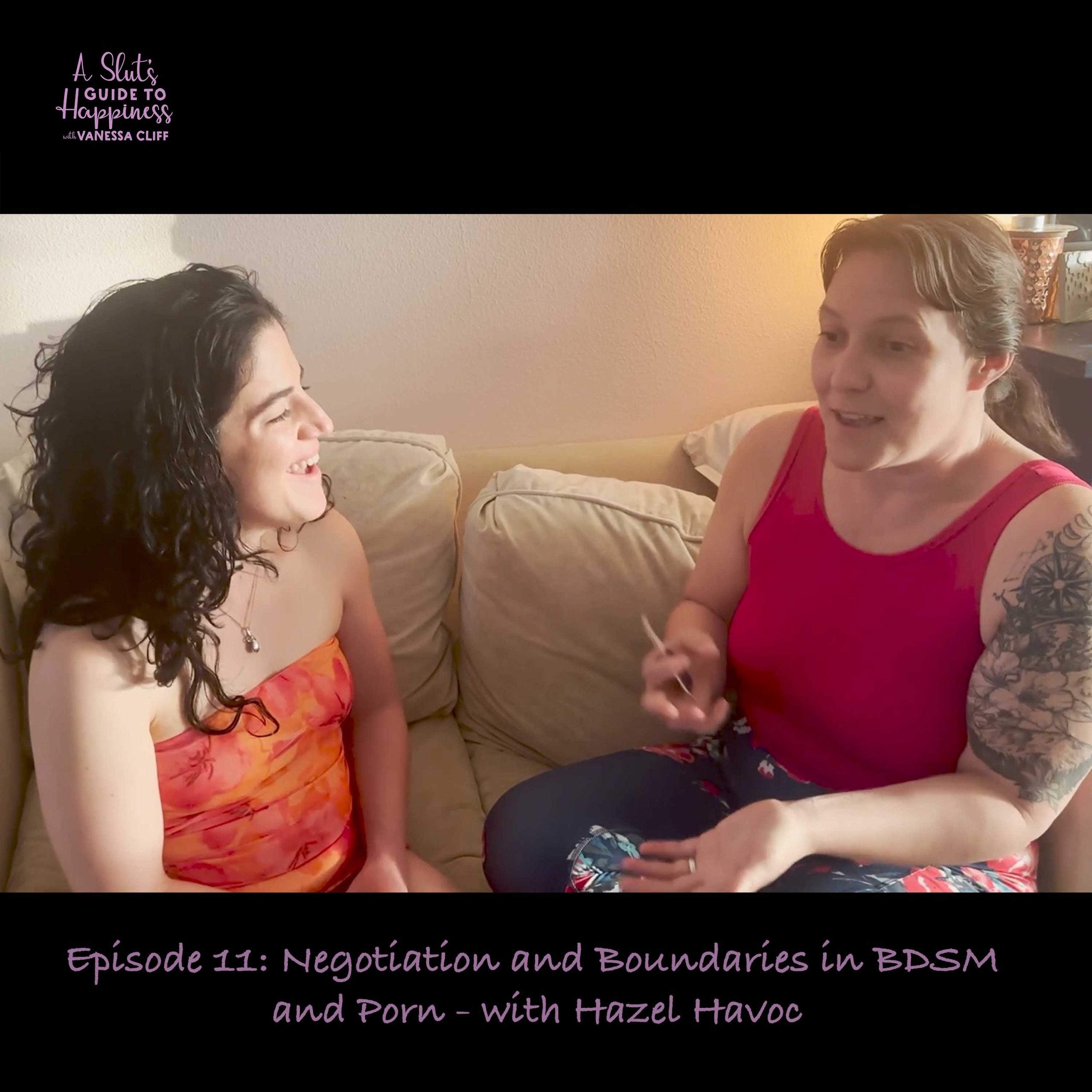
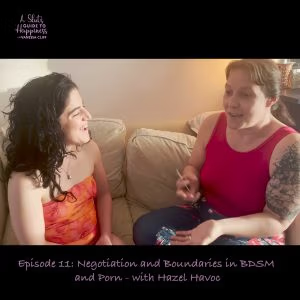
When filming porn or exploring kink, like impact play, bondage, or humiliation, consent becomes more complex and nuanced than off-camera or vanilla sex. Hazel Havoc, a long-time pro-domme, pornstar and personal life kinkster, explains methods to ensure that all participants are experiencing BDSM and porn in a way that is positive and desirable.
Hazel uses a variety of communication strategies to prepare for scenes that range in their depth and formality depending on the circumstances. She shares the little card she keeps in her wallet to remind her of the categories of questions to check in about before play. She also describes the longer questionnaire she uses with more professional, complex scenes. Even with ample preparation, not every situation works for all participants; safe words, repair and aftercare are also important components of positive sex.
These approaches may be most useful for people engaging in BDSM play, or producing or starring in porn. However, the ethos of extensive conversation before, during and after play can also apply to less kinky sexual play and vanilla romantic partnerships, wherein negotiation deepens connection and trust.
Welcome to A Slut’s Guide to Happiness, where your body is perfectly imperfect and it’s safe to be as sexual, kinky, queer or slutty as you want.
Today we will be talking again with a dear friend and wicked smart pro-domme, sex-positive education and the Chief Learning Officer at Cliff Media, Hazel Havoc.
Previously we talked with Hazel Havoc and her husband about their journey with sex work and porn. Today we will be talking with Hazel about another really critical topic around boundaries in kink and porn. This woman has a lot of really smart ideas about how to handle a critically important and often very tricky conversation that happens in all kinds of sexual situations.
Hazel, can you tell us about the very first time you negotiated a kink scene?
Hazel:
Yeah, the first time, the very first time it was with this human, Sasha, who I was sure was far more experienced than me in every way, shape or form. So I felt like I had to come with my A-game. They have a ton of experience.
Vanessa:
So you’re feeling some intimidation.
Hazel:
Yeah, I didn’t want to fall short. Little did I know, months and months after Sasha and I became dear friends, they told me that they felt the same way about me.
So one thing that I brought in with me, I went and did research. I have my own questions on what I know I need to ask about, things about the body, things about how they felt that day, things that they experience.
But I knew I wanted to go deeper than that. So I started doing research. What are other questions that people ask within guidelines, for boundaries, for kink scenes?
One thing that I found, through a local dungeon here in Portland called Sub Rosa, were these negotiation cads. They had these out for the community. They have such great resources for the community in general. They do workshops and all kinds of stuff there. They’re a great resource.
I actually took this scene negotiation card into my session with Sasha and I had my notebook of all my questions. So I brought this with me.
Vanessa:
For folks who are listening, Hazel is referencing a business card she’s holding, with little tiny print on both sides.
Hazel:
I’m taking this content in my bag and I use it, I refer to it. And even now, because I’ve been doing scene negotiations for a long time and I do them pretty frequently, there are times where I still refer back to this. It reminds me to ask about things, to make sure I hit on a subject.
It’s a good refresher. It’s especially helpful for when you’re just beginning, but it’s also good for when you’re experienced too. It puts in stuff, like remembering to ask about STAR testing status. There are times that I’ve worked with someone so frequently that I feel like I know them and know this stuff, but I forget to ask about STI testing stuff. This is a good thing to remember to ask.
Vanessa:
This is such a good lesson. Maybe when you first interact with someone, you’re nervous and new to kink in general, you take the card. But after that, you start to feel confident, I got it. But actually you’re suggesting throughout your experiences with kink, with anyone, you’re constantly checking back on those basics.
Hazel:
Yeah. The basics are important. For example, you ask “Do you have an emergency plan?” “Do you have an aftercare plan?” Those are important things because your emergency plan can change depending on who you’re working with.
Do I have a general emergency plan? Yes. But I need to know if I have an emergency plan specifically for this human based on their care and needs. I need to make sure that I do. Especially if this person has a medical need or some health need involved, then my emergency plan needs to change.
Vanessa:
It reminds me of the scene that we did yesterday with Cliff Media where we had a nurse that also filmed but had people’s medicine stuff in between her boobs. She was ready. I also remember you told me once that sometimes you ask people if they have health insurance.
Hazel:
Yes, in case you need to take them somewhere. Because you never know if something is going to come up. Health emergencies are going to arise. If someone has a health emergency, I need to know how to respond to that. I’m not a nurse. I’m trained in CPR first aid, but that is the extent of my medical expertise and knowledge.
As far as administering medicines, I don’t know that. But if I can communicate that information to a medical professional, that’s going to help the person get care faster.
If I know that this is an asthma attack or that you have a history of asthma, then I can call if I need to. I can say they’re having an asthma attack. Or if I know where your inhaler is, or if we have that available, then we can attend to the medical pieces that we need to consider.
Vanessa:
I know your card has a long list. What are some of the other things that you and Sasha talked about or that typically discuss before scenes?
Hazel:
What I love about the card is it divides the questions into categories.
So it gets into personal history questions.
Then it gets into readiness, how ready are you for this scene? Not only mentally ready but physically ready.
Then it gets into the future, what’s going to happen in the future if there’s an emergency, what aftercare do you need.
Then it goes through your scene outline. You go through any reminders, like your safe words. That is such a big thing. Often I hear people say things like, I forgot what my safe words were. That hurts my heart.
Vanessa:
Yeah, I was in a scene being paid by someone. He he had me in shackles, arms and legs, he told me what my safe word phrase should be in advance. I said it repeatedly and he said he forgot it. As the person who is domming, you can’t forget the safe word.
Hazel:
Yes, absolutely. To hear people on any side of the scene say they’re forgetting the safe word, that’s a big red flag. So having a reminder that these are your safe words, that’s important.
Sometimes you get into the flow, sometimes you get on autopilot when you’re doing these sorts of negotiations, especially with somebody you’ve worked with for a long time. I have done that with people that I’ve worked with for a long time.
I’ve forgotten to do reminders of what safe words were because I just sort of assume that they know, even though sometimes we never use that. Then I think about it and we’ve talked about safe words maybe twice even though we’ve worked together a dozen or more times. They’ve never used it. Of course I don’t remember. Education tells us that we don’t use it, we lose it. That’s true for learning languages.
Vanessa:
I know some people use red, yellow, green for safe words. Do you have other ones too?
Hazel:
There is one other that I use, which is that my favorite safe word of all time. Red, yellow and green are ones that I use pretty much universally with people because they’re so easy to use.
With clients I’ve worked with for a really long time, there’s another safe word we use. A lot of the clients I work with, we push boundaries. So sometimes we use red, and we’re really getting into boundaries and we don’t want to stop exploring. So we try to change what that definition is.
The word that we use beyond red is Hallelujah. It means, I can’t go on, I’m done.
Vanessa:
Hallelujah. The safe word doesn’t communicate to you that you as the domme that you did something bad, it’s just the person saying I’m done, I’m finished, I’ve been fulfilled, that’s all I need.
Hazel.
Yeah. So the safe word beyond red is hallelujah. So I remind people of that with clients I’ve worked with for a long period of time. Reminders of both red and hallelujah are really important.
That’s what I love about this card. One thing I love that always makes me laugh, there’s a reminder to go to the bathroom, to go pee, before the scene. It’s basic things right there.
Then it gets into much more specific things about the scene like what kind of play do you want, how much do you want, how much pain do you want, how intense do you want it, and what kind do you want? Do you want nudity just below the waist, full nudity?
Vanessa:
I love defining sex that doesn’t necessarily mean that you’re completely naked and putting a body part in another body part. It can be all kinds of things.
Hazel:
Yeah. Sex changes. So checking in with that each time you’re doing a scene with someone I think is an important thing, to check in each time. How much? What kind? Because that’s going to change from moment to moment.
Vanessa:
One of the things that I love about what you’re describing is that it has implications for all kinds of sex. I hear, for example, a lot of people saying we don’t have to talk about sex in advance because that takes away the mystery of the sensuality of it. We just want the chemistry flowing, and that just happens.
But I think about, for example, recently I’m having sex with someone who was pulling my hair really hard. I like it, but sometimes I don’t want my hair pulled for 15 minutes at a time. That’s a situation where I can imagine even those vanilla sex acts, yellow might be helpful, it would have been nice had we had that conversation before sex.
But often people go on a date to dinner, then come home and get it on. Sometimes I think people feel awkward about navigating boundaries with people, especially in personal life. What are your recommendations for people?
Hazel:
Yeah, those conversations can be hard because they’re vulnerable, even professionally. Because people are talking about, what do you really want? So often, I think especially when we’re talking about women, we are really taught to talk about what we don’t want. So to talk about what we do want in the positive, that I think is hard to do, a very vulnerable thing for somebody to do.
That’s why I think, sometimes having those conversations is really just about taking the plunge. It can start with a question that is vanilla and you can come back to some of these things on the card. For example, what kind of touch do you want tonight? How is your body feeling tonight? These are kind of sexy questions to me.
They don’t have to be this kind of business thing. It could be, does it feel good when I stroke your arm from your shoulder to your elbow?
I just did that to you without asking.
Vanessa:
That’s okay! You asked me that in the past.
Hazel:
Or to ask, do you want your hair pulled tonight? Can I pull your hair? To ask those sort of questions that can be, for one, consent-based, and then two, about how your body feels and what you want that night. That can also be really hot. It can be a really sexy interaction, especially with an intimate partner.
Vanessa:
I’m hearing that it might be scary for some people, but useful if someone’s asking, do you want me to touch you from your shoulder to your elbow? How does that feel? I think there’s an impulse to say I want it, just to please the other person, even if that’s not what you actually want. But being able to cultivate the space together, where you understand that not wanting a particular thing doesn’t mean you don’t want that person.
Hazel:
Yeah. Because the thing and the person trying to tease out that rejection, that’s where having those talks beforehand can really help. Because then it becomes less about the person and more about the act. We’re talking about the kind of touch we want, not about whether I want you. The answer is yes, I want you. I want you to do these things, here’s how I want you to do them, here’s how it feels good to me.
Rather than saying after it happened that something feels bad, something might feel better, or something might feel more like a turn-on. Like saying, I like it when you suck on my nipples; I like it better when you bite them.
Vanessa:
I think one of the things that was really powerful about the scene that you and Lila, another one of the directors with Cliff Media, directed yesterday, where you had the people who were bottoming write in Sharpie on their bodies, you instructed them to write what they wanted.
It wasn’t about writing what they didn’t want, but what they did want. Like if someone didn’t want to be fucked in the ass, they wrote, fuck my pussy hard. It gave the top something to do rather than a message like, don’t interact with me. That mae it feel more life-affirming, talking about the things you want in the positive. It made it less about rejection and more about connection.
Hazel:
Right, you’re not saying no to something. You’re saying this is what I do want, go ahead and do this.
One thing in my personal life, I don’t really always love giving blowjobs. So I talk about the things that I do want to do. Here’s the list of things that are possible in the realm of things I do want to do. So it becomes less about what you don’t want and more about what you do.
Vanessa:
So if someone is having a personal, intimate interaction, I can imagine it’s different than pro-domme Hazel Havoc, sitting someone down for a negotiation conversation for a scene. In the intimate space with partners, what do you think are some of the core key questions that people want to be asking? What are the top things that people need to handle?
Hazel:
Yeah, one way to handle that is super vulnerable. It can be very scary to start with. I know for me, when I am going into those conversations in my personal life, I always feel butterflies in my stomach because I’m about to talk about things that I want and that can feel very scary.
In my professional work, it’s part of my job so there’s a level of professionalism that goes in that. One of the armors that I bring with me in my personal life is also that professionalism. I try to bring this level of professionalism to the conversation that feels so open and vulnerable. It makes me feel a little bit safer.
In the personal realm, it’s important to establish boundaries around what you do want and what you don’t want. Sometimes you don’t know, especially if you’re new to it. So that’s where with “maybe”, something that you want to try, and trying that thing and trying to figure out those boundaries in that realm.
The first couple of times I played with kink in my personal life, there were some disasters. So know that this can happen, knowing that you can have these conversations and feel good about the conversations, and still have things go sideways. But still, that’s okay.
I remember one time in my personal life, the idea was we were going to have this dom scene where he was going to dom me, which always feels very unnatural to me, but I decided I’d give it a try. It got to the point where I felt panicky. Giving over that control at that moment that he was demanding it felt so scary to me.
I needed to call a timeout in the middle of the scene because I was feeling like I can’t do this. My head was so far out of the game that I didn’t even feel sexual anymore. It came up that him demanding that level of control was not something I was willing to give. I didn’t know I would get there until we were in the scene.
Vanessa:
That takes a level of bravery to be in that scene where you were trying to have a sexual connection with someone but you hit a wall where it didn’t feel good anymore. I can imagine that some people would feel like, since they’ve started this, they should push through and finish, I don’t want to disrespect the person.
But then it can get to a place of, is it bringing up trauma? Could it be having a negative lasting impact? You had a moment of expressing your boundary, even thought it was really uncomfortable, in the middle of sexual acts going on.
Hazel:
It was scary to do but I knew that it was necessary. We were in an intimate relationship, so I felt like I needed to be able to say something. I need to be able to shut this down and say no. The whole thing, it felt vulnerable.
Vanessa:
Another thing I’m hearing is an approach to pushing your boundaries. You try something out, see how it goes. But you’re not necessarily trying to reach an end point or follow a scripted plan. You’re negotiating an exploration together.
Hazel:
When I work with people, I push boundaries, the idea is that we’re playing in the upper realm of where our boundaries are. We’re trying to discover where new boundaries are and push old boundaries. That’s the whole point of it. It’s a play in the ways that we do that.
One example, I work with this client and usually we go so hard because he’s a deep masochist. Usually we go really hard, deep masochism. Then one time, we wanted to play with some boundaries, and so one thing we added was silence. Everything had to be silent.
So not only did he have to be silent, the tools that I used had to be more or less silent, which ruled out a lot of tools because paddles make a lot of sound. Floggers make a lot of sound.
So a lot of the sensation had to be the sort of stuff that we could dig into the skin. I think you’ve seen my paddle that has shells on it. We had to get really creative. We got to play with boundaries we don’t usually play with, because usually silence is not something we have as a boundary.
He told me later that it made everything more intense. Everything had to be silent and made everything he was experiencing feel way more intense, which was really cool.
Vanessa:
I love that, and I feel like it’s an example of a case in which you could miss an opportunity if you’re not exploring in advance the possibilities of what you’re going to do with someone. Deciding to be silent isn’t a suggestion that would normally come up if you’re just going with the flow of whatever feels good in the moment. You all had that conversation to decide that you were going to do this creative thing today.
Hazel:
Yeah. Some of it can be natural things that come up. Sometimes I’ve been working with clients and there’s this natural boundary. We share a wall with a neighbor so we can’t use things that are super loud.
Or there are other logistical things that come up. For example, I have really long floggers. If we have low ceilings, it makes it so we can’t usually do my long floggers. It makes it so we have to change things up and talk about the environment and how that changes what impact play we’re going to do.
Vanessa:
Have you ever experienced a moment in a scene where someone’s boundaries violated, where the negotiation conversation ended up not working out?
Hazel:
One of these happened in my personal life where we had conversations in advance. The idea was to go out, I would have a blindfold on and he would be my eyes. Condom use was going to be required.
Vanessa:
This was in a gangbang setting at a club?
Hazel:
Yeah. So condom use was going to be required and he was going to be my eyes. And there was a moment where I was pretty sure a transition happened way too fast from oral to penetration.
Vanessa:
You were thinking in the moment, your brain was there, but you couldn’t respond to it because you had no eyes.
Hazel:
Yeah, so I’m trusting that this human is behind watching what’s going on. There’s so much trust. But this transition happened really quickly and it just made me wonder.
Vanessa:
It takes you out of the moment.
Hazel:
Right, it takes you into your mind, takes you out of any sort of subspace that you might be experiencing. Now you’re wondering what just happened? Since I wasn’t sure, I let the scene progress, then afterwards when we talked about it, I described what I experienced because I didn’t have eyes. So because I didn’t really have proof, I could only talk about what my experience was.
I didn’t stop the scene. I knew I could have. I didn’t make that choice in the scene. That was a choice I was willing to live with.
We were talking afterward, and one thing that he communicated was that he was unaware that I wanted him to be watching the whole time.
Vanessa:
But you had discussed in advance that you weren’t going to take the blindfold off and he was going to be your eyes.
Hazel:
Yeah, he was going to be my eyes, I thought I had been very clear about that. One thing that my partner kind of laughed about when he was looking at this text message exchange, he said, “Man, I know what it’s like to date dudes now.” Because often men are not socialized, at least normative male masculinity, is not conditioned to be really concerned about negotiating boundaries. So it’s a thing that we’re learning together.
Vanessa:
The other thing I heard from your description is that you were pulled out of subspace, you were drawn out of that headspace when you lost trust in your play partner. So being able to trust someone and having through negotiation conversations in advance, when your boundaries are respected, the interaction ends up way sexier.
Hazel:
Yeah, you can go deeper. It’s way hotter because then you can trust people more. When you’re talking about kink discussions, you want to only agree to things that you can follow through on and things you clearly understand. If you are negotiating and agreeing to something, you need to be clear about what you’re agreeing to.
Vanessa:
That part can be sexy and hot too. Sometimes even when you think you’re being really clear, there can be miscommunication. I wondered what I did wrong. Because I didn’t think that I needed to say to this other human, I need to watch the entire time. I made this assumption. I said, I’m going to be wearing a blindfold, I need you to be aware and watching, which I thought was clear enough. I made the assumption that we understood the same thing.
I think trying to be overly clear in these conversations is always helpful. When you’re talking about erring on the side of caution, err on the side of being more clear. There c
Vanessa:
We’ve been discussing negotiations in the context of personal life and play, and also some pro and BDSM kink. I’m wondering if we can also talk about porn, that thing a lot of people watch. And yet, there’s a stereotype that it’s exploitative, that maybe girls get into porn because they’re initially attracted or drawn in by the money, but then it turns out that they’re actually just being used in a terrible way by the male performers or male producers.
I think that is true sometimes, in some cases. And then there are also ways that people are exploring porn that’s more consent-driven. Consent violations and exploitation are not inherent to the act of performing in porn. You have a lot of experience in lots of different capacities in the porn world. What have you seen that does and doesn’t work in terms of promoting positive consent?
Hazel:
Very important. We had a group of people that got together. We called it Havoc’s Den. And one thing we always talked about before we did any sort of shooting or scenes was basically these questions about what do we want today? Where is our consent? What are we consenting to or not consenting to?
We had those conversations and we made it part of our routine. It became normal. While the initial conversations might seem awkward and weird, have them, because if you start making them a normal part of your sexual life, it becomes easier.
So we would get together in a group and, before we started each time – and we’ve done this too with Cliff Media – before we start shooting, we sit down and talk about what are our “hell yesses” and our “fuck nos” for the day. I think
I think every time I’ve been in, especially a group scene, there has been some sort of formal time where people sit down and talk about what are their hell yeses and their hell nos. Whether it was with Havoc’s Den, or how our opening circles at Cliff Media, or when I sit down and talk with people professionally, or my personal life.
I’m thinking, what do I really want today? What am I not looking forward to today? What am I not looking forward to? Or not really good for?
Vanessa:
I have worked with a variety of porn producers who, some are really good about sending a list of sex acts in advance. You go through and check “yes, that’s okay / maybe, or no.” But what I’m hearing that is different about the way you’re describing this is you’re not just talking about what is “okay”, you’re asking “What do you want?” “What is really interesting and desirable to you today?”
Hazel:
Yeah, because that’s really what we want to get into. We want to get into what people really want to do. What are your fuck yeses? What are those desires? The absolute wants? Because that’s what we want to play in, not the “maybe”, “okay”. Unless you’re playing with a boundary and that’s a boundary you’re excited about exploring.
This goes back to the podcast we did on energy play. Your energy is going to play into my energy. So if you’re energy is really blasé about what we’re doing, I’m going to feel that from you. And I don’t want to feel blasé. “Yeah!” That is hot. “Yeah..” is not going to feel good to me. I want to feel the energy that says “fuck yes”.
Vanessa:
One of the things we’ve talked about in Cliff Media is – you know you described one the examples of when your boundaries were maybe violated, it certainly wasn’t what you expected – so when people are experiencing this, when they’re trying really hard to express their boundaries, whether it’s in porn or kink or their business, how do you handle it when your boundary may have been violation, or some squishy thing happened that wasn’t quite what you wanted?
Hazel:
It takes some acknowledgement that your boundary could have been violated. I think that can be hard, it can be hurtful, especially depending on who or what violated your boundary.
I remember talking with a good friend of mine, they were talking about boundary violations that happened at a club and the repercussions that were happening for that. Because sometimes boundary violations happen with people that you don’t really know. It could be a stranger, maybe they don’t know the boundary. But it’s still a boundary violation. If it happens in an intimate relationship, that one is a really big struggle.
Being able to say that, this was my boundary and this is how it was violated, that is a great thing to be able to do. And if you’ve had that pre-negotiation, it makes it a bit easier to go back because you can say, hey do you remember when we talked about X, Y, Z before we started? This is what happened. This was my experience.
That’s what I try to do and it’s difficult. But really sticking with, what was your experience, so it doesn’t become about them and what they did. It becomes about what you were experiencing and what you expected and what actually happened. And then how you felt during that experience.
Vanessa:
It’s a very empathetic to it. You are using “I” statements. I felt this, I experienced this. You are not necessarily applying guilt and shame to someone. People should not be violating boundaries, but sometimes it’s ignorance or misunderstanding.
So you’re opening the space to grow together, rather than saying “Why did you do this to me?” It’s an opportunity to get better together about negotiations. Hopefully also honoring the fact that you need something to manage your personal experience of violations.
Hazel:
Yes, because there needs to be some follow up to that too. Lots of times I have found that it’s not that people are violating boundaries purposely. Often people do it either accidentally or because they didn’t know, there was a misunderstanding, it was unclear.
So it requires a conversation because ultimately a boundary violation is a trust violation. So you have to do some trust rebuilding. What part of trust was broken at this point? It was a boundary. What do you need to feel safe again?
You have to have those conversations. It can be difficult, it’s a vulnerable thing to do. But if you’re going to navigate into the kink work or even into the polyamory world, it’s going to require vulnerability.
People think it’s so easy to just walk into fuck someone. That’s easy. But you don’t just go and have all these relationships with people. It’s hard and requires vulnerability and trust. It requires hard conversations, conversations about boundaries, conversation about boundary violations or perceived violations.
Sometimes it’s a grey area. You might be approaching a boundary and you say “woah, warning, warning.” And you have to have a conversation about that, what is coming up for you. I think it’s important to stick with what is happening for you, in your experience.
There have been times where it’s been the opposite, where I’ve been working professionally with people and the person I was working with was violating some of my boundaries. We had talked about communication in our relationship, what that was going to look like, how often communication needed to happen.
That level of communication kept being pushed. The frequency of communication had been pushed. What was being asked of them during communication was being questioned. And I needed to reaffirm, hey this what we talked about.
I remember having the pre-negotiation conversation. So you can go back and say, remember when we talked before about communication and how often. I just want to make sure that we’re clear, this is what I need for communication. Going back to those conversations is helpful.
Vanessa:
I love that it’s not communicating that you’re a bad human. You’re saying, I need this thing, let me take care of expressing this to you.
I actually had a kink contract with someone for a while, a relationship contract for the beginning. It’s fun to go back to the google doc and see how things have evolved. One of the things that I’m hearing for you was you describing how boundaries can shift, even during a scene.
I have a partner who is into humiliation play, where I’m saying degrading things in a loving way. But I’m also aware that some things I say may trigger something. So at the moment, I have to pause and ask for affirmation. I need that step back from this. Even though he thought that was a “hell yes” boundary at the beginning.
Hazel:
Humiliation is definitely one of the things on this consent card. Like how much, checking in with humiliation. Each time this humiliation changes, how much you wanted it and what kind of humiliation you can can change from experience to experience. And knowing that humiliation in particular can be really trigger some things for people.
Vanessa:
It’s important to know that kink brings up not just sexual experiences but all kinds of life experiences. That includes the way you were talked to as a child and the way you have navigated other intimate relationships.
I also hear you saying that it’s in this vulnerability, in these conversations are also a form of emotional intimacy. You are sharing an almost secret part of yourself, communicating that.
Hazel:
I think that when you’re engaging in BDSM and kink, you’re engaging in a lot of emotional intimacy. In some ways it’s impossible not build some level of intimacy with the people that you’re doing it with, whether it’s in professional relationships or in your intimate relationships with me, it actually enhances intimacy. You have these conversations that people don’t normally have.
Even if you have a vanilla sex life, if you’re talking about how much sex you want on a normal everyday basis, how much is too much, how much is not enough, or if you’re talking about how much nudity do you want? Sometimes even in my person, I don’t want to be naked today, I ask for us to keep clothes on.
Sometimes I’m feeling insecure about my body. We’re not the same person every day. We’re different things, we get different things. I remember after I had my kid, I didn’t want to be naked and I didn’t want my boobs touched a lot. But those things change over time.
So checking in with those things is a really important piece. And it builds intimacy within not only intimate couples, but with any people who are engaging in these conversations.
Vanessa:
I love the idea of expanding kink negotiations to understanding it in the context of the whole relationship. How often do you want to meet? How often do you want to have sex? How often do you want to text and communicate? People are often just exploring this as they go, but being able to be very clear about what you want.
I feel like wanting something and knowing and honoring that it’s okay to want something for yourself is a big theme in there. What do you really want sexually or emotionally out of this relationship?
Hazel:
And even if what you come up with, what you really want, that moment is to do something to make the other person happy, that is an okay thing. If all you can think of is I want to do things that make you happy, that can be a place to start. That kind of leads up to the other person expressing something they would desire. Then you can start taking about boundaries together.
That reminds me of this thing called the relationship smorgasbord. It’s a smorgasbord of all the things a relationship can provide. It’s intimacy, kink, domestic companionship and partnership. There’s so many things available. But what it does is provide you with a tool, basically a non-emotional tool with your partner. What are the boundaries in our relationship, the needs of our relationship, what our relationship provides and what we look for in this relationship?
You can go through all of the things on the smorgasbord. For example, do you depend on that relationship for financial stability? Do you provide that or do you depend on that relationship for emotion or cuddling or emotional intimacy?
Because not all relationships do that. I have a ton of relationships that I do not depend on for financial stability. I have a lot of relationships that I do not depend on for cuddling and intimacy. Because the boundaries in those relationships look different.
Then you can go back and have another tool, either when those boundaries need to shift or when a boundary has been violated or there’s a gray area that keeps coming up.
Vanessa:
I know this comes out of the poly world, where you have people choosing which of their relationships meet different needs. But I imagine that it’s also useful in monogamous situations where people are choosing what kind of relationship they want to get into. They may not actually want to get married, they may not want to live together or have financial integration, but they still want emotional intimacy or sex or cuddling. Being able to choose those things can be useful.
I am hearing that people who want to get into kink, or have these deep conversations, or dive deep into intimacy or partnerships, might benefit from a binder with a list of questions, some form of how they think that relationship is going. Let’s just say, it’s going to be a how-to guide that you can fill out with Cliff University of Non-Traditional Slutology.
Hazel:
Yes, I love all that nerdy stuff.
Vanessa:
That is so sexy.
Hazel:
Yes, I have a binder. It has questions, it talks about aftercare and foreplay, if there are things you want to go straight to, not just want happens during sex, but what happens before and after. Do you want sexy text messages? Do you want to talk about what you want?
What do you want? It’s all about what you want.
Vanessa:
What do you want? I encourage you to spend some time tonight, tomorrow, whenever you have some time to yourself to think about what you really want. It reminds me of recommendations that if you want to figure out how to have someone pleasure you, pleasure yourself first so you can learn.
You might spend some time thinking about how you express your boundaries, not only to reduce experiences of assault or boundary violations, but also to have a really good time, get into deep headspace or kink, have a great relationship or whatever kind of intimacy you’re looking for. A
Hazel:
I would say one thing you asked about before, one thing to do when you’re starting to have these conversations is to set aside a time and date to schedule it on the calendar. Don’t spring it on your partner, don’t just be like, over dinner, hey I have a binder. Here’s a violation of boundaries.
Tell them you want to talk about boundaries, intimacy in your sex like, in the kink world, whatever you want to do. But set a time and date to talk about it, so that your partner has the same amount of opportunity to think about it. Tell them what you want to talk about it and be open about it. That way they can come to the table just as prepared to talk about things, and you’ll have a better discussion tha
Vanessa:
I had a partnership with someone where we wanted to schedule how much sex we’re having on the Google calendar. We’d put, for example, going to Disneyland Thursday night. Disneyland was in bed. So scheduling that was helpful. Those conversations, relationship conversations, allow for a sexier, more consent-driven time.
Hazel, thank you so much for your guidance in kink, personal life, professional life and in porn. It is way sexier when we’re getting sex that we really want.
Hazel:
That’s true.
Vanessa:
Thank you listeners, also, for joining us.
This has been another edition of A Slut’s Guide to Happiness by your host, Vanessa Cliff, and our amazing pro-domme and smart woman, Hazel Havoc.
You can find us where you get your podcasts, including Apple and Spotify, as well as on cliffmediaproductions.com
If you’re over the age of 18, you can check out our video content, including lots of other amazing queer women and powerful people who are coming together in beautiful community to love our bodies, on our website, cliffmediaproductions.com
And most of all, I invite you to join us in the pleasure of being awkwardly human, naked and without pretense.
Let’s get free.














Materials found in this section may be sexually explicit in nature. To view materials on the site, you must affirm all of the following:
I am at least 18 years of age (21 in some localities). Any sexually explicit material I am viewing is for my own personal use and I will not expose minors to the material under any circumstances. I do not find images of nude adults, adults engaged in sex, or other sexual material to be offensive or objectionable and I desire to receive and view sexually explicit material.
The viewing, reading and downloading of sexually explicit materials does not violate the standards of my community, town, city, state or country. I am solely responsible for any false disclosures or legal ramifications of viewing, reading or downloading any material on this site.
This website and its affiliates shall not be held responsible for any legal ramifications arising from fraudulent entry into or use of this website. This warning page constitutes a legal agreement between this website and you.
All models, actresses and actors whose images appear on this site are over the age of 18. Bookmarking to a page on this site whereby this warning page and/or terms and conditions are by-passed shall constitute an implicit acceptance of the terms and conditions herein.